

Cry ransomware gets an update – CryLocker virus
The virtual community should become alerted as new ransomware – CryLocker virus – came into daylight. The cyber threat happens to be the alternative version of previously launched Cry virus which stands for Central Security Organization. The hackers rolled up their sleeves to make an alerting message and alarming users with the supposed military virus. Though the threat might give the horrifying impression, keep in mind that hackers are used to causing psychological terror. In any case, do not waste time and remove CryLocker as soon as possible. For that purpose, you should employ FortectIntego. If you hesitate to eliminate the threat quickly, CSTO ransomware might inflict more damage. It is understandable if you are now in the state of engagement since the ransomware locked all important files. Do not lose hope of recovering the files because virus researchers suspect that the malware might be decryptable. What you can do now is to start CryLocker removal.
The cyber criminals seem to sympathize to the creators of infamous virus CryptoWall and CryptoLocker. Not only was the threat named according to similar fashion, but the malware also shares similar characteristics to previously mentioned viruses. Likewise, the threat employs Command and Control servers to gather important information about the victims’ operating systems. What is more, the hackers are suspected of keeping the decryption tools there. Contrary to the previous version of Cry, the recent version introduces the main distinctive feature. The virus transmits the collected data to multiple different IP locations using UDP (User Datagram Protocol). It helps to maintain loss-tolerating connections between the programs on the Web. The virus also tries to make the diversion by storing the victims’ data in such websites as Imgur.com and Pastee.org. Another novelty of the ransomware is that with the help of nearby SSID wi-fi networks, it identifies the location of the victims.
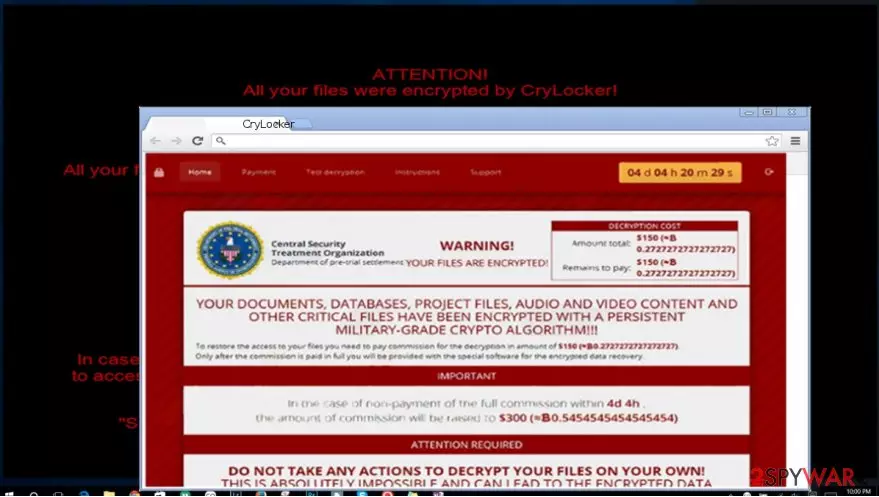
CryLocker malware tends to encrypt a large number of different image, document, audio, and video files. Thus, the hackers try to inflict as much damage as possible. Consequently, you might spot that the virus appends a .cry extension to all affected files. In addition, the virus does not lag behind the previously rampaged viruses since CryLocker ransomware tends to delete Shadow Volume Copies with the help of vssadmin delete shadows /all /quiet command. It means that fewer chances remain to unlock the files. Lastly, the virus presents its demands in Recovery_[random_characters].html and !Recovery_[random_characters].txt files. The malware demands 1.1 BTC which is equal to 625 USD.
How does the malware infect systems?
This virus is distributed via spam emails. This transmission model has been popular since users still are not careful opening emails received from unknown senders. Nevertheless, the awareness of ransomware threats has risen. That is why the hackers try to deceive users by forging fake tax refund or package delivery emails. If you happen to get the email from FBI or tax institution, do not panic but inquire the company directly to clear out any misunderstandings. In addition, improve the cyber security of your device by updating existing software and installing the anti-spyware application, such as [1], to minimize the risk of CryLocker hijack.
The ransomware removal guidelines
The best way to remove CryLocker virus is to run the security programs, e.g. FortectIntego or MalwarebytesMalwarebytes. These applications will deal with the malware within a couple of minutes. When the elimination process is finished, think about the ways to recover the files. Regarding this issue, we present some recommendations at the bottom of this page. They might help to retrieve at least a portion of important files. Lastly, if you cannot complete CryLocker removal because of the malfunctioning operating system, feel free to use our access recovery guidelines.
Did this guide help?
4 comments
Ronald
Finally, some serious ransomware...
paulBet
Have several anti-virus programs. I hope they will work.
cheryl78
The hackers are getting better and better...
Ashley
I wonder where exactly they are keeping the data in those websites...