

SamSam a dangerous ransomware virus that is using brute-force attacks for propagation
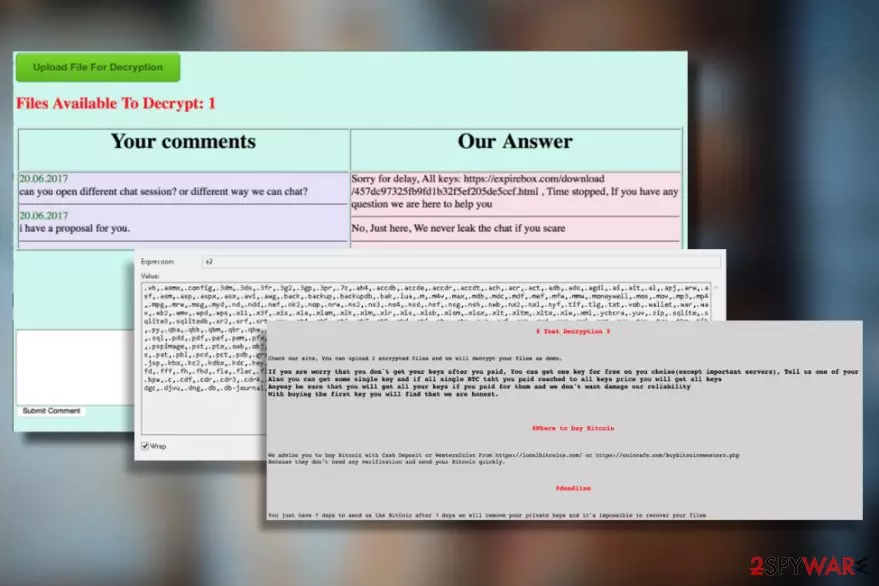
SamSam ransomware is a cryptovirus that was first spotted making rounds in March 2016. Despite being a relatively old infection, it is still prevalent in the US and some Asian countries. Fortunately, its developers, Faramarz Shahi Savandi and Mohammad Mehdi Shah, have already been found guilty.[1] Initially, malware used JBoss software vulnerability to install the payload remotely. In 2018, researchers observed hackers conducting brute-force attacks via FTP, RDP or Java-based servers. SamSam ransomware is huge, with total earnings of 6 million dollars during its time of operation over two and a half years.[2] It concurred such institutions like Labcorb or city of Atlanta, resulting in millions in damages. The malware is used exclusively for money extortion purposes – it uses RSA-2048 to lock up personal files and adds an appendix (such as .weapologize, .AreYouLoveMyRansFile, .breeding123, .country82000, etc.), making them inaccessible. To decipher them, victims have to pay a ransom in Bitcoin which can range up to $51,000.
| Summary of the cyber threat | |
|---|---|
| Name | SamSam |
| Type | Ransomware |
| Danger level | High. Makes system changes and encrypts files |
| Release date | June 2016 |
| Cryptography | RSA-2048 |
| Appended extensions |
|
| Ransom notes |
|
| Ransom | Varies. Some versions ask to pay 0.7 Bitcoins for one computer; others demand 45 BTC for the whole network. |
| To uninstall SamSam ransomware, install FortectIntego and run a full system scan | |
SamSam virus is identified by major security programs as Trojan.Ransom.SamSam, MSIL/Filecoder_Samas.B!tr, Backdoor.Ratenjay.Gen!c, Msil.Trojan.Dothetuk.Tccf, etc.[3] However, the virus is designed to bypass the computer's security, so it's not enough to install reputable security software to avoid the attack. Samsam.exe executable is dropped on the system when a victim opens a malicious email attachment.
Initially, SamSam ransomware is known to rely on fake email messages pretending to be notifications from UPS or similar delivery company. However, researchers noted malware shifted overtime and started using brute-force attacks to infect systems and its networks.
Once inside the system, ransomware encrypts files and provides a special email address (nullforwarding@qualityservice.com, etc.) to contact its developers. The data is typically encrypted with the RSA-2048 encryption algorithm, so there is no chance to guess the code needed for its decryption.
One of the examples of SamSam ransom notes:
#What happened to your files?
All your files encrypted with RSA-2048 encryption. For more information search in Google “RSA Encryption.”
#How to recover files?
RSA is a asymmetric cryptographic algorithm, You need one key for encryption and one key for decryption
So you need Private key to recover your files.
It’s not possible to recover your files without private key
#How to get private key?
You can get your private key in 3 easy step:
Step1: You must send us 1,7 Bitcoin for each affected PC or 29 BitCoins to receive ALL Private Keys for ALL affected PCs.
Step 2: After you send us 1,7 Bitcoin, Leave a comment on our Site with this detail: Just write your “host name” in your comment.
* Your host name is: XXXXXXXXXXXX
[…]
However, paying the ransom is not recommended. Crooks are known for not giving working decryption software and putting victims into more significant problems. Therefore, it is recommended to remove SamSam ransomware instead of taking shady cybercriminals' offers to recover files. In some cases, malware fails to delete Shadow Volume Copies, and data can be restored with third-party tools, but first, you need to get rid of the virus.

SamSam removal requires using anti-malware software. Use professional tools like FortectIntego or MalwarebytesMalwarebytes to clean the affected device. However, if you cannot download or run security software, you should reboot the affected machine to Safe Mode with Networking as we have explained at the end of this article.
SamSam ransomware – a large scale business
SamSam ransomware authors rely on a strange code of “honesty and fairness.” Quite often, hackers use “Sorry” in the titles of their ransom notes, and also offer free decryption of several personal files. It seems like bad actors try to make others believe that that they are nice and friendly people, which is complete nonsense.
Nevertheless, SamSam managed to reach incredible highs throughout its existence, crippling large hospitals, city municipalities, and other large-scale organizations.
SamSam ransomware was detected after it infected several hospitals in the United States[4] in 2016. MedStar hospital was in the worst position after this ransomware attack because it was required to pay 45 Bitcoins or $18,500 in exchange for the encrypted data. Fortunately, IT specialists in this hospital managed to remove SamSam virus and find backups of encoded data and used them to recover affected files. Hence, cybercriminals did not receive the money.
Therefore, the main targets of the malware are organizations and businesses. FBI has officially warned the corporations and companies to increase their cybersecurity.[5] According to the latest information, malware relies on the targeted attacks and does not seem to infect random computers. The functionality of the virus requires attackers participation – he or she has to enter a specific password to begin the attack.[6]

Atlanta City attack – a devastating hit that cost $2.6 million
Atlanta suffered SamSam ransomware intrusion in March 2018, when the citizens of the city were unable to process certain actions:[7]
The City of Atlanta is currently experiencing outages on various customer facing applications, including some that customers may use to pay bills or access court-related information. We will post any updates as we receive them.
The infection affected five city departments out of 13, and employees were forced to connect personal computers in order to perform operations and deal with sensitive data. Additionally, some police records were lost in the attack.
The officials were given two choices: either pay $6,000 per infected machine or a whopping $51,000 to recover operation of all networks at once. While it is unknown if any of the demanded money was paid, the attackers quickly closed down the payment portal and left the city in havoc.
Atlanta ended up spending over $2.6 million for the damages caused by SamSam ransomware.

LabCorp: SamSam ransomware hits one of the largest medical testing companies in US
LabCorp, one of the most prominent medical diagnostics company, has recently reported about a suspicious activity on their network on July 14.[8] At that time, IT specialists couldn't identify the cause of it. Although, now the official report from the LabCorp confirms about a ransomware attack, SamSam in particular.
Luckily, security experts have managed to shut down affected parts of the system in 50 minutes and prevent further damage. Currently, the recovery process has started and the company already operates at 90-percent capacity. However, some clients may not be able to access test results as a result of SamSam ransomware attack.
According to the analysis, SamSam virus was infiltrated on the company's network via Brute Force against Remote Desktop Protocol (RDP). Thanks to quick response by cybersecurity specialists, none of the customers' information was stolen. Although, the ransomware managed to encrypt the following parts of the network:
- 7,000 systems;
- 1,900 servers;
- 350 production servers.
Sophisticated infections are distributed in multiple ways
The key difference of this file-encrypting from other ransomware-type infections is that it uses targeted attacks. In other terms, it does not aim to infect the computers of regular users rather than target large-scale organizations. Thus, the developers of the virus create unique spam emails to infiltrate the networks of well-known firms.
This threat has been distributed using other methods too. The most shocking discovery is that this virus has been relying on vulnerability found in JBoss application. Alternatively known as WildFly,[9] it helped the virus infect the entire network and invade several computers at the same time.

When spreading with the help of this method, the virus uses a special tool called JexBossooks to look for JBoss vulnerabilities. Once the vulnerabilities are detected, it drops Trojan:BAT/Samas.B [10] and Trojan:BAT/Samas.C.[11] to steal personal credentials. After obtaining such data, the hackers launch their ransomware as a psexec.exe file and initiate the attack of the ransomware.
Therefore, to avoid ransomware attack, you have to:
- Be careful with received emails and do not rush opening any attached files;
- Install all software and OS updates to avoid exploitation of vulnerabilities;
- Download updates and security patches from the official websites.
Perform the following steps to remove SamSam ransomware from your device
It is evident that the attackers try their best to create an infection which is persistent. Therefore, SamSam ransomware removal process is not an easy task. Although, professional security tools can significantly help with the elimination of this cyber threat.
We suggest eliminating the virus with one of these programs FortectIntego, SpyHunterCombo Cleaner or MalwarebytesMalwarebytes. Security programs cannot only delete all ransomware-related files but keep your computer protected from cyber threats in the future.
For it to maintain its functionalities flawlessly, you need to update the software daily. If you cannot remove SamSam virus because of the inability to launch the security program or access other important OS programs, take a look at the recovery guidelines below.
You should also create a safe environment on your computer before initiating Samsam removal. To help you protect your registry entries and similar components, we prepared a video guide to show you how it is done:
Did this guide help?
5 comments
BruceAl
yeah..hospitals are the right companies to hijack. The hackers could aim at the black market instead.
Roger48
They are becoming too powerful.
Sammy
So do anti-virus programs work?
Liz
Smart move. Now they are shifting to networks...
Billy.Joel
My friend got this virus packed in spam.