

How does Search.arcahol.com virus affect the computer?
If you are a Mac user, you shouldn’t think that your Mac device cannot be affected by potentially unwanted programs (PUPs) or viruses. In fact, Search.arcahol.com browser hijacker namely targets Mac users only. As the name of this hijacker suggests, it has something to do with the indicated URL. In fact, this program sets this URL as default homepage as well as default new tab page address. This site looks entirely malware-free and secure to use, and even if it is not malicious itself, we do not recommend you to search via the search engine that this site provides. It appears that this search engine has been developed with a plan to implement pay-per-click advertising scheme and advertise websites that belong to third-party companies. This search engine functions just like Search.polebeary.com, which was created for the same purpose.
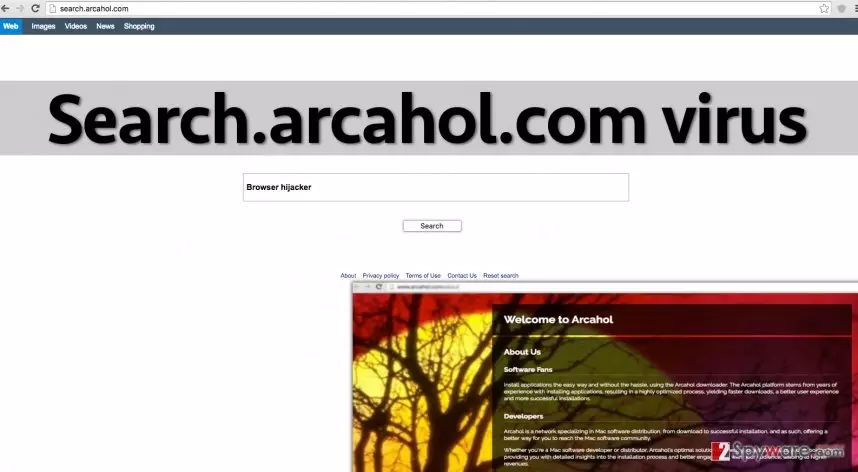
The above-mentioned search engine delivers results that are slightly altered. Not all of the search results are genuine and contain links to corresponding websites. If you clicked on a forged result, you would experience a redirect to a random third-party site. Search.arcahol.com redirects users to various websites in order to promote them and make them more popular, but unfortunately, not all of these sites can be trusted. Some of them might promote vague applications or infected software updates, or try to coax personal information from you. Needless to say, you should stay away from such sites. To sum up, this browser hijacker cannot enhance your browsing experience, and it only worsens the performance of your computer and your Internet browser. It is clear that it was developed to be a tool that generates revenue, and it was obviously not designed to be useful for a regular computer user. Therefore, we advise you to remove Search.arcahol.com and rely on a different search tool instead. You can run a system scan using FortectIntego and delete components of this hijacker automatically, however, we have also prepared a manual removal guide for you as well.
How does this program spread?
It is very doubtful that computer users would like to find and install such potentially unwanted programs by their choice, and no wonder why it is nearly impossible to find their download links online. Developers of such potentially unwanted programs utilize installers of other free programs to promote their products. They bundle several programs together and create software packages, which are widely known as software bundles. Such package looks like a single program, and only its setup wizard can tell you that a few additional applications will be installed along with the main program. However, you still need to know where to look for this information. We advise you to select Custom or Advanced settings in order to see what additional programs are added to the primary program and if you see some, deselect the permissions to install them. It is not recommended to install software with Default/Standard/Basic settings (which are typically auto-selected for you), as they do not provide the possibility to adjust components of a software pack.
How to solve Search.arcahol.com redirect issue?
If you do not want to experience redirects caused by Search.arcahol.com virus anymore, you have to uninstall the browser hijacker that initiates them. By uninstalling this program, you will also remove Search.arcahol.com from your browser and then you will be able to change its settings again. You can delete it from your Mac using the anti-malware program, but you can also remove it manually. You can find links to download reputable anti-malware solutions, and also Search.arcahol.com removal guide below.
Delete from macOS
Remove the unwanted application:
- From the menu bar, select Go > Applications.
- In the Applications folder, look for any suspicious entries, then drag them to Trash (or right-click and pick Move to Trash).


Delete leftover files and folders:
- Select Go > Go to Folder.
- Enter /Library/Application Support and remove any suspicious folders related to the unwanted program.
- Repeat the same check in the /Library/LaunchAgents and /Library/LaunchDaemons folders, deleting any suspicious entries.

- Finally, empty the Trash to permanently remove the leftovers.

Reset Internet Explorer
Remove dangerous add-ons:
- Open Internet Explorer, click on the Gear icon (IE menu) on the top-right corner of the browser
- Pick Manage Add-ons.
- You will see a Manage Add-ons window. Here, look for suspicious plugins. Click on these entries and select Disable.


Change your homepage if it was altered:
- Open IE and click on the Gear icon.
- Select Internet Options.
- In the General tab, delete the Home page address and replace it by your preferred one (for example, Google.com).
- Click Apply and then select OK.


Delete temporary files:
- Press on the Gear icon and select Internet Options.
- Under Browsing history, click Delete...
- Select relevant fields and press Delete.


Reset Internet Explorer:
- Click on Gear icon > Internet options and select Advanced tab.
- Select Reset.
- In the new window, check Delete personal settings and select Reset.


Remove from Mozilla Firefox (FF)
Remove dangerous extensions:
- Open Mozilla Firefox browser and click on the Menu (three horizontal lines at the top-right of the window).
- Select Add-ons.
- In here, select the unwanted extension and click Remove.


Reset the homepage:
- Click three horizontal lines at the top right corner to open the menu.
- Choose Settings.
- Under Home, set your preferred homepage and new tab settings.
Clear cookies and site data:
- Click Menu and pick Settings.
- Go to Privacy & Security section.
- Scroll down to locate Cookies and Site Data.
- Click on Clear Data...
- Select Cookies and Site Data and Temporary cached files and pages, then click Clear.


Reset Mozilla Firefox
If clearing the browser as explained above did not help, reset Mozilla Firefox:
- Open Mozilla Firefox browser and click the Menu.
- Go to Help and then choose Troubleshooting Information.

- Under Give Firefox a tune up section, click on Refresh Firefox...
- Once the pop-up shows up, confirm the action by pressing on Refresh Firefox.



Remove from Google Chrome
Delete malicious extensions from Google Chrome:
- Open Google Chrome, click on the Menu (three vertical dots at the top-right corner) and select More tools > Extensions.
- In the newly opened window, you will see all the installed extensions. Uninstall all suspicious extensions related to the unwanted program by clicking Remove.


Clear cache and web data from Chrome:
- Click on Menu and pick Settings.
- Under Privacy and security, select Clear browsing data.
- Select Browsing history, Cookies and other site data, as well as Cached images and files.
- Click Clear data.


Change your homepage:
- Click menu and choose Settings.
- Look for a suspicious site in the On startup section.
- Click on Open a specific or set of pages and click on three dots to find the Remove option.
Reset Google Chrome:
If the previous methods did not help you, reset Google Chrome to eliminate all the unwanted components:
- Click on Menu and select Settings.
- In the Settings, scroll down and click Advanced.
- Scroll down and locate Reset and clean up section.
- Now click Restore settings to their original defaults.
- Confirm with Reset settings.


Delete from Safari
Remove dangerous extensions:
- Open Safari, click Safari in the menu at the top-left of the screen, and select Preferences.
- Go to the Extensions tab, look for any suspicious entries, and click Uninstall to remove them.


Clear history and website data:
- Click Safari in the menu and pick Clear History.
- Set Clear to all history and confirm with Clear History.


Reset Safari:
- Click Safari in the menu and select Preferences > Advanced.
- Enable Show Develop menu in menu bar.
- From the menu bar, click Develop and select Empty Caches.


Was this guide helpful?
4 comments