

The questionable features of the Search.gomaps.co search engine:
Most of us are excited about the Rio Olympic Games, but there are also some nasty computer threats like Search.gomaps.co virus that are willing to profit from it. If you are a major sports fan, upgrading your browser to something more thematic might seem like a good idea. And GoMaps offers you just that. The site features a nice, sports-related interface and promises a reliable search service as well. Unfortunately, it turns out that this search engine is nothing more than a browser hijackers virus. Instead of providing the expected service, this clingy, ad-based infection can sure ruin your Olympic spirit by injecting numerous pop-ups, banners, sponsored links and other sorts of ads into your browser soon after being installed on the PC. More worrying is the fact that you do not necessarily have to be involved in the whole Olympic craze, and this site may still appear instead of your default search engine or homepage. The main reason for such stealthy hijack is deceptive marketing, but we will elaborate on this issue later in the article. As for now, you are probably wondering if the Search.gomaps.co removal is possible and what is the easiest way to do it. The virus can sure be banished from your PC and reputable anti-malware equipment, such as FortectIntego can help you do that.
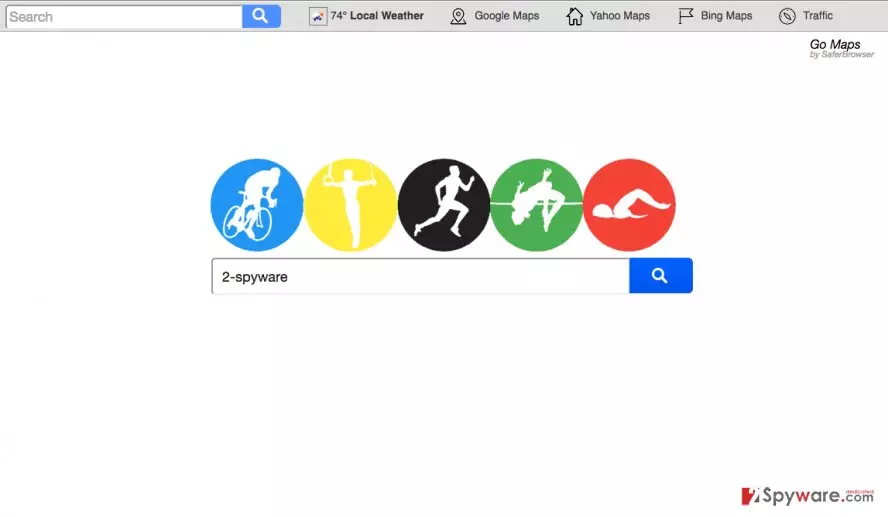
When talking about Search.gomaps.co hijack it is necessary to note that it might be triggered by the “Go Maps” browser extension. It appears that extension belongs to the SaferBrowser which is another shady browser hijacker program that any reputable search engine should not have any business with. But the creators of this hijacker are least worried about their reputation because their main interest is advertising revenue. They install this bogus search engine in order to generate sponsored links and ads, redirect users to third-party websites, increase their traffic and get paid. Search.gomaps.co redirect issue is also accompanied by crashing and freezing browser as well as overall worsening of the system performance. As you can see, the major problem here lies not in the virus itself, but in the way it causes your computer to behave. To regain the full control of your computer, get ready to remove Search.gomaps.co from the system.
How hijackers infiltrate the computer and can this stealthy hijack be avoided?
As already pointed out previously, there are more than one way that creators of the indicated hijacker may use to sneak this unwanted program on your computer. It can suddenly appear on your browser after installing the “Go Maps” browser extension, or you can download it together with some completely legitimate freeware or shareware applications. There is a specific term for this deceptive marketing strategy – “bundling”. It is especially popular in the distribution of potentially unwanted programs because it is an effortless way shady software can reach thousands of computers. All it takes is to pin Search.gomaps.co redirect virus to any of the popular programs and wait for the careless users to download and install it. Fortunately, you can put an end to this stealthy installation by choosing “Advanced” or “Custom” modes to carry out the software’s setup and terminating all the undesirable programs.
Can Search.gomaps.co removal wait?
If you have already noticed the Search.gomaps.co virus on your computer, it is better that you continue to its removal without delay. There is no reason to keep this bogus search site on your browser. If you are unsure about how to approach this virus, we offer two options: manual and the automatic one. The quickest way to get your old search engine back is by employing a professional antivirus scanner. After the automatic Search.gomaps.co removal you will be able to change your browser’s settings back and choose what search engine or homepage you want to use yourself. For a more detailed elimination process, you can go for the manual virus elimination. Remove Search.gomaps.co following the guidelines provided below.
Uninstall from Windows
Uninstall from Windows 10/8:
- Type Control Panel into the Windows search box and open the result.
- Under Programs, select Uninstall a program.


Uninstall from Windows 7/XP:
- Click on Windows Start > Control Panel (Windows XP users should click on Add/Remove Programs).
- In Control Panel, select Programs > Uninstall a program.


Remove the unwanted program:
- In the Programs and Features window, look for any recently installed suspicious entries, select them, and click Uninstall.
- If User Account Control appears, click Yes to confirm, then complete the removal.


Delete from macOS
Remove the unwanted application:
- From the menu bar, select Go > Applications.
- In the Applications folder, look for any suspicious entries, then drag them to Trash (or right-click and pick Move to Trash).


Delete leftover files and folders:
- Select Go > Go to Folder.
- Enter /Library/Application Support and remove any suspicious folders related to the unwanted program.
- Repeat the same check in the /Library/LaunchAgents and /Library/LaunchDaemons folders, deleting any suspicious entries.

- Finally, empty the Trash to permanently remove the leftovers.

Remove from Microsoft Edge
Delete unwanted extensions from MS Edge:
- Select Menu (three horizontal dots at the top-right of the browser window) and pick Extensions.
- From the list, pick the extension and click on the Gear icon.
- Click Remove.


Clear cookies and other browser data:
- Click on the Menu (three horizontal dots at the top-right of the browser window) and select Settings > Privacy, search, and services..
- Under Clear browsing data, pick Choose what to clear.
- Select Cookies and other site data and Cached images and files. (apart from passwords, although you might want to include Media licenses as well, if applicable) and click on Clear.


Restore new tab and homepage settings:
- Click the menu icon and choose Settings.
- Then find On startup section.
- Click Remove next to any suspicious startup page.
Reset MS Edge if the above steps did not work:
- Press on Ctrl + Shift + Esc to open Task Manager.
- Click on More details arrow at the bottom of the window.
- Select Details tab.
- Now scroll down and locate every entry with Microsoft Edge name in it. Right-click on each of them and select End Task to stop MS Edge from running.


Instructions for Chromium-based Edge
Delete extensions from MS Edge (Chromium):
- Open Edge and click select Settings > Extensions.
- Delete unwanted extensions by clicking Remove.


Clear cache and site data:
- Click on Menu and go to Settings.
- Select Privacy, search and services.
- Under Clear browsing data, pick Choose what to clear.
- Under Time range, pick All time.
- Select Clear now.


Reset Chromium-based MS Edge:
- Click on Menu and select Settings.
- On the left side, pick Reset settings.
- Select Restore settings to their default values.
- Confirm with Reset.
- This will disable extensions and reset startup pages but will not delete bookmarks, saved passwords, or browsing history.


Remove from Mozilla Firefox (FF)
Remove dangerous extensions:
- Open Mozilla Firefox browser and click on the Menu (three horizontal lines at the top-right of the window).
- Select Add-ons.
- In here, select the unwanted extension and click Remove.


Reset the homepage:
- Click three horizontal lines at the top right corner to open the menu.
- Choose Settings.
- Under Home, set your preferred homepage and new tab settings.
Clear cookies and site data:
- Click Menu and pick Settings.
- Go to Privacy & Security section.
- Scroll down to locate Cookies and Site Data.
- Click on Clear Data...
- Select Cookies and Site Data and Temporary cached files and pages, then click Clear.


Reset Mozilla Firefox
If clearing the browser as explained above did not help, reset Mozilla Firefox:
- Open Mozilla Firefox browser and click the Menu.
- Go to Help and then choose Troubleshooting Information.

- Under Give Firefox a tune up section, click on Refresh Firefox...
- Once the pop-up shows up, confirm the action by pressing on Refresh Firefox.



Remove from Google Chrome
Delete malicious extensions from Google Chrome:
- Open Google Chrome, click on the Menu (three vertical dots at the top-right corner) and select More tools > Extensions.
- In the newly opened window, you will see all the installed extensions. Uninstall all suspicious extensions related to the unwanted program by clicking Remove.


Clear cache and web data from Chrome:
- Click on Menu and pick Settings.
- Under Privacy and security, select Clear browsing data.
- Select Browsing history, Cookies and other site data, as well as Cached images and files.
- Click Clear data.


Change your homepage:
- Click menu and choose Settings.
- Look for a suspicious site in the On startup section.
- Click on Open a specific or set of pages and click on three dots to find the Remove option.
Reset Google Chrome:
If the previous methods did not help you, reset Google Chrome to eliminate all the unwanted components:
- Click on Menu and select Settings.
- In the Settings, scroll down and click Advanced.
- Scroll down and locate Reset and clean up section.
- Now click Restore settings to their original defaults.
- Confirm with Reset settings.


Delete from Safari
Remove dangerous extensions:
- Open Safari, click Safari in the menu at the top-left of the screen, and select Preferences.
- Go to the Extensions tab, look for any suspicious entries, and click Uninstall to remove them.


Clear history and website data:
- Click Safari in the menu and pick Clear History.
- Set Clear to all history and confirm with Clear History.


Reset Safari:
- Click Safari in the menu and select Preferences > Advanced.
- Enable Show Develop menu in menu bar.
- From the menu bar, click Develop and select Empty Caches.


Was this guide helpful?
Be the first to comment