

Yontoo Layers Client – adware that modifies DNS servers to take control of your visited online sources
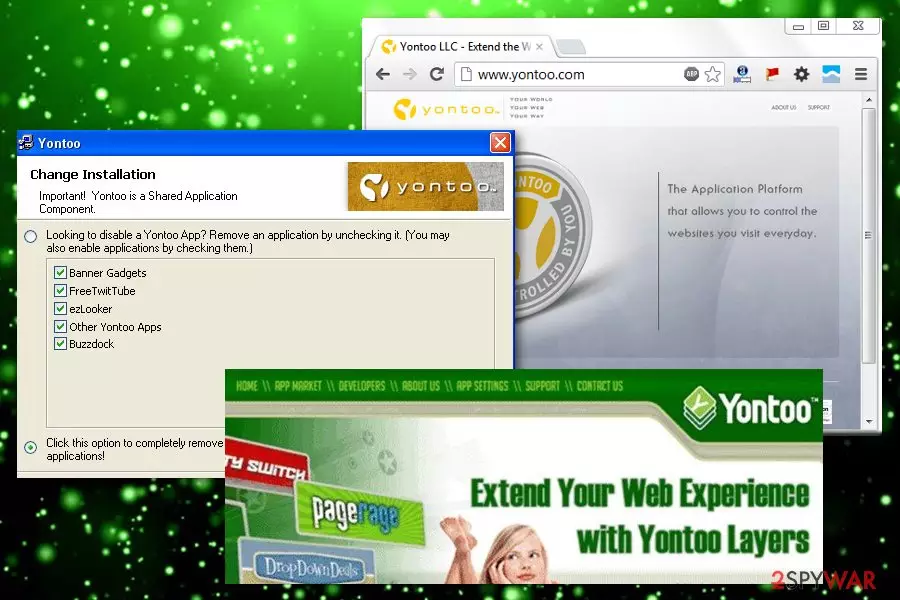
Yontoo Layers Client is a questionable browser add-on from Yontoo Technology, Inc., which can be used for creating a specific look for webpages. One of the most interesting parts of this adware program is that it changes the computer's default DNS server to its own in order to be able to manage the websites that the users are visiting and include its own ad server. A big variety of users appears to be encountering trouble while trying to get rid of Yontoo Layers Client virus activity permanently because they do not disable the created DNS server and the program keeps spamming with adverts. Advertising is known to be the most popular income source for adware developers as they often support the pay-per-click marketing strategy.
When the adware enters the targeted computer system, it can drop its own created files in the C:\Program Files\ or C:\ProgramData section if it is operating on a Windows computer. If it is a Mac that has been affected, you can encounter doubles files and apps in the Applications section. Beware that Yontoo Layers Client is very similar to other PUPs such as Yontoo and Yontoo Pagerage that have already been included in our website some time ago. Even though this PUp can appear on any type of web browser app, you are likely to see the YontooIEClient.dll file on the computer if you are employing the Internet Explorer app as your main browsing tool.
| Name | Yontoo Layers Client |
|---|---|
| Type | Adware/potentially unwanted program |
| Developer | Yontoo Technology, Inc. |
| Similar to | Yontoo, Yontoo Pagerage |
| Features | This adware application compromises the DNS servers and replaces them to the ones that are employed by the developers, can initiate major web browser changes on the homepage and new tab URL sections, display advertising content, reroute the user to affiliate sources, collect non-personal information related to the user's browsing habits and online experience |
| Main file | When the adware program enters the computer system, it drops the YontooIEClient.dll file if it has appeared on the Internet Explorer web browser |
| Location | You can find suspicious files and folders included in the C:\Program Files\ or C:\ProgramData locations on your Windows computer system |
| Targeted apps | You can find signs of the adware on web browsers such as Google Chrome, Mozilla Firefox, Internet Explorer, Microsoft Edge, and Internet Explorer |
| Spreading | If you have been infected with the adware app, there is a big chance that it has come from bundled software packages that you have downloaded from secondary sources |
| Removal | To get rid of the adware application that has invaded your computer and web browser, you should perform an automatic or manual removal process. For step-by-step guidelines, check the end of this article |
| Fix tip | If you have discovered some system compromisation on your PC and have been looking for a tool that could help you to fix it, try downloading and employing FortectIntego |
As soon as Yontoo Layers Client enters the computer, it may easily alter the homepage, new tab URL, and some other settings. You are also likely to see your web browser filled with unknown components such as extensions,[1] plug-ins, and add-ons. These types of objects help the adware to fulfill its functionality.
After doing so, you may need to deal with Yontoo Layers Client redirects to unknown websites that are sponsored by the program's developer. There you might meet some questionable deals and offers. However, the worst part about these reroutes is that you can be transferred to a potentially malicious location that includes dangerous parasites such as ransomware or Trojan viruses.

However, the most intense activity that is completed by Yontoo Layers Client is advertising. The adware loads a big variety of advertisements while the user is completing online sessions with the infected web browser app. Users often get spammed by various bogus offers, deals, coupons, surveys, and scams. The best thing to do is have nothing income with the ads, i.e. provide no information about yourself or your computer.
According to a user who has been having trouble with Yontoo Layers Client on the Internet Explorer web browser, he kept receiving the following message during the activity period of the browser app:
This website wants to run to the following add-on “Yontoo Layers Client for Internet Explorer” from “Yontoo Technology, Inc., (unverified publisher).
Nevertheless, if ads from Yontoo Layers Client keep approaching you frequently, you might find the infected web browser struggling to maintain browsing sessions and even load properly. This can happen because the advertising activity has gotten so intense that your computer's processor can hardly deal with all of the sessions at once.
Besides, Yontoo Layers Client may start tracking you and may collect various data about your browsing habits. For example, it may record your search terms, mostly visited websites, data that you leave when visiting each of these sites and information about your computer, like its IP address, location, your email address, etc.
If you, just like us, think that such information shouldn't be revealed for unknown parties, you should remove Yontoo Layers Client from your computer. Be sure that it will hide in your machine as an optional browser add-on, which is compatible with each of the web browsers and has scattered various unknown files in various locations of your PC.
Yontoo Layers Client removal includes downloading and installing an antimalware program that has been tested by security experts. Also, you can try using the manual step-by-step guidelines that have been added at the end of this article. If your computer has experienced any compromisation as adware can let other bogus or even malicious apps plant themselves on the affected PC, you can try diminishing the damage with FortectIntego

The infiltration process of adware programs
Cybersecurity specialists from LesVirus.fr[2] claim that adware programs are often distributed through a deceptive technique called “software bundling”.[3] Developers who spread such apps are interested in targetting a bigger number of users and this can be done only by infiltrating the application via stealth technique (bundling).
Users who have selected the Quick or Recommended technique over the Custom or Advanced one are highly recommended to change the configuration immediately, otherwise, they might not notice how suspicious applications sneak into their computer systems. By opting for the Advanced mode you will give yourself the ability to track all incoming downloads and deselect all of the unwanted ones.
Furthermore, adware applications are often delivered via secondary downloading sources such as cnet.com, download.com, soft32.com, softonic.com and come together with various download managers, video players, and PDF converters. You should avoid receiving your software from such websites as you are at a high risk of getting an additional product (adware) during the installation, especially if you are likely to skip some downloading/installing steps.
To continue, potentially unwanted programs can be settled on a particular computer system through infectious advertisements and hyperlinks that users meet while browsing the web. You should prevent yourself from visiting websites that have been marked as deceptive by your web browser or antimalware software. This way you will have a chance to avoid landing on unknown places that are filled with unknown content.
Eliminate Yontoo Layers Client virus from your PC
To remove Yontoo Layers Client from your Windows or Mac computer system, you should employ automatical security software that is tested as trustworthy by various security experts. These types of tools will make the entire elimination process safer and more effective for a big variety of less-advanced users.
However, if you believe in your skills, you can try completing Yontoo Layers Client removal with the help of the manual step-by-step guidelines that have been added to the end of this article. There you will learn how to perform OS and browser cleaning at once.
Note that it is important to uninstall Yontoo Layers Client virus not only from your computer system but also from surfing apps such as Google Chrome, Mozilla Firefox, Internet Explorer, Microsoft Edge, and Safari. The adware might have left questionable browser extensions and plug-ins in your browsers.
Uninstall from Windows
Uninstall from Windows 10/8:
- Type Control Panel into the Windows search box and open the result.
- Under Programs, select Uninstall a program.


Uninstall from Windows 7/XP:
- Click on Windows Start > Control Panel (Windows XP users should click on Add/Remove Programs).
- In Control Panel, select Programs > Uninstall a program.


Remove the unwanted program:
- In the Programs and Features window, look for any recently installed suspicious entries, select them, and click Uninstall.
- If User Account Control appears, click Yes to confirm, then complete the removal.


Delete from macOS
Remove the unwanted application:
- From the menu bar, select Go > Applications.
- In the Applications folder, look for any suspicious entries, then drag them to Trash (or right-click and pick Move to Trash).


Delete leftover files and folders:
- Select Go > Go to Folder.
- Enter /Library/Application Support and remove any suspicious folders related to the unwanted program.
- Repeat the same check in the /Library/LaunchAgents and /Library/LaunchDaemons folders, deleting any suspicious entries.

- Finally, empty the Trash to permanently remove the leftovers.

Reset Internet Explorer
Remove dangerous add-ons:
- Open Internet Explorer, click on the Gear icon (IE menu) on the top-right corner of the browser
- Pick Manage Add-ons.
- You will see a Manage Add-ons window. Here, look for suspicious plugins. Click on these entries and select Disable.


Change your homepage if it was altered:
- Open IE and click on the Gear icon.
- Select Internet Options.
- In the General tab, delete the Home page address and replace it by your preferred one (for example, Google.com).
- Click Apply and then select OK.


Delete temporary files:
- Press on the Gear icon and select Internet Options.
- Under Browsing history, click Delete...
- Select relevant fields and press Delete.


Reset Internet Explorer:
- Click on Gear icon > Internet options and select Advanced tab.
- Select Reset.
- In the new window, check Delete personal settings and select Reset.


Remove from Microsoft Edge
Delete unwanted extensions from MS Edge:
- Select Menu (three horizontal dots at the top-right of the browser window) and pick Extensions.
- From the list, pick the extension and click on the Gear icon.
- Click Remove.


Clear cookies and other browser data:
- Click on the Menu (three horizontal dots at the top-right of the browser window) and select Settings > Privacy, search, and services..
- Under Clear browsing data, pick Choose what to clear.
- Select Cookies and other site data and Cached images and files. (apart from passwords, although you might want to include Media licenses as well, if applicable) and click on Clear.


Restore new tab and homepage settings:
- Click the menu icon and choose Settings.
- Then find On startup section.
- Click Remove next to any suspicious startup page.
Reset MS Edge if the above steps did not work:
- Press on Ctrl + Shift + Esc to open Task Manager.
- Click on More details arrow at the bottom of the window.
- Select Details tab.
- Now scroll down and locate every entry with Microsoft Edge name in it. Right-click on each of them and select End Task to stop MS Edge from running.


Instructions for Chromium-based Edge
Delete extensions from MS Edge (Chromium):
- Open Edge and click select Settings > Extensions.
- Delete unwanted extensions by clicking Remove.


Clear cache and site data:
- Click on Menu and go to Settings.
- Select Privacy, search and services.
- Under Clear browsing data, pick Choose what to clear.
- Under Time range, pick All time.
- Select Clear now.


Reset Chromium-based MS Edge:
- Click on Menu and select Settings.
- On the left side, pick Reset settings.
- Select Restore settings to their default values.
- Confirm with Reset.
- This will disable extensions and reset startup pages but will not delete bookmarks, saved passwords, or browsing history.


Remove from Mozilla Firefox (FF)
Remove dangerous extensions:
- Open Mozilla Firefox browser and click on the Menu (three horizontal lines at the top-right of the window).
- Select Add-ons.
- In here, select the unwanted extension and click Remove.


Reset the homepage:
- Click three horizontal lines at the top right corner to open the menu.
- Choose Settings.
- Under Home, set your preferred homepage and new tab settings.
Clear cookies and site data:
- Click Menu and pick Settings.
- Go to Privacy & Security section.
- Scroll down to locate Cookies and Site Data.
- Click on Clear Data...
- Select Cookies and Site Data and Temporary cached files and pages, then click Clear.


Reset Mozilla Firefox
If clearing the browser as explained above did not help, reset Mozilla Firefox:
- Open Mozilla Firefox browser and click the Menu.
- Go to Help and then choose Troubleshooting Information.

- Under Give Firefox a tune up section, click on Refresh Firefox...
- Once the pop-up shows up, confirm the action by pressing on Refresh Firefox.



Remove from Google Chrome
Delete malicious extensions from Google Chrome:
- Open Google Chrome, click on the Menu (three vertical dots at the top-right corner) and select More tools > Extensions.
- In the newly opened window, you will see all the installed extensions. Uninstall all suspicious extensions related to the unwanted program by clicking Remove.


Clear cache and web data from Chrome:
- Click on Menu and pick Settings.
- Under Privacy and security, select Clear browsing data.
- Select Browsing history, Cookies and other site data, as well as Cached images and files.
- Click Clear data.


Change your homepage:
- Click menu and choose Settings.
- Look for a suspicious site in the On startup section.
- Click on Open a specific or set of pages and click on three dots to find the Remove option.
Reset Google Chrome:
If the previous methods did not help you, reset Google Chrome to eliminate all the unwanted components:
- Click on Menu and select Settings.
- In the Settings, scroll down and click Advanced.
- Scroll down and locate Reset and clean up section.
- Now click Restore settings to their original defaults.
- Confirm with Reset settings.


Delete from Safari
Remove dangerous extensions:
- Open Safari, click Safari in the menu at the top-left of the screen, and select Preferences.
- Go to the Extensions tab, look for any suspicious entries, and click Uninstall to remove them.


Clear history and website data:
- Click Safari in the menu and pick Clear History.
- Set Clear to all history and confirm with Clear History.


Reset Safari:
- Click Safari in the menu and select Preferences > Advanced.
- Enable Show Develop menu in menu bar.
- From the menu bar, click Develop and select Empty Caches.


Did this guide help?
Be the first to comment