

Secanalertsnow.shop is a scam website that attempts to make users download potentially suspicious applications

Secanalertsnow.shop is a scam website designed to deceive users by benefiting from affiliate links, where people end up becoming victims. Typically, users land on this site by accident after clicking on a malicious link found elsewhere, contributing to the success of the scam.
Scammers created Secanalertsnow.shop to mimic a security software provider's system scan results page, making it appear as though it belongs to McAfee. The fake results displayed on the page claim that the user's computer is infected with malware and needs immediate fixing.
If users follow the instructions on the page, they are redirected to download worthless (and possibly harmful) software. This benefits scammers through clicks and affiliate links. To be clear, everything promoted on this page is fake and should not be trusted – McAfee has no association with these phishing pages.
If you have encountered this scam, read the following information to learn more about it. We also explain how to remove adware from your computer if present and how to disable push notifications from Secanalertsnow.shop if they were enabled accidentally or otherwise.
| Name | Secanalertsnow.shop |
| Type | Scam, phishing, redirect |
| Scam content | The scam is based on scaring users into believing that their systems are infected and that they need to remove those infections with promoted software |
| Distribution | Redirects from other malicious websites, adware |
| Risks | Loss of finances due to fake subscriptions; redirects to other malware-laden, scam websites; installation of potentially unwanted or malicious software |
| Removal | Interacting with the scam content is dangerous, as scammers may promote fake versions of antivirus software. Instead, use reputable tools for your system safety |
| Other tips | Upon successful removal of adware and other potentially unwanted programs, it is recommended to clear your browser of cookies and other tracking elements. The FortectIntego tool can be instrumental in facilitating this cleansing process |
Often, scammers create fake messages online to make money from advertisements, software downloads, or subscriptions to unnecessary services. While running an affiliate program is legal, advertising the product in a deceptive and malicious manner is not, which is a critical detail.
Fake virus alerts, in particular, are designed to cause users distress, leading them to purchase software to supposedly fix the problem they are shown. This situation provides scammers with an opportunity to persuade people to spend money on software they don't actually need.
What does the scam page look like?
Fear is a powerful emotion, which is why many internet fraud campaigns target it. Users become alarmed when they see frightening messages claiming viruses have been found on their computers, especially if they don't fully understand malware and the infection process. Scammers often use the names of well-known companies like Google, Microsoft, or Norton to deceive users more effectively.
When users accidentally visit the Secanalertsnow.shop scam site, they are often surprised by what they see—a security scan that appears to show files being scanned and pop-ups triggered by detections of malicious entries. Just a few seconds later, they are presented with results that read (note that the website could host a variety of similar or slightly different messages):
IMMEDIATE ACTION REQUIRED!
Your McAfee subscription has expired!
Renew now to keep your PC protected.
Viruses found on this PC most likely track internet activity to collect banking details and login credentials. Unprotected PCs are 93% more vulnerable to suffer from malware.
Those who are unfamiliar with scams of this type might actually believe that reputable security vendors have found viruses on their systems and that immediate action is necessary. This is exactly what scammers are hoping for—users who are not familiar with these tactics.

As mentioned, none of the contents of this site are real, and the scan results are completely fabricated. These same tactics are used by numerous other phishing sites, such as Tylophes.xyz or Protecttoday.space. It is likely that they were created by the same individuals and are being spread all over the internet.
Checking the system for infections
More often than not, you might encounter a phishing website after visiting an already deceptive one. For example, sites related to torrents, peer-to-peer networks, and software crack distributors are more likely to have hidden booby-trapped links. Sometimes, an accidental click on these websites might lead to an unexpected redirect. Therefore, it's best to avoid such sites as much as possible.
Alternatively, your computer might already be infected with adware or other potentially unwanted or malicious programs. If that's the case, you are more likely to see numerous advertisements while browsing the web or experience redirects. Thus, if your system is infected, encountering a malicious ad or fake update becomes more likely.
We recommend using powerful security software, such as SpyHunterCombo Cleaner or MalwarebytesMalwarebytes, and performing a full system scan. The security tool will locate and remove malicious components on your system. Additionally, with FortectIntego, you can clean up leftover files such as cookies used for tracking, thereby improving your system's performance.
Stopping malicious push notifications
Even after users have carefully removed suspicious programs from their computers, intrusive alerts might not disappear. This happens because these notifications are tied directly to the browser's permissions, not the software installed on the system. As a result, even if the malicious software is gone, the push notifications can continue to disrupt the user's experience.
These persistent pop-ups can serve various malicious purposes, including phishing attempts and promoting additional scam websites. Fortunately, there is a way to stop these malicious push notifications. Instructions on how to do this can be found below.
Google Chrome
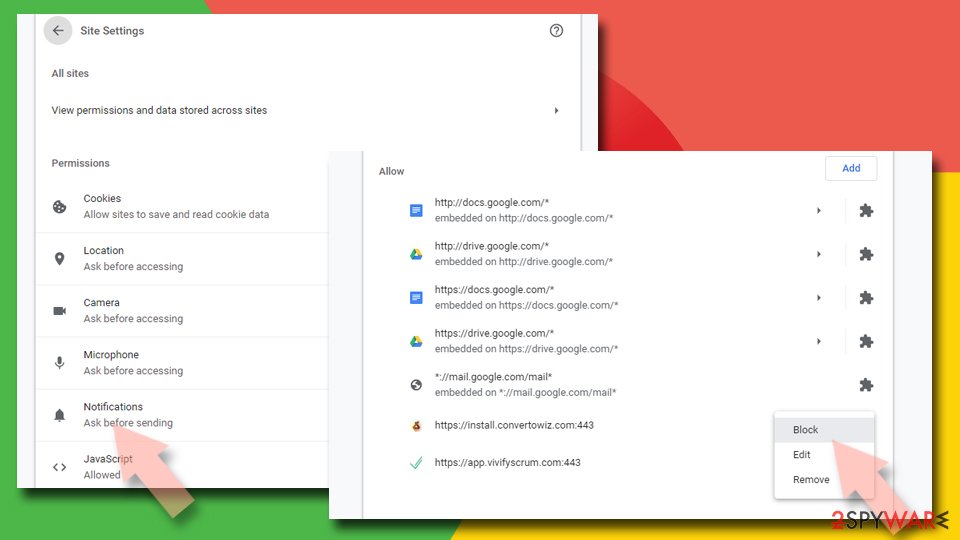
- Open the Google Chrome browser and go to Menu > Settings.
- Scroll down and click on Advanced.
- Locate the Privacy and security section and pick Site Settings > Notifications.
- Look at the Allow section and look for a suspicious URL.
- Click the three vertical dots next to it and pick Block. This should remove unwanted notifications from Google Chrome.

Mozilla Firefox
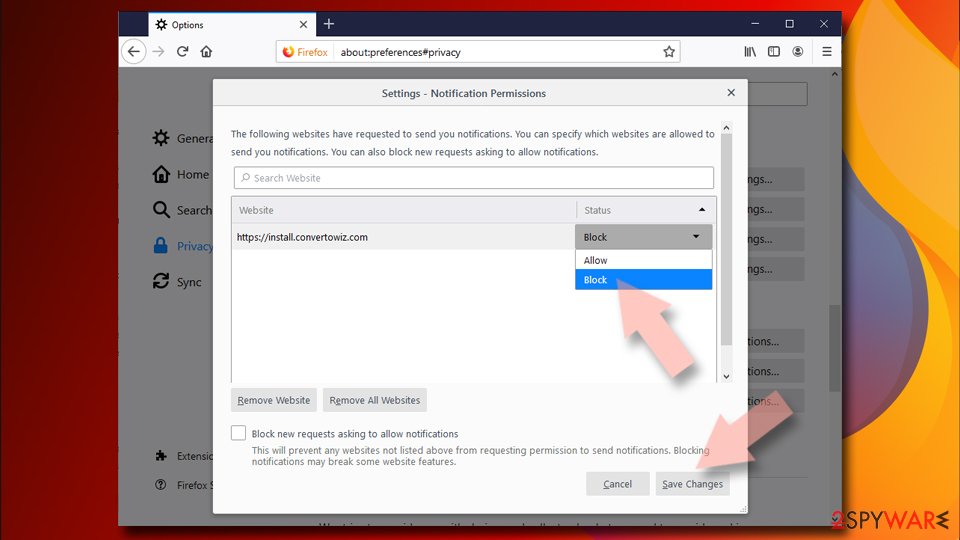
- Open Mozilla Firefox and go to Menu > Options.
- Click on Privacy & Security section.
- Under Permissions, you should be able to see Notifications. Click the Settings button next to it.
- In the Settings – Notification Permissions window, click on the URL's drop-down menu.
- Select Block and then click on Save Changes. This should remove unwanted notifications from Mozilla Firefox.

Safari
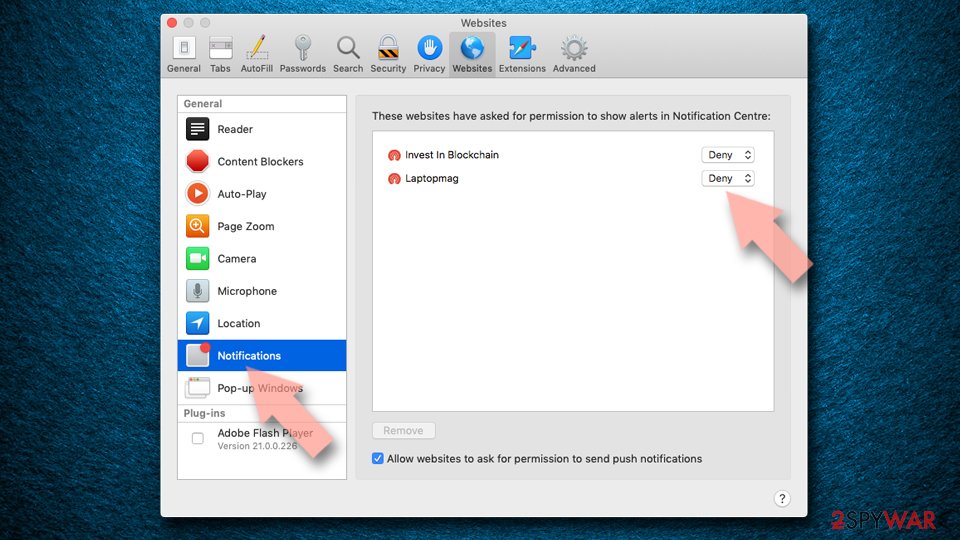
- Click on Safari > Preferences…
- Go to the Websites tab and, under General, select Notifications.
- Select the web address in question, click the drop-down menu and select Deny.

MS Edge (Chromium)
- Open Microsoft Edge, and go to Settings.
- Select Site permissions.
- Go to Notifications on the right.
- Under Allow, you will find the unwanted entry.
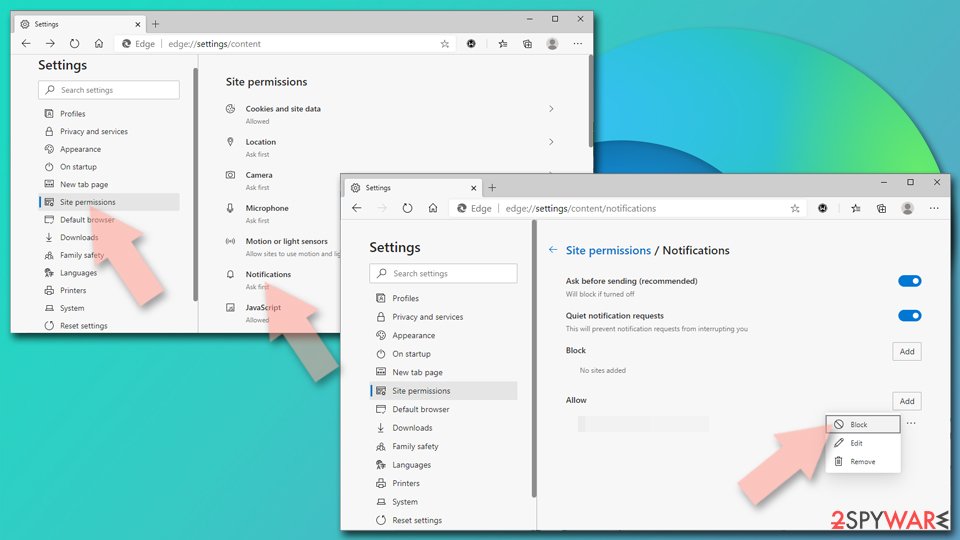
- Click on More actions and select Block.

Did this guide help?
Be the first to comment