

Unsealator.com – a fake website designed to mislead its visitors

Unsealator.com is a questionable website that wants to trick users into subscribing to push notifications. These can later clutter your device with spam, ads, and even undesirable content. The website typically uses fake alerts or misleading messages to trick the visitors into clicking the “Allow” button by setting up some sort of critical system warnings or offerings.
Once these notifications are accepted, users may then become overrun with frequent, unwanted pop-up messages even when their browsers are closed. These range from advertisements on doubtful products and services to malicious links pointing to websites housing malware or phishing. These frequent disturbances not only ruin the user experience but also pose serious threats toward system security.
Basically, the thing to note here is that Unsealator.com does not provide anything of value, except in ways that it abuses the browser notification permission. When this permission is granted, the pop-ups keep appearing even when you are nowhere near the website itself.
By default, if your browser is redirecting to Unsealator.com or you are getting notifications from this website, you should immediately revoke the permissions and begin taking the necessary steps to remove the adware or malware programs completely responsible for these alerts.
| Name | Unsealator.com |
| Type | Push notifications, ads, pop-ups, scam |
| Distribution | Intrusive pop-ups can start showing up at some point after the “Allow” button is pressed within the notification prompt |
| Symptoms | Pop-ups show up on a regular basis on the screen – these ads often include inappropriate, scam, phishing, or other similar content |
| Risks | If you click on links provided by the website, you might end up infecting your system with malware/PUPs, disclosing your personal information to cybercriminals, or losing money for useless services |
| Removal | You can stop unwanted notifications by accessing web browser settings. If you suspect adware infection, you should use SpyHunterCombo Cleaner security software to get rid of it |
| Other tips | Do not forget to clean your browsers properly to avoid the return of ads and further data tracking. You can also repair damaged system files with FortectIntego |
What to expect on a push notification scam website
Although push notification scams can appear less dangerous when compared to larger threats like tech support scams, they do pop up in very large numbers and need not be taken lightly. While these are relatively harmless at the onset, they can quickly move on to become a nuisance and potentially even lead to further risks.
These are usually the websites that cyber fraudsters have set up, with the likes of Unsealator.com. Users mostly land on such sites, as a result of being redirected by another web page for any reason-either by clicking on some link provided by a high-risk website or due to adware running in the system background.
The scammers operating these kinds of sites come up with deceiving messages, which can easily take them through users' actions. The common scam prompts usually sound like: “Click 'Allow' to start downloading,” “Click 'Allow' to win a prize,” or “Press 'Allow' to verify you are not a robot.” Such messages are supposed to deceive users into giving permission for push notifications, which means giving permission to scammers to directly flood devices with unwanted ads and possibly harmful content.
Whatever interaction was made with the site, whether clicking “Allow” or “Block” in the notification prompt, takes users to a similar scamming site operating in the same way. And with more and more sites gaining access for permission from users, so grows the number of intrusive ads which might cover the browser completely with unwanted content. As a result, the constant ad display would disturb browsing and allow exposure of users to more hazardous websites and scams.

Removal of Unsealator.com ads
It is because users are made to face intrusive push notifications as a part of some scam, usually leaving them puzzled as to whom these annoying pop-ups are coming from and what actually causes it.
Many users genuinely believe that a virus has taken over their system, as suspicious and continuous pop-ups are considered one of the symptoms a malware infection could cause. In trying to solve the problem, they may scan their devices for security and be assured no threats have been detected.
The crucial moment of the procedure to stop ads from Unsealator.com and all other similar sites is not the virus removal itself but the management of browser settings that allow or block certain websites from sending push notifications. For that, users need to access their browser settings and block the URL that causes unwanted notifications. Here's a step-by-step guide to help you do that:
Google Chrome
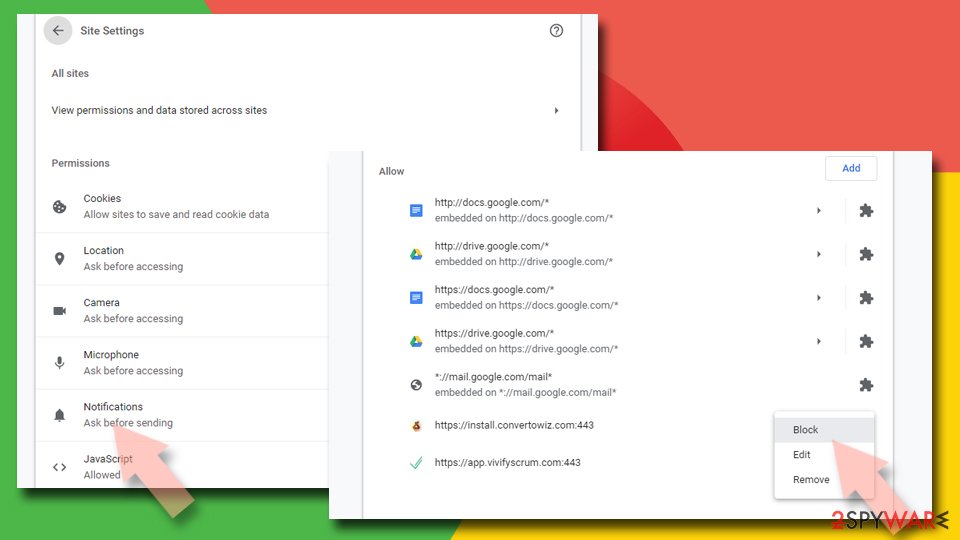
- Open the Google Chrome browser and go to Menu > Settings.
- Scroll down and click on Advanced.
- Locate the Privacy and security section and pick Site Settings > Notifications.
- Look at the Allow section and look for a suspicious URL.
- Click the three vertical dots next to it and pick Block. This should remove unwanted notifications from Google Chrome.

Google Chrome (Android)
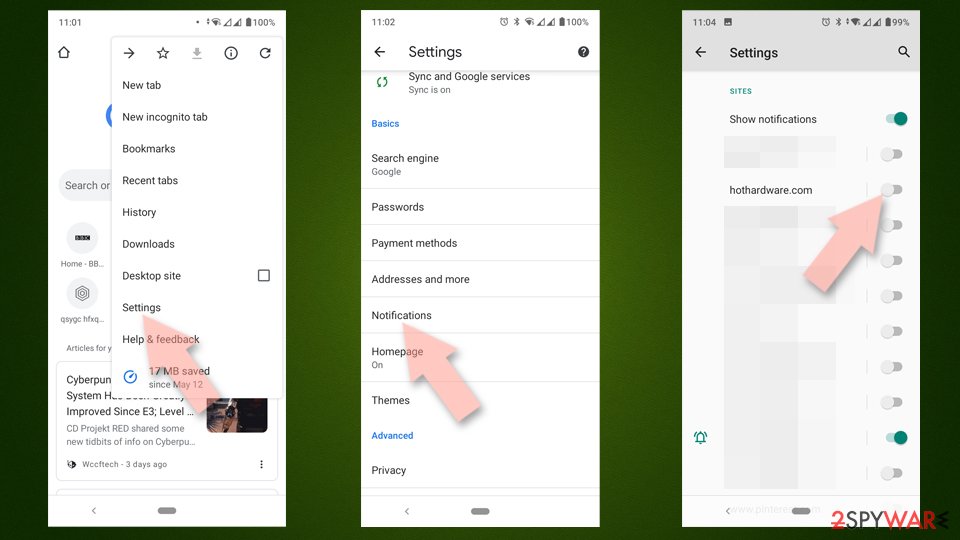
- Open Google Chrome and tap on Settings (three vertical dots).
- Select Notifications.
- Scroll down to the Sites section.
- Locate the unwanted URL and toggle the button to the left (Off position).

Mozilla Firefox
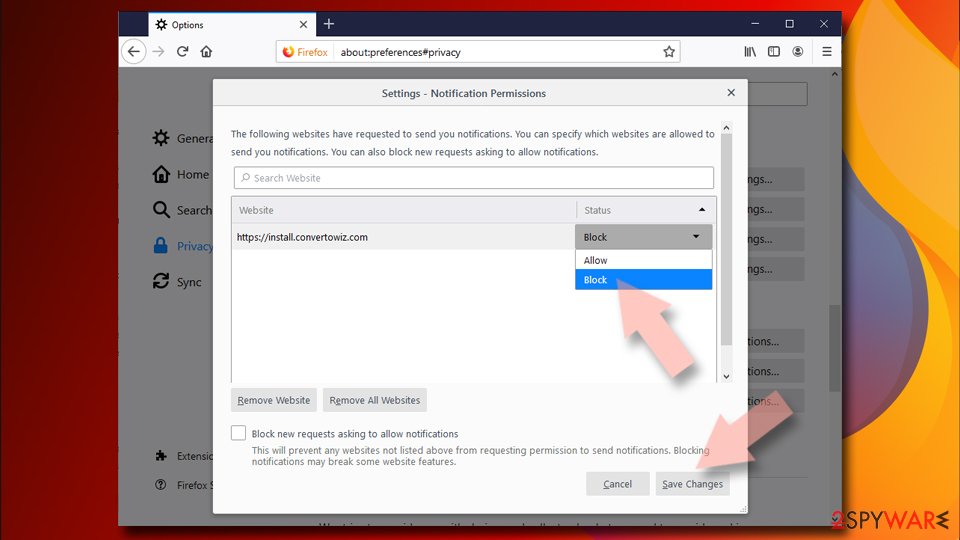
- Open Mozilla Firefox and go to Menu > Options.
- Click on Privacy & Security section.
- Under Permissions, you should be able to see Notifications. Click the Settings button next to it.
- In the Settings – Notification Permissions window, click on the drop-down menu by the URL in question.
- Select Block and then click on Save Changes. This should remove unwanted notifications from Mozilla Firefox.

Safari
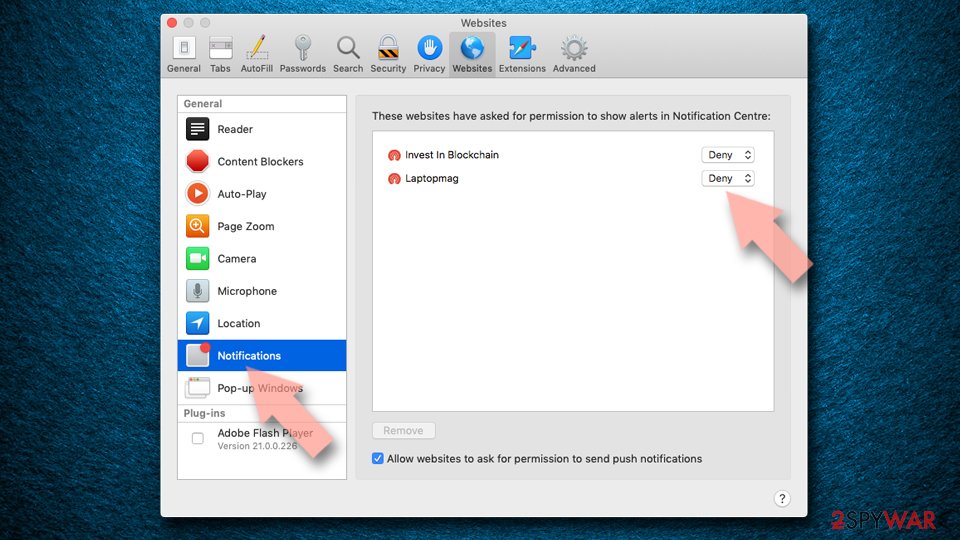
- Click on Safari > Preferences…
- Go to the Websites tab and, under General, select Notifications.
- Select the web address in question, click the drop-down menu and select Deny.

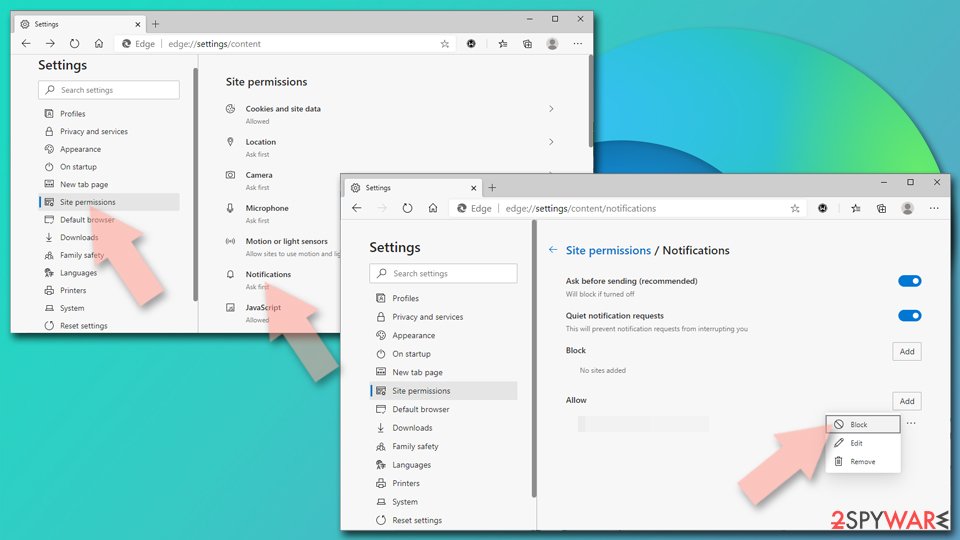
MS Edge
- Open Microsoft Edge, and go to Settings.
- Select Site permissions.
- Go to Notifications on the right.
- Under Allow, you will find the unwanted entry.
- Click on More actions and select Block.

Internet Explorer
- Open Internet Explorer, and click on the Gear icon at the top-right of the window.
- Select Internet options and go to the Privacy tab.
- In the Pop-up Blocker section, click on Settings.
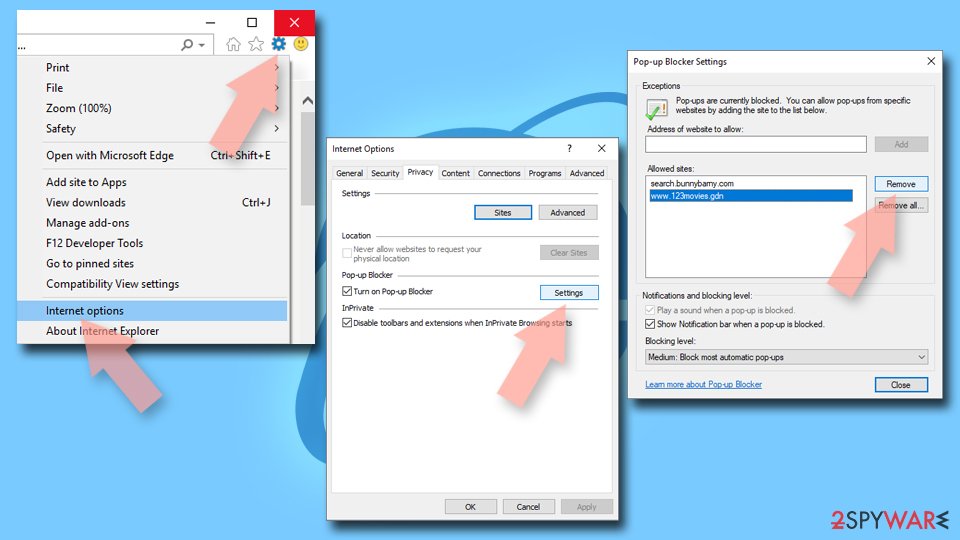
- Locate the web address in question under Allowed sites and pick Remove.

Secure your device from adware or other malware
You should also ensure your device is adware-free or free from other malware. Most of the adware has obvious symptoms, such as browser setting changes, suspicious website redirects, and intrusive ads, but some types of malware operate silently without obvious symptoms.
Thus, we highly recommend scanning your system for viruses using a reliable anti-malware tool, such as SpyHunterCombo Cleaner or MalwarebytesMalwarebytes. Needless to say, protection from adware and other malware is of utmost importance, as security software secures against any possible cyberattacks.
If a scan reveals any infections, they will be dealt with immediately, and all malicious files will be deleted at once. We also recommend employing FortectIntego PC repair and maintenance utility after that to clean your browsers automatically. The app can also repair any damage caused by a virus, ensuring you won't experience crashes, errors, or other stability issues.
Did this guide help?
Be the first to comment