

Adsforcomputercity.com ads can show misleading messages and redirect to potentially dangerous websites

Adsforcomputercity.com is a push notification scam website that tricks users by using social engineering techniques. Once users enter the page, they are quickly asked to confirm they aren't robots, that they are above 18 years of age, as well as similar misleading messages. Since these requests can be encountered practically anywhere, users tend to confirm them without giving too much thought, only to realize that the website has no substance whatsoever, and they then quickly get redirected to another suspicious place.
While initially, nothing much happens, and users are quick to forget this encounter, Adsforcomputercity.com ads would start showing up consistently directly on their desktops. This is where things get a bit more complex, as people struggle to understand why they see these ads. In reality, because they clicked the “Allow” button within the notification prompt, it allowed the website to deliver any kind of information via the built-in API (Application Programming Interface).[1]
Since scam websites like Adsforcomputercity.com almost always associate themselves with rogue ad networks, the quality of shown ads is very poor; they might expose users to get-rich-quick[2] schemes or show fake virus infection alerts. As a result, people might be misled into installing malware on their systems or spending money on useless services.
| Name | Adsforcomputercity.com |
| Type | Push notifications, pop-ups, ads, scam |
| Distribution | The website gains access to deliver any information as soon as the “Allow” button is pressed within the push notification prompt |
| Symptoms | Push notifications show on the desktop at random time intervals. These pop-ups show fake notices and push scams. Links can also lead to malware-laden sites |
| Risks | The ads shown within push notifications might include misleading messages and links to malicious websites. If clicked, you might end up infecting your system with malware, disclosing your personal information, or losing money |
| Removal | You need to access your browser's settings section to block intrusive pop-ups. Also, perform a scan with SpyHunterCombo Cleaner anti-virus to check for infections |
| Other checks | Make sure you clean your browsers after you delete PUPs from the system. You can do that quickly with FortectIntego maintenance utility |
Scam techniques used
There are plenty of different scams out there in the wild, and while the goals of cybercriminals and the principles of the scams may vary, the main goal here is to deceive people so that they would do something they otherwise wouldn't.
For that, scammers rely on time-tested techniques that rely on various human traits and emotions, including fear, excitement, and simple lack of attention when encountering dubious messages online. For example, tech support scams[3] rely on users getting scared about their computer health as they see fake virus scans and alarming results. In the meantime, push notification scams are rather simple but quite effective at what they do: expose users to a large number of ads without them knowing how to stop them.
The push notification feature was first introduced in 2015 on desktops, and, even though it may seem like a long time, the feature is not particularly desirable by users, hence many don't know what's the experience like. As such, scammers can abuse this feature by showing users fake reasons why they should allow notifications in the first place. For example:
Click Allow if you are not a robot
This is one of the most commonly used short messages by Adsforcomputercity.com and numerous other scam websites in order to make users subscribe without intending to do so. Legitimate websites actually use captchas and similar verification techniques to protect themselves from cyberattacks known as DDoS, so some may think it's just another check to be bypassed.

Unfortunately, as soon as the “Allow” button is pressed, the scam has fulfilled its duty, and users are now bound to start receiving intrusive ads on their desktops at any time, for as long as the browser is running. Luckily, this mistake is easily correctable, as long as the promoted content is not interacted with.
Remove Adsforcomputercity.com ads easily
While users get redirected to Adsforcomputercity.com due to them visiting high-risk places such as torrent distribution sites, it is not always the case. Sometimes, adware could be one of the main reasons for suspicious encounters with phishing material and excessive ads online.
Thus, you should do a full system scan with SpyHunterCombo Cleaner, MalwarebytesMalwarebytes, or another reputable anti-malware software. The scan can ensure that all found threats and their components are eliminated at once. If something was indeed detected, you should also use FortectIntego to repair system damage and clear the browser and system from junk and trackers.
Once you are sure that all potentially unwanted and malicious software is terminated from your system, you can then proceed with blocking the push notifications via browser settings. Follow this guide and pick the browser you are using:
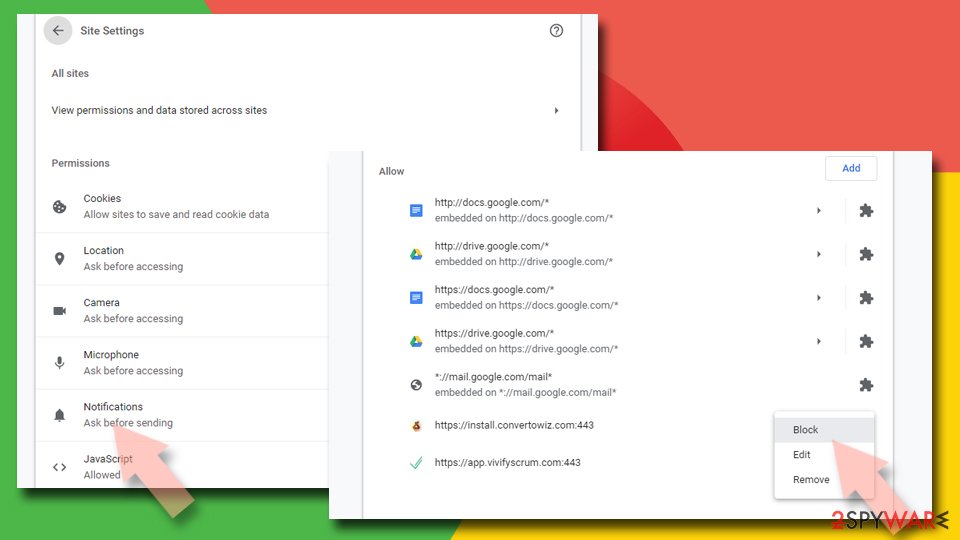
Google Chrome
- Open the Google Chrome browser and go to Menu > Settings.
- Scroll down and click on Advanced.
- Locate the Privacy and security section and pick Site Settings > Notifications.
- Look at the Allow section and look for a suspicious URL.
- Click the three vertical dots next to it and pick Block. This should remove unwanted notifications from Google Chrome.

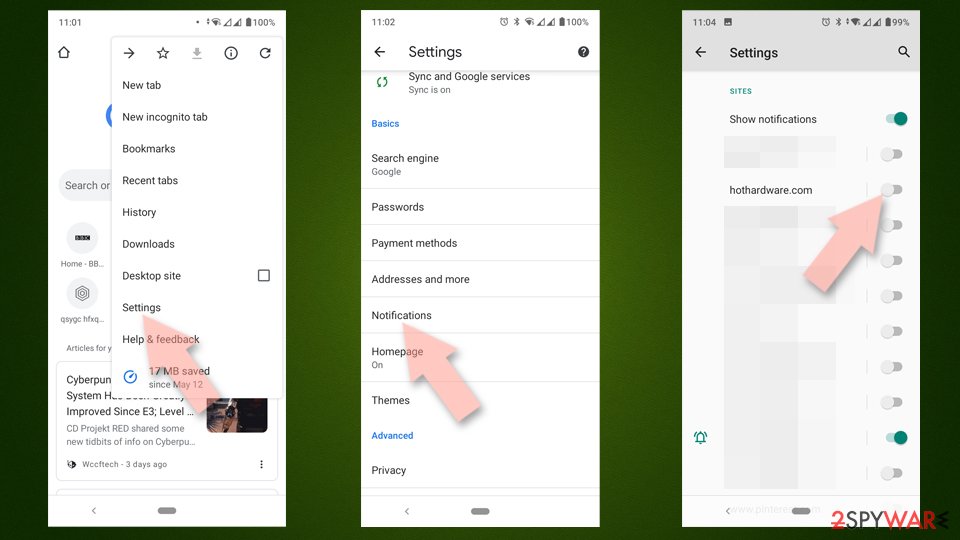
Google Chrome (Android)
- Open Google Chrome and tap on Settings (three vertical dots).
- Select Notifications.
- Scroll down to the Sites section.
- Locate the unwanted URL and toggle the button to the left (Off position).

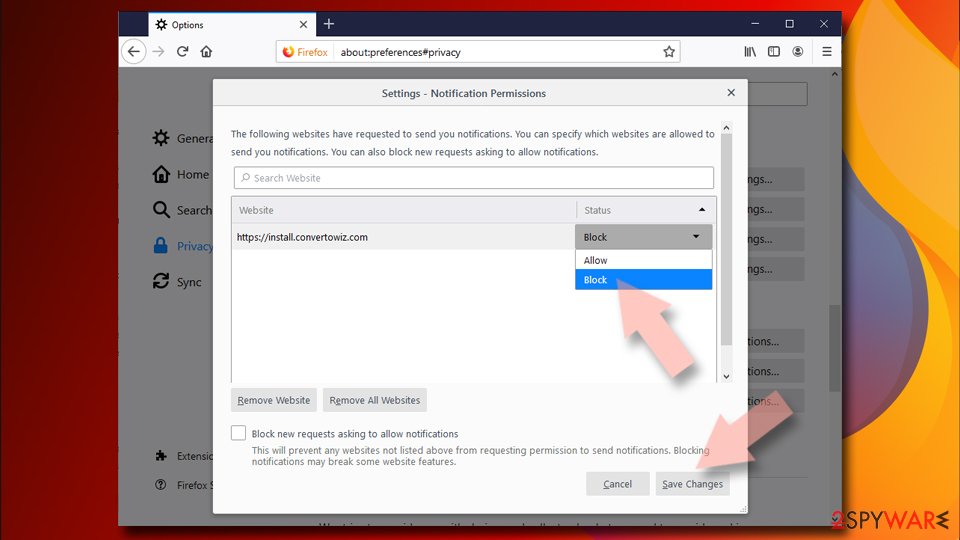
Mozilla Firefox
- Open Mozilla Firefox and go to Menu > Options.
- Click on Privacy & Security section.
- Under Permissions, you should be able to see Notifications. Click the Settings button next to it.
- In the Settings – Notification Permissions window, click on the drop-down menu by the URL in question.
- Select Block and then click on Save Changes. This should remove unwanted notifications from Mozilla Firefox.

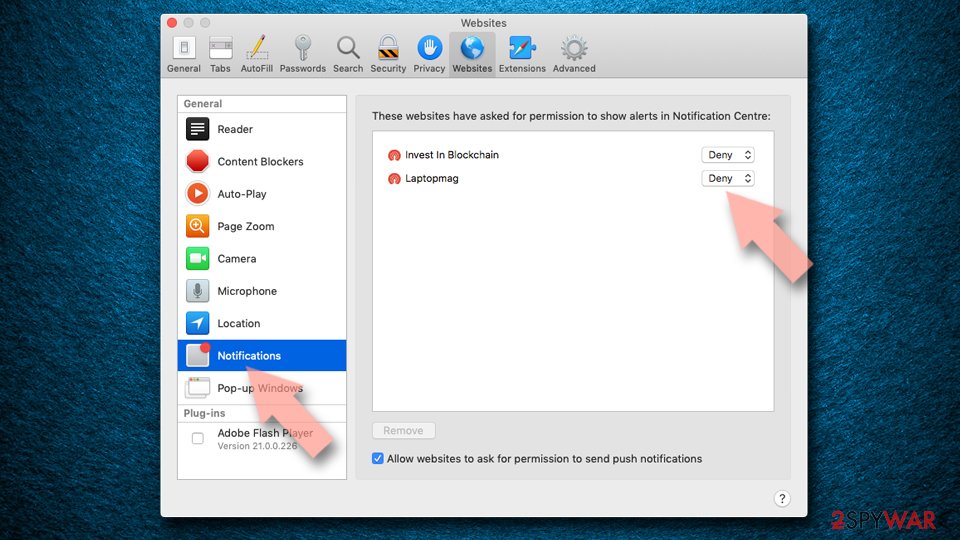
Safari
- Click on Safari > Preferences…
- Go to the Websites tab and, under General, select Notifications.
- Select the web address in question, click the drop-down menu and select Deny.

MS Edge
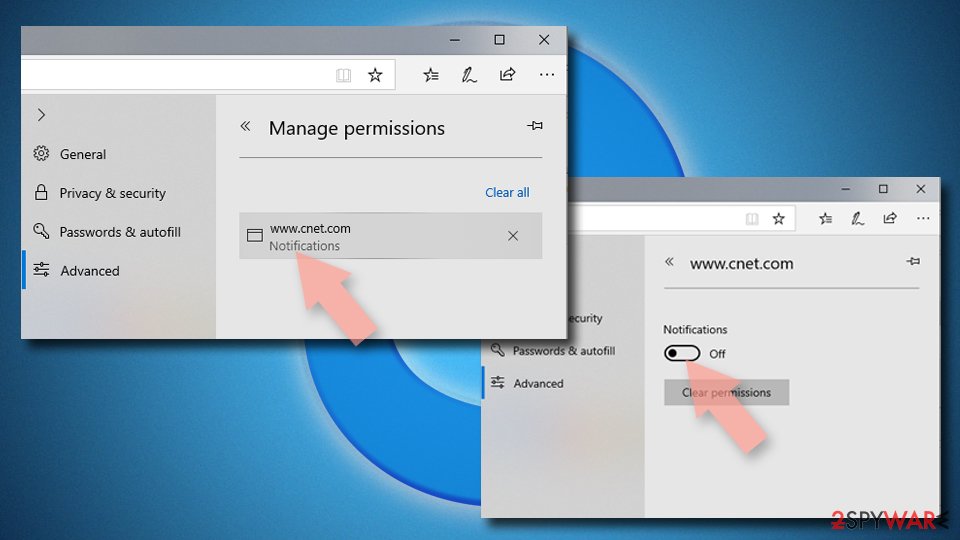
- Open Microsoft Edge, and click the Settings and more button (three horizontal dots) at the top-right of the window.
- Select Settings and then go to Advanced.
- Under Website permissions, pick Manage permissions and select the URL in question.
- Toggle the switch to the left to turn notifications off on Microsoft Edge.

MS Edge (Chromium)
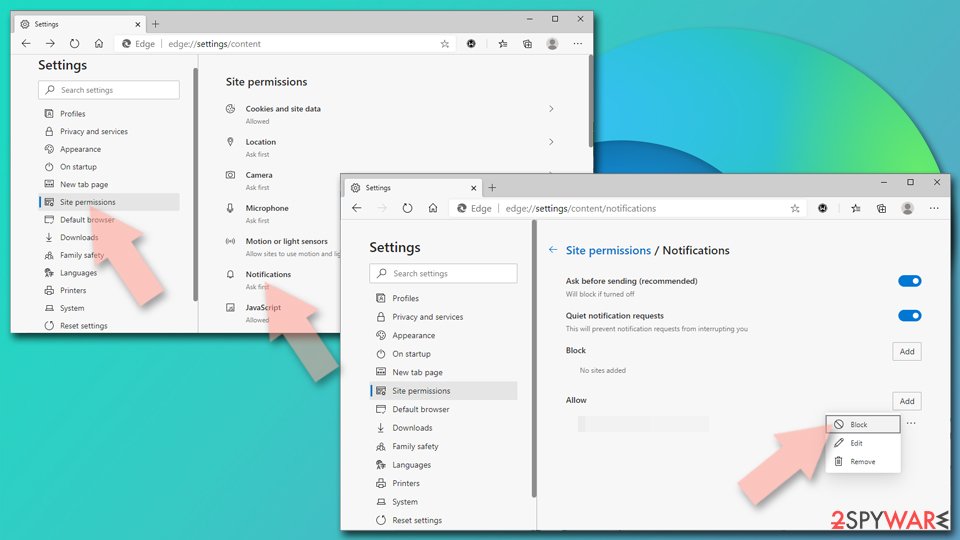
- Open Microsoft Edge, and go to Settings.
- Select Site permissions.
- Go to Notifications on the right.
- Under Allow, you will find the unwanted entry.
- Click on More actions and select Block.

Internet Explorer
- Open Internet Explorer, and click on the Gear icon at the top-right of the window.
- Select Internet options and go to the Privacy tab.
- In the Pop-up Blocker section, click on Settings.
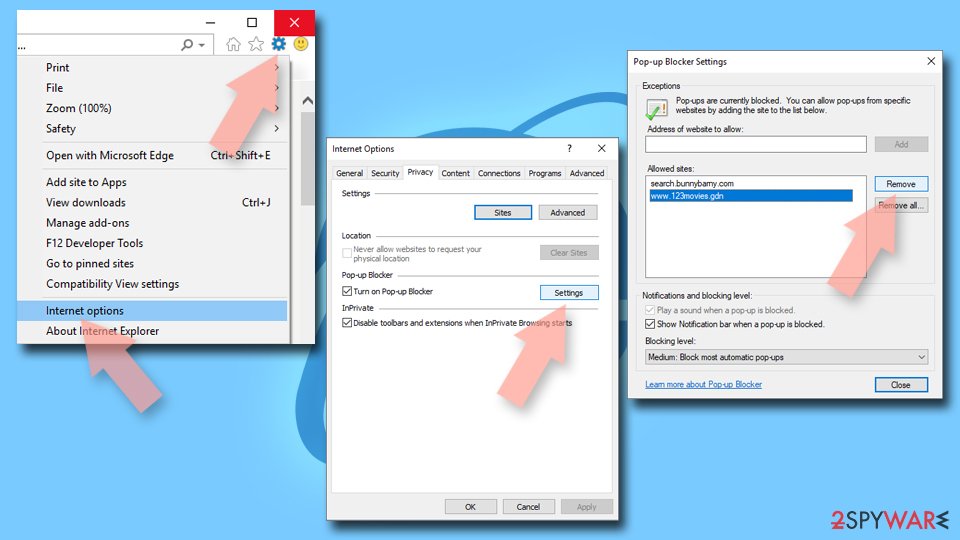
- Locate the web address in question under Allowed sites and pick Remove.

Did this guide help?
Be the first to comment