

Emyresumef.hair feeds users fake information so they would enable push notifications

Emyresumef.hair is a fake website created by scammers to manipulate users' actions that may harm them in the long run. To be more precise, it specializes in showing users fake messages about the push notification prompt's real purpose upon site entry. If accepted, it would allow the site to deliver intrusive pop-ups at any time for as long as the browser is either actively being used or is running in the background.
Emyresumef.hair shown content is often of poor quality, mainly because scammers often associate themselves with rogue advertising networks. For example, push notifications may include links to malware-laden websites, promote survey scams or get-rich-quick[1] schemes, and claim that the system has been infected by multiple viruses.
Therefore, we recommend you avoid clicking the promoted links and exploring the websites they lead to. Instead, make sure that your system is not infected with adware and get rid of the annoying push notifications by accessing browser settings, as we explain in our instructions below.
| Name | Emyresumef.hair |
| Type | Push notifications, ads, pop-ups, scam |
| Distribution | The only way the ads would start being shown is by users pressing the “Allow” button within the notification prompt |
| Symptoms | Notifications show up at the bottom-right corner of the screen – these include fraudulent content and links to potentially dangerous websites |
| Dangers | Once enabled, notifications from malicious websites would bring misleading or other suspicious content to your screen. These links could lead to malware-laden, scam, phishing, or similar malicious sites |
| Removal | Removing push notifications from your desktop requires you to access browser settings and block the unwanted URL. Scanning the system with SpyHunterCombo Cleaner is also recommended |
| Tips | We recommend using FortectIntego to fix any virus damage that might have occurred due to a system infection. The app can also remove various trackers for better privacy |
Why do you encounter online scams?
Online fraud is something that hardly will be eliminated, as the internet is simply way too vast to moderate it strictly. It consists of multiple components, entities, and regulators and is extremely dynamic, changing every day. This is why scam websites such as Emyresumef.hair can emerge at any time and, regardless of their lifespan, still reach hundreds of users.
Rogue advertising networks and malicious/poorly regulated websites are the biggest helpers of scammers here. For example, torrents and similar websites distributing pirated software or cracks are known for their dangerous nature. They often include fake “Download” links, infected torrent files, malicious ads, and similar content. Therefore, visiting them may not only redirect you to a phishing website but also result in the infection of malware, such as ransomware.
Despite this, there's also a chance that adware may initiate redirects to phishing websites. Adware is a deceptive type of application that commonly runs in the background and causes various browsing issues. For example, it may employ a virtual layer that would show ads on top of everything else, or it may insert links into text, etc. As a result, there are by far more ways of accessing suspicious websites while the infection is active.
How frequent are push notification scams, and how do they work?
Push notification scams have been around since the surface of the feature within the desktop environment back in 2015. The feature is, of course, meant to be used for legitimate purposes – people could get immediate notifications from websites they like, while the said websites can accumulate more traffic.

However, cybercriminals had a different idea and decided to use the feature for their own malicious deeds. Emyresumef.hair is just one of the millions of websites quickly created by scammers to fool users – they don't really differ much from each other. In fact, Fynservice.com, Space-ads.xyz, Mscreviews.com, and many others, use the exact same messages and images, which are copied from one another.
This is because these websites hold no useful information or content that would be useful for anyone. Their only purpose is to mislead users and interact with the push notification prompt by showing the following fake messages:
- Click Allow to watch the video
- Press “Allow” bot verify, that you are not robot
- Browser verification in progress – click the button “Allow” to access
- If you are 18+, click Allow
- Click “Allow” to win a prize and get it in our shop!
Without a doubt, it is not difficult to see how users may get confused here. They have previously seen requests to confirm they aren't robots (captcha and similar checks are extremely common, as they prevent unexpected DDoS[2] attacks on numerous websites) or that they are above 18 years old. In some cases, users are promised some underlying content, such as a video of an alleged gift.
As we already mentioned, these websites have zero substance and are not worth spending time on. If you have allowed push notifications from the site, you shouldn't worry too much – as long as you do not interact with the pop-ups, you should be relatively safe.
Remove malicious notifications from our device
Emyresumef.hair push notifications are problematic because they can trick people into visiting suspicious and malicious websites, resulting in all sorts of issues for users. Even if you are not planning to go to these promoted sites, you might still click the link by accident. Under certain circumstances (whenever vulnerable software[3] is installed on the device), that would be enough to infect your system with dangerous malware.
Regardless of whether you clicked on the shown links and entered promoted websites or not, we recommend you make some adware checks before moving on to the removal of push notifications. The easiest method to check your system is by scanning it with SpyHunterCombo Cleaner, MalwarebytesMalwarebytes, or another powerful security app. Likewise, FortectIntego can remove various trackers and fix virus damage automatically, resolving computer stability issues.
To stop the intrusive pop-ups, you have to access browser settings and block the related URL in the site settings submenu:
Google Chrome
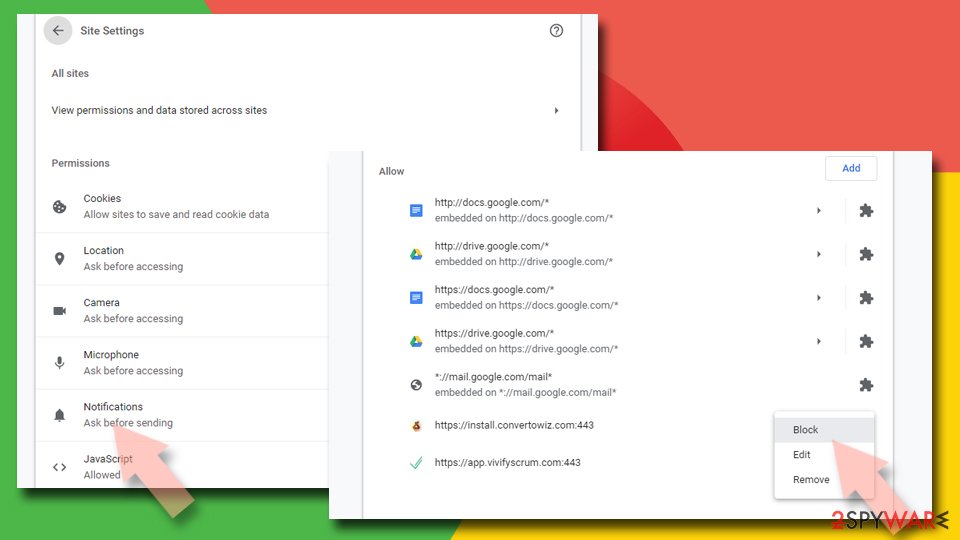
- Open the Google Chrome browser and go to Menu > Settings.
- Scroll down and click on Advanced.
- Locate the Privacy and security section and pick Site Settings > Notifications.
- Look at the Allow section and look for a suspicious URL.
- Click the three vertical dots next to it and pick Block. This should remove unwanted notifications from Google Chrome.

Mozilla Firefox
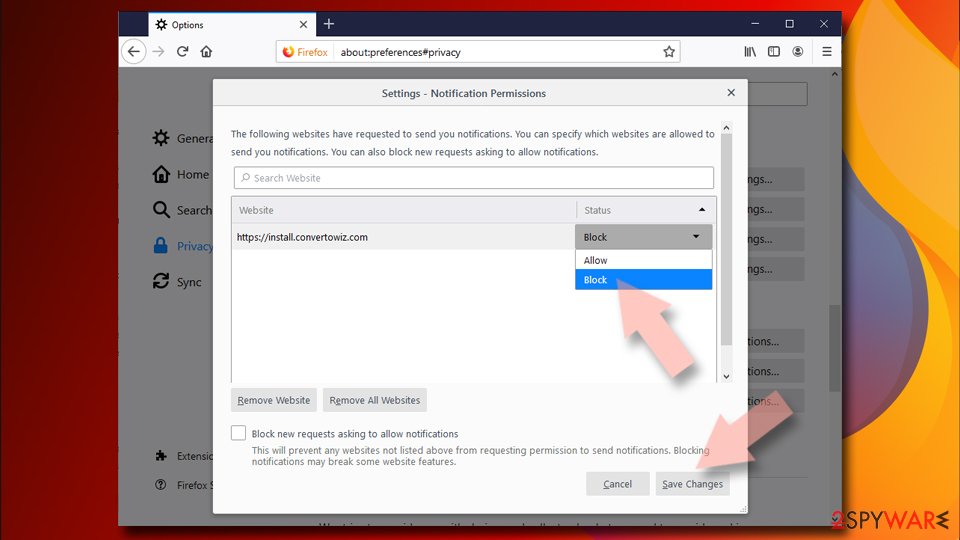
- Open Mozilla Firefox and go to Menu > Options.
- Click on Privacy & Security section.
- Under Permissions, you should be able to see Notifications. Click the Settings button next to it.
- In the Settings – Notification Permissions window, click on the drop-down menu by the URL in question.
- Select Block and then click on Save Changes. This should remove unwanted notifications from Mozilla Firefox.

Safari
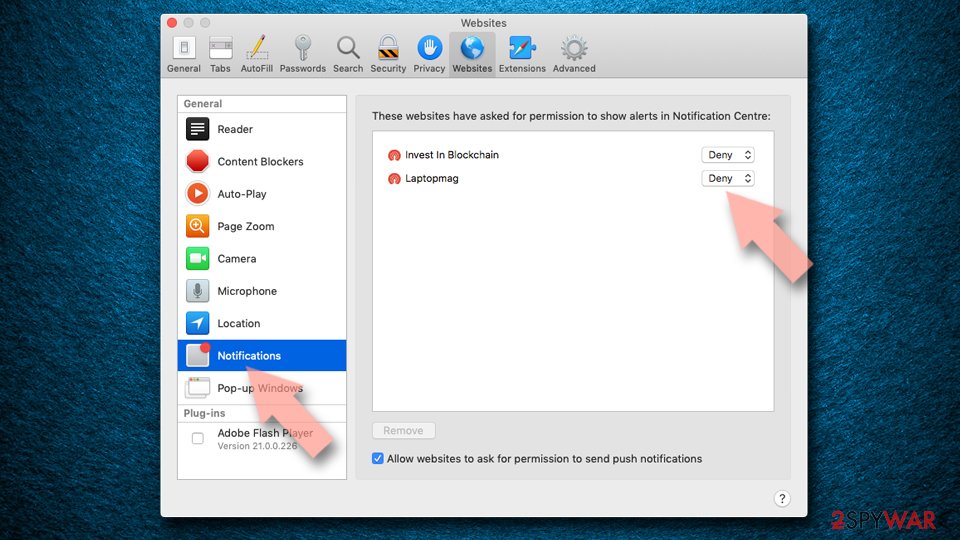
- Click on Safari > Preferences…
- Go to the Websites tab and, under General, select Notifications.
- Select the web address in question, click the drop-down menu and select Deny.

MS Edge
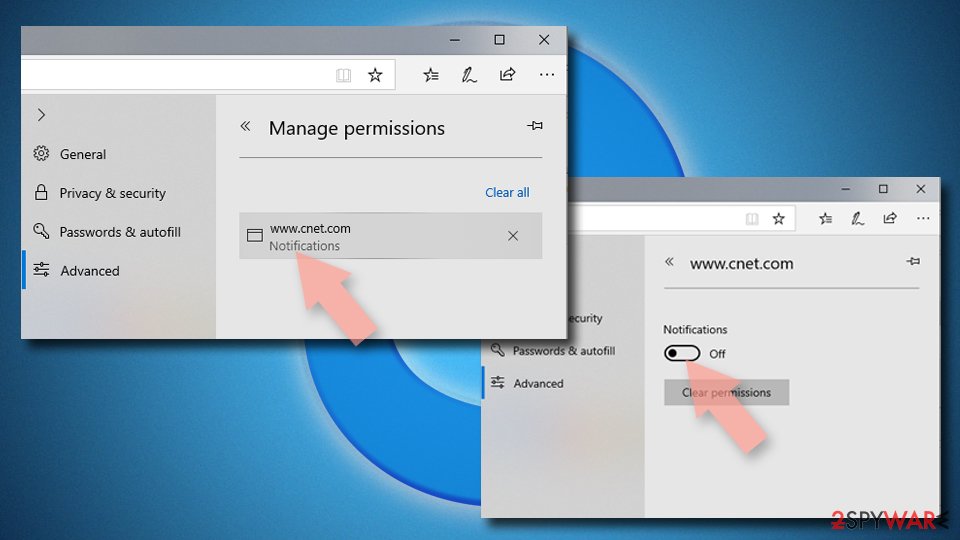
- Open Microsoft Edge, and click the Settings and more button (three horizontal dots) at the top-right of the window.
- Select Settings and then go to Advanced.
- Under Website permissions, pick Manage permissions and select the URL in question.
- Toggle the switch to the left to turn notifications off on Microsoft Edge.

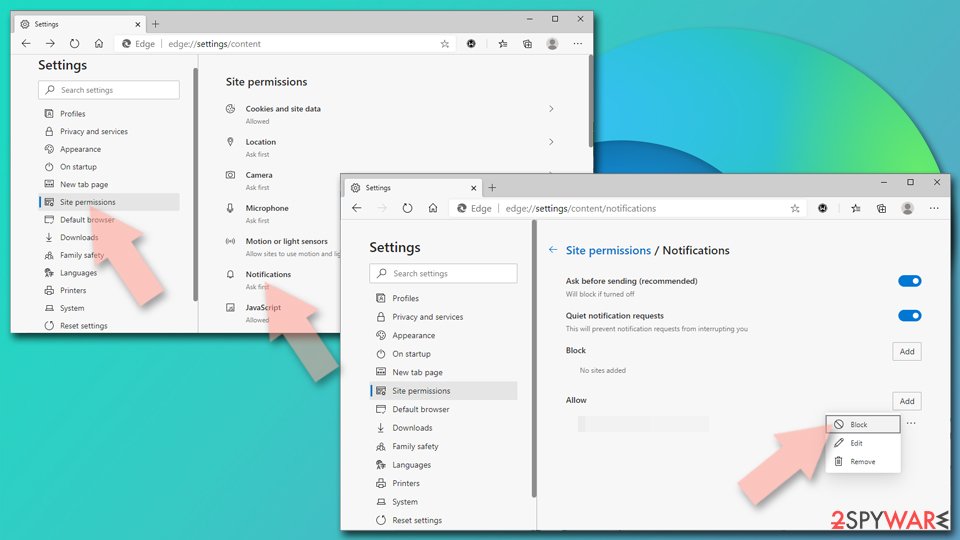
MS Edge (Chromium)
- Open Microsoft Edge, and go to Settings.
- Select Site permissions.
- Go to Notifications on the right.
- Under Allow, you will find the unwanted entry.
- Click on More actions and select Block.

Internet Explorer
- Open Internet Explorer, and click on the Gear icon at the top-right of the window.
- Select Internet options and go to the Privacy tab.
- In the Pop-up Blocker section, click on Settings.
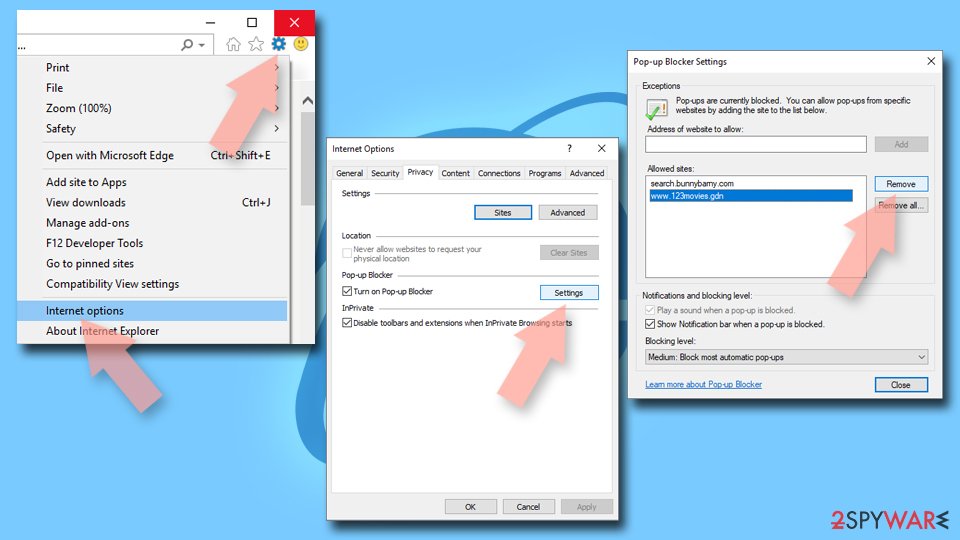
- Locate the web address in question under Allowed sites and pick Remove.

Did this guide help?
Be the first to comment