

Buygadsgroup.com ads can lead you to malicious websites

Buygadsgroup.com is a potentially hazardous web address that may appear as a result of seeing intrusive pop-up ads from it. Many individuals are taken aback by this activity, as the notifications persistently appear on their desktops, regardless of the website they are currently visiting.
If you are not aware, Buygadsgroup.com ads are present due to the fact that the user may have inadvertently granted permission for push notifications at some point in the past. The website employs deceptive tactics to convince users to subscribe, leaving many unaware of their actions. The unwanted activity often begins at a later time, making it difficult for some users to make the connection.
One of the most concerning aspects of accepting Buygadsgroup.com notifications is that they are not only highly disruptive but may also contain malicious content or promote fraudulent schemes. This could result in users becoming infected with malware, exposing their sensitive information to cybercriminals, or losing money to useless products or services.
| Name | Buygadsgroup.com |
| Type | Push notifications, ads, pop-ups, scam |
| Distribution | Users allow push notifications in after they click the “Allow” button within the prompt upon site entry |
| Symptoms | Notifications show up at the bottom-right corner of the screen – these include fraudulent content and links to potentially dangerous websites |
| Risks | If you click on links provided by the website, you might end up infecting your system with malware/PUPs, disclosing your personal information to cybercriminals, or losing money for useless services |
| Removal | Access browser settings to stop intrusive push notifications. After that, make sure that your system is not infected with adware or malware – scan it with SpyHunterCombo Cleaner |
| Tips | It is important to clean your browsers after removing potentially unwanted programs from your system – use FortectIntego for quick and reliable results |
What are push notifications, and are they the same as pop-up ads?
Many users may mistakenly confuse pop-up ads and push notifications, and it's not hard to see why. Both appear as separate windows displaying commercial content, and they share a similar visual appearance. Although their aim is the same, which is to generate ad revenue, their functioning is distinct.
Typically, ads are triggered when users access a website that hosts them, and users can opt not to visit that site to avoid intrusive pop-ups and other annoying ads. On the other hand, Buygadsgroup.com ads operate under a different principle, leveraging the push notification API (Application Programming Interface) of the browser.
As a result, push notifications to persist regardless of which website the user is visiting, even if they are not actively using the web browser. In some cases, users may be abruptly taken out of full-screen mode while watching videos or playing games if they have a browser running in the background.
How crooks operate push notification scams
It is evident that users would not willingly grant push notifications from untrusted or malicious websites. The individuals behind these scams are aware of this and have devised a scheme to achieve their goals. They create fake websites, such as Buygadsgroup.com, which are crafted to deceive users into believing that granting permission is a necessary step.
To achieve this, they utilize various social engineering tactics, such as claiming that a video cannot be played because the browser blocks it, requiring users to confirm their age or prove that they are human. As many individuals have encountered similar requests in different contexts, they often believe them to be legitimate.
Check out these examples of scam messages you might encounter after entering Buygadsgroup.com:
- “Click Allow to confirm you are not a robot” is a common refrain in push notification scams. The familiarity of human verification procedures like captchas makes this request seem trustworthy. Scammers take advantage of this by exploiting it in new ways.
- “If you are 18+, click Allow” is often used as a fake age verification method. Since many legitimate websites are required to verify users' age before allowing access to content, this process is well-known to many people.
- “Click “Allow” to win a prize and get it in our shop!” promises extravagant rewards for free through a fake giveaway. In reality, there are no prizes or winners.
- “Click Allow to watch the video” is another frequently used tactic in push notification scams. This often involves showing a fake video GIF that is about to play or imitating a YouTube video format.

Don't fall for false claims, as there is no actual content on the site and no video to watch or prize to win. You will likely be redirected to another phishing website where you'll be asked to take similar actions. It's best to ignore these requests and take the necessary steps to prevent push notifications from malicious sites.
Remove intrusive Buygadsgroup.com pop-ups
Many users fail to remove Buygadsgroup.com ads because they are not entirely sure where they are coming from. Scanning the system with security software doesn't help – understandably, as the activity is not a direct outcome of an infection. Thus, you need to access your browser settings and block the website's URL as follows:
Google Chrome
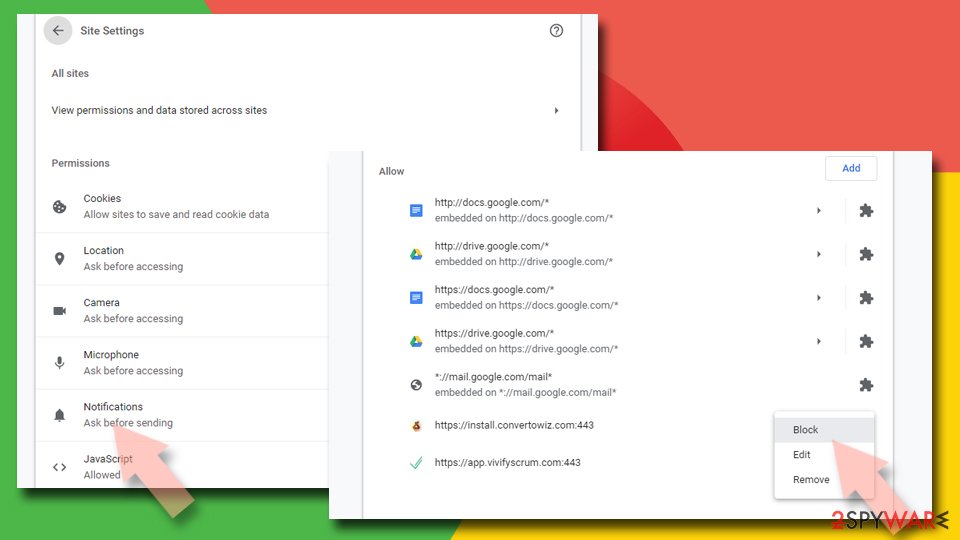
- Open the Google Chrome browser and go to Menu > Settings.
- Scroll down and click on Advanced.
- Locate the Privacy and security section and pick Site Settings > Notifications.
- Look at the Allow section and look for a suspicious URL.
- Click the three vertical dots next to it and pick Block. This should remove unwanted notifications from Google Chrome.

Google Chrome (Android)
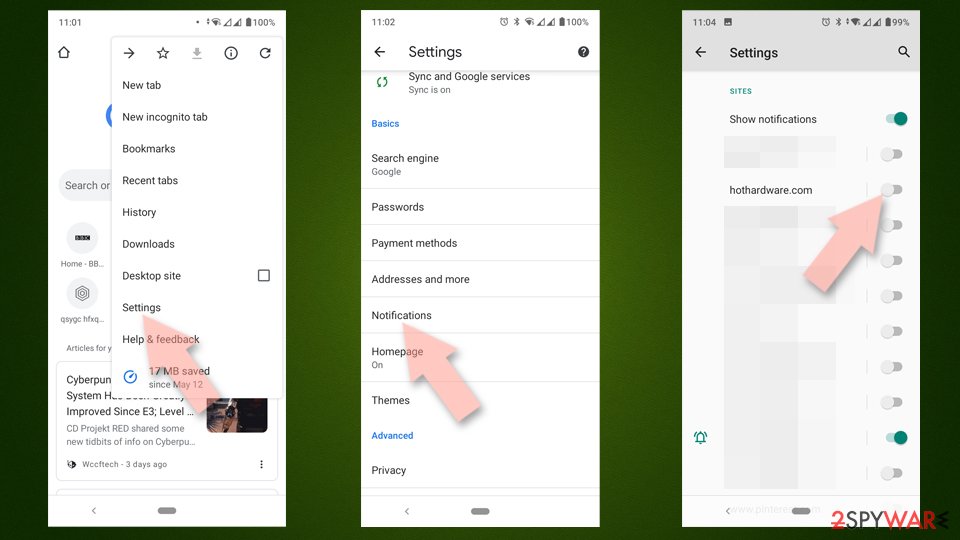
- Open Google Chrome and tap on Settings (three vertical dots).
- Select Notifications.
- Scroll down to the Sites section.
- Locate the unwanted URL and toggle the button to the left (Off position).

Mozilla Firefox
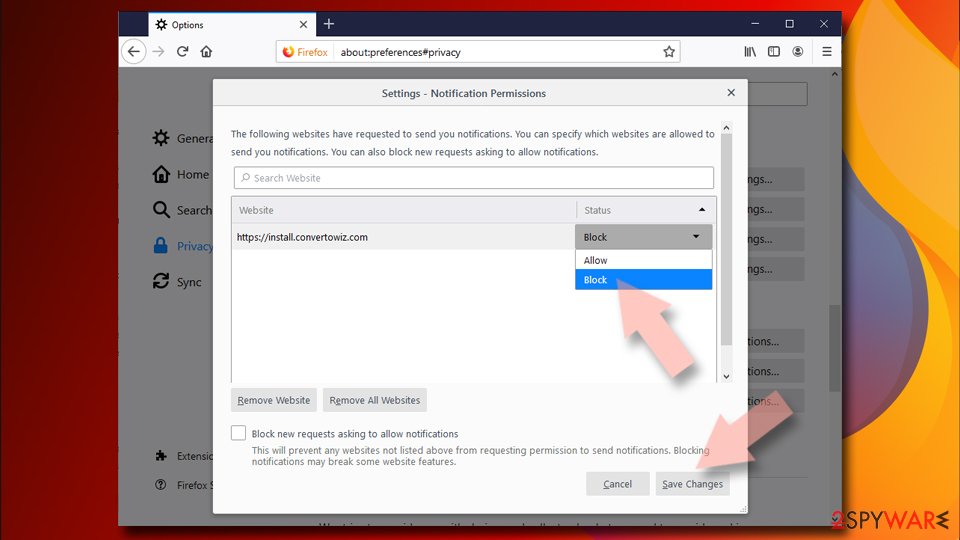
- Open Mozilla Firefox and go to Menu > Options.
- Click on Privacy & Security section.
- Under Permissions, you should be able to see Notifications. Click the Settings button next to it.
- In the Settings – Notification Permissions window, click on the drop-down menu by the URL in question.
- Select Block and then click on Save Changes. This should remove unwanted notifications from Mozilla Firefox.

Safari
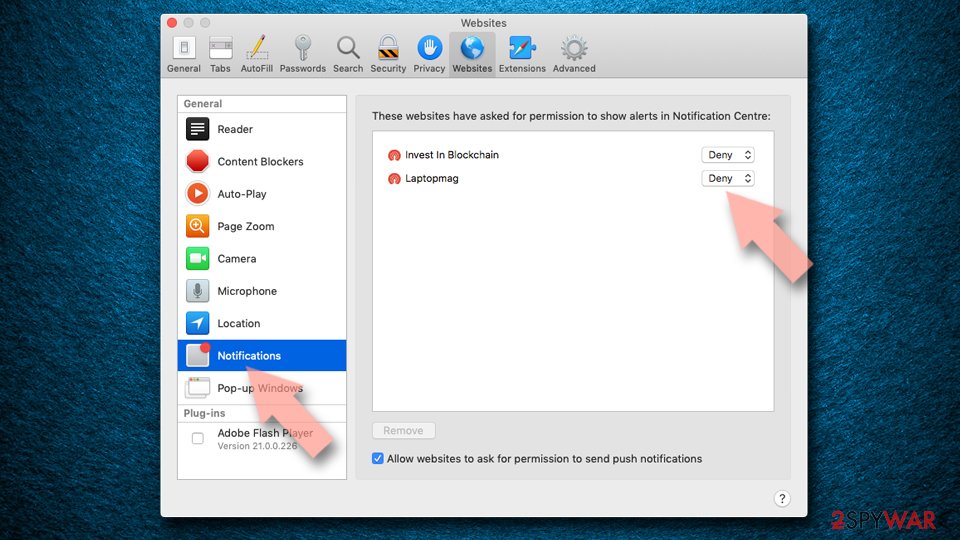
- Click on Safari > Preferences…
- Go to the Websites tab and, under General, select Notifications.
- Select the web address in question, click the drop-down menu and select Deny.

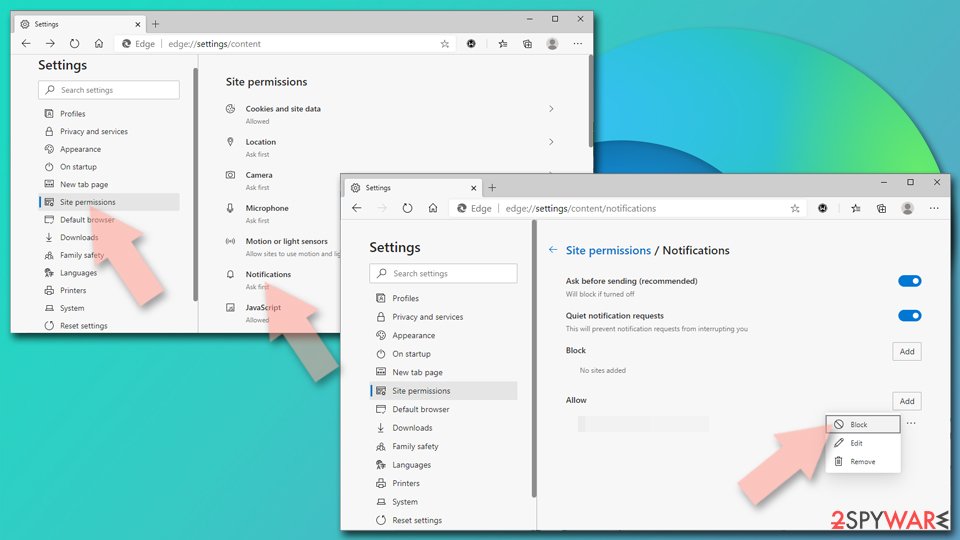
MS Edge
- Open Microsoft Edge, and go to Settings.
- Select Site permissions.
- Go to Notifications on the right.
- Under Allow, you will find the unwanted entry.
- Click on More actions and select Block.

Internet Explorer
- Open Internet Explorer, and click on the Gear icon at the top-right of the window.
- Select Internet options and go to the Privacy tab.
- In the Pop-up Blocker section, click on Settings.
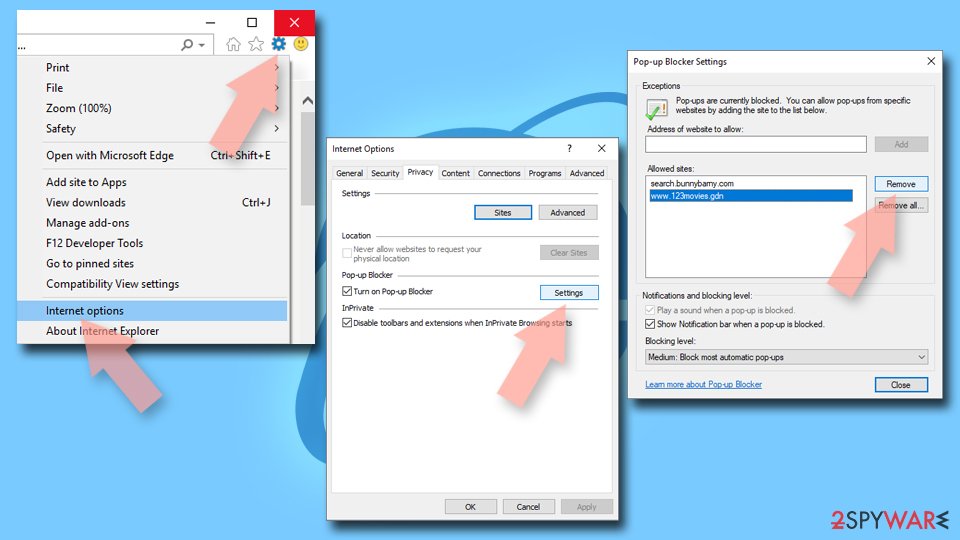
- Locate the web address in question under Allowed sites and pick Remove.

Take care of the adware problem
Adware, a type of software that often creeps onto computers through deceptive means like bundled software, is a reason why people end up on fake websites. It's often hard to tell if an intrusive program has been installed, as adware is designed to blend in as a useful tool, leading to unintentional installations.
If you've noticed strange redirections on your browser, it's time to take action and scan your computer for infections. A full scan with security software like SpyHunterCombo Cleaner or MalwarebytesMalwarebytes can easily determine if there is any malware or adware in your system and quickly eliminate them if found.
Once you've cleared your computer of unwanted programs, using FortectIntego PC repair and maintenance software is recommended to clean your browsers and repair any virus damage. If you prefer to do this manually, please refer to the instructions provided at the bottom.
Remove from Microsoft Edge
Delete unwanted extensions from MS Edge:
- Select Menu (three horizontal dots at the top-right of the browser window) and pick Extensions.
- From the list, pick the extension and click on the Gear icon.
- Click Remove.


Clear cookies and other browser data:
- Click on the Menu (three horizontal dots at the top-right of the browser window) and select Settings > Privacy, search, and services..
- Under Clear browsing data, pick Choose what to clear.
- Select Cookies and other site data and Cached images and files. (apart from passwords, although you might want to include Media licenses as well, if applicable) and click on Clear.


Restore new tab and homepage settings:
- Click the menu icon and choose Settings.
- Then find On startup section.
- Click Remove next to any suspicious startup page.
Reset MS Edge if the above steps did not work:
- Press on Ctrl + Shift + Esc to open Task Manager.
- Click on More details arrow at the bottom of the window.
- Select Details tab.
- Now scroll down and locate every entry with Microsoft Edge name in it. Right-click on each of them and select End Task to stop MS Edge from running.


Instructions for Chromium-based Edge
Delete extensions from MS Edge (Chromium):
- Open Edge and click select Settings > Extensions.
- Delete unwanted extensions by clicking Remove.


Clear cache and site data:
- Click on Menu and go to Settings.
- Select Privacy, search and services.
- Under Clear browsing data, pick Choose what to clear.
- Under Time range, pick All time.
- Select Clear now.


Reset Chromium-based MS Edge:
- Click on Menu and select Settings.
- On the left side, pick Reset settings.
- Select Restore settings to their default values.
- Confirm with Reset.
- This will disable extensions and reset startup pages but will not delete bookmarks, saved passwords, or browsing history.


Remove from Mozilla Firefox (FF)
Remove dangerous extensions:
- Open Mozilla Firefox browser and click on the Menu (three horizontal lines at the top-right of the window).
- Select Add-ons.
- In here, select the unwanted extension and click Remove.


Reset the homepage:
- Click three horizontal lines at the top right corner to open the menu.
- Choose Settings.
- Under Home, set your preferred homepage and new tab settings.
Clear cookies and site data:
- Click Menu and pick Settings.
- Go to Privacy & Security section.
- Scroll down to locate Cookies and Site Data.
- Click on Clear Data...
- Select Cookies and Site Data and Temporary cached files and pages, then click Clear.


Reset Mozilla Firefox
If clearing the browser as explained above did not help, reset Mozilla Firefox:
- Open Mozilla Firefox browser and click the Menu.
- Go to Help and then choose Troubleshooting Information.

- Under Give Firefox a tune up section, click on Refresh Firefox...
- Once the pop-up shows up, confirm the action by pressing on Refresh Firefox.



Remove from Google Chrome
Delete malicious extensions from Google Chrome:
- Open Google Chrome, click on the Menu (three vertical dots at the top-right corner) and select More tools > Extensions.
- In the newly opened window, you will see all the installed extensions. Uninstall all suspicious extensions related to the unwanted program by clicking Remove.


Clear cache and web data from Chrome:
- Click on Menu and pick Settings.
- Under Privacy and security, select Clear browsing data.
- Select Browsing history, Cookies and other site data, as well as Cached images and files.
- Click Clear data.


Change your homepage:
- Click menu and choose Settings.
- Look for a suspicious site in the On startup section.
- Click on Open a specific or set of pages and click on three dots to find the Remove option.
Reset Google Chrome:
If the previous methods did not help you, reset Google Chrome to eliminate all the unwanted components:
- Click on Menu and select Settings.
- In the Settings, scroll down and click Advanced.
- Scroll down and locate Reset and clean up section.
- Now click Restore settings to their original defaults.
- Confirm with Reset settings.


Delete from Safari
Remove dangerous extensions:
- Open Safari, click Safari in the menu at the top-left of the screen, and select Preferences.
- Go to the Extensions tab, look for any suspicious entries, and click Uninstall to remove them.


Clear history and website data:
- Click Safari in the menu and pick Clear History.
- Set Clear to all history and confirm with Clear History.


Reset Safari:
- Click Safari in the menu and select Preferences > Advanced.
- Enable Show Develop menu in menu bar.
- From the menu bar, click Develop and select Empty Caches.


Did this guide help?
Be the first to comment