Weather In is a bogus browser extension that changes the main settings to generate revenue
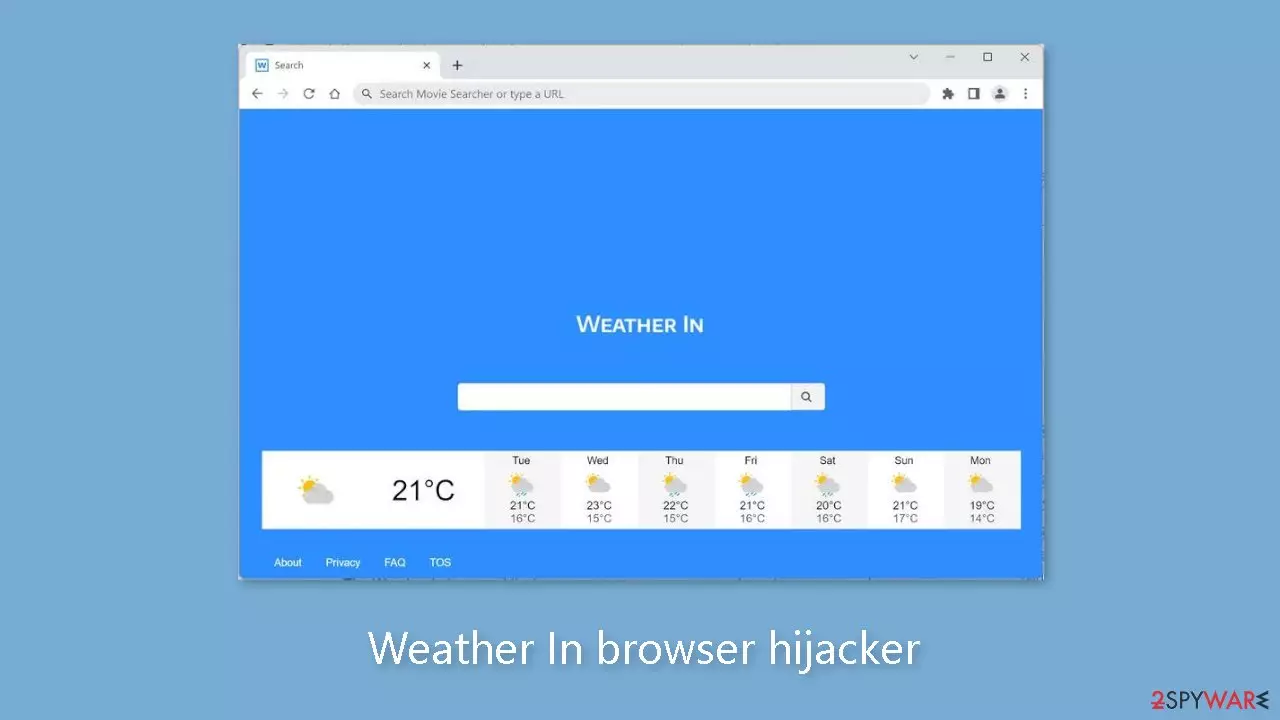
Weather In is a dubious program that hijacks web browsers and modifies important settings such as the homepage, new tab address, and search engine settings. As a result, users are forced to use specific channels for browsing, posing numerous privacy and security risks.
The software is marketed as a useful utility that provides comprehensive weather forecasts, but its actual methods for doing so are unclear. Hijacker plugins frequently fail to deliver on their promises. Instead, they are used to generate profits by shady individuals. These individuals may monetize the hijacker by collecting user data about browsing activities or by participating in pay-per-click advertising schemes.
NAME
Weather In
TYPE
Browser hijacker; potentially unwanted program
SYMPTOMS
The app changes the main settings of the browser, like the homepage, new tab address, and search engine
The application may be collecting data about users' browsing activities; users might get redirected to dangerous websites that can trick them into providing personal information or downloading PUPs and malware
ELIMINATION
Remove the extension via browser settings; performing a scan with professional security tools is recommended
FURTHER STEPS
Use FortectIntego to clear your browsers from cookies and cache
Distribution methods
Scammers frequently create “official” promotional websites for their applications in order to present them in the best light possible and convince people to download them. It is, however, critical to only install extensions from official web stores, as these apps go through a rigorous review process before being listed.
In any case, we strongly advise conducting extensive research, which includes reading reviews, examining ratings, and calculating the number of users. It is critical to read the application description thoroughly, and if the claims appear too good to be true, they most likely are. Furthermore, it is advisable to pay close attention to the grammar and spelling used on the website, as errors in these areas should raise concerns about trusting the developers.
Clear your browsers
Keeping your web browsers in good working order is critical for maintaining your online privacy. Cookies[1] are frequently used by websites to collect information such as your IP address, geolocation, visited pages, clicked links, and online purchases. Typically, this data is used to tailor the user experience.
Cookies, on the other hand, serve as yet another means for crooks to generate profits. These cookies can be sold to advertising networks and other third parties, or they can be hijacked for malicious purposes. As a result, it is critical to delete cookies on a regular basis in order to protect your privacy. We recommend using a maintenance tool like FortectIntego to make this task easier.
It has the ability to automatically clear cookies and cache with a single click. It can also fix system errors, BSODs (Blue Screen of Death), repair corrupted files, and resolve registry issues. This tool is especially useful after a virus infection, ensuring the stability and security of your system.
Remove the unwanted extension
You can remove browser add-ons by going to your settings. Find the list of extensions installed in your browser and remove Weather In. Learn how to do that in the guide below:
Google Chrome
Open Google Chrome, click on the Menu (three vertical dots at the top-right corner) and select More tools > Extensions.
In the newly opened window, you will see all the installed extensions. Uninstall all the suspicious plugins that might be related to the unwanted program by clicking Remove.
MS Edge:
Select Menu (three horizontal dots at the top-right of the browser window) and pick Extensions.
From the list, pick the extension and click on the Gear icon.
Click on Uninstall at the bottom.
MS Edge (Chromium)
Open Edge and click select Settings > Extensions.
Delete unwanted extensions by clicking Remove.
Mozilla Firefox
Open Mozilla Firefox browser and click on the Menu (three horizontal lines at the top-right of the window).
Select Add-ons.
In here, select unwanted plugin and click Remove.
Safari
Click Safari > Preferences…
In the new window, pick Extensions.
Select the unwanted extension and select Uninstall.
Freeware platforms
In some cases, simply removing the browser extension may not resolve the problem, as users may still experience unwanted symptoms. In such cases, it is best to scan your computer for adware, which is a program that runs in the background and generates commercial content.
If you have adware, simply removing the add-on will not solve the problem because the settings may continue to change until the intruder is completely removed from your system. To prevent potentially unwanted programs (PUPs)[2] from infiltrating your system as bundled software,[3] follow these simple installation guidelines:
Always opt for the “Custom” or “Advanced” installation methods.
Read the Privacy Policy and Terms of Use to understand what information will be collected and what actions the application will be permitted to perform on your system.
The most crucial step is to carefully review the file list and uncheck any suspicious or unrelated items that you encounter.
Scan your system
PUAs are frequently disguised as “useful” tools in order to make it difficult for average users to identify them. Because the program causing the erratic behavior could have any name or icon, we recommend using SpyHunterCombo Cleaner or MalwarebytesMalwarebytes anti-malware tools if you are unsure what to do and do not want to risk deleting the wrong files.
They can scan your machine, eliminate it, and prevent such infections in the future by giving you a warning before a PUP can make any changes. If manual removal is what you still prefer, we have instructions for Windows and Mac machines:
Windows 10/8:
Enter Control Panel into Windows search box and hit Enter or click on the search result.
Under Programs, select Uninstall a program.
From the list, find the entry of the suspicious program.
Right-click on the application and select Uninstall.
If User Account Control shows up, click Yes.
Wait till uninstallation process is complete and click OK.
Windows 7/XP:
Click on Windows Start >Control Panel located on the right pane (if you are Windows XP user, click on Add/Remove Programs).
In Control Panel, select Programs > Uninstall a program.
Pick the unwanted application by clicking on it once.
At the top, click Uninstall/Change.
In the confirmation prompt, pick Yes.
Click OK once the removal process is finished.
Mac:
From the menu bar, select Go > Applications.
In the Applications folder, look for all related entries.
Click on the app and drag it to Trash (or right-click and pick Move to Trash)
To fully remove an unwanted app, you need to access Application Support, LaunchAgents, and LaunchDaemons folders and delete relevant files:
Select Go > Go to Folder.
Enter /Library/Application Support and click Go or press Enter.
In the Application Support folder, look for any dubious entries and then delete them.
Now enter /Library/LaunchAgents and /Library/LaunchDaemons folders the same way and terminate all the related .plist files.






Be the first to comment