

Unassise.com attempts to exploit users' unawareness to insert malicious ads into their systems
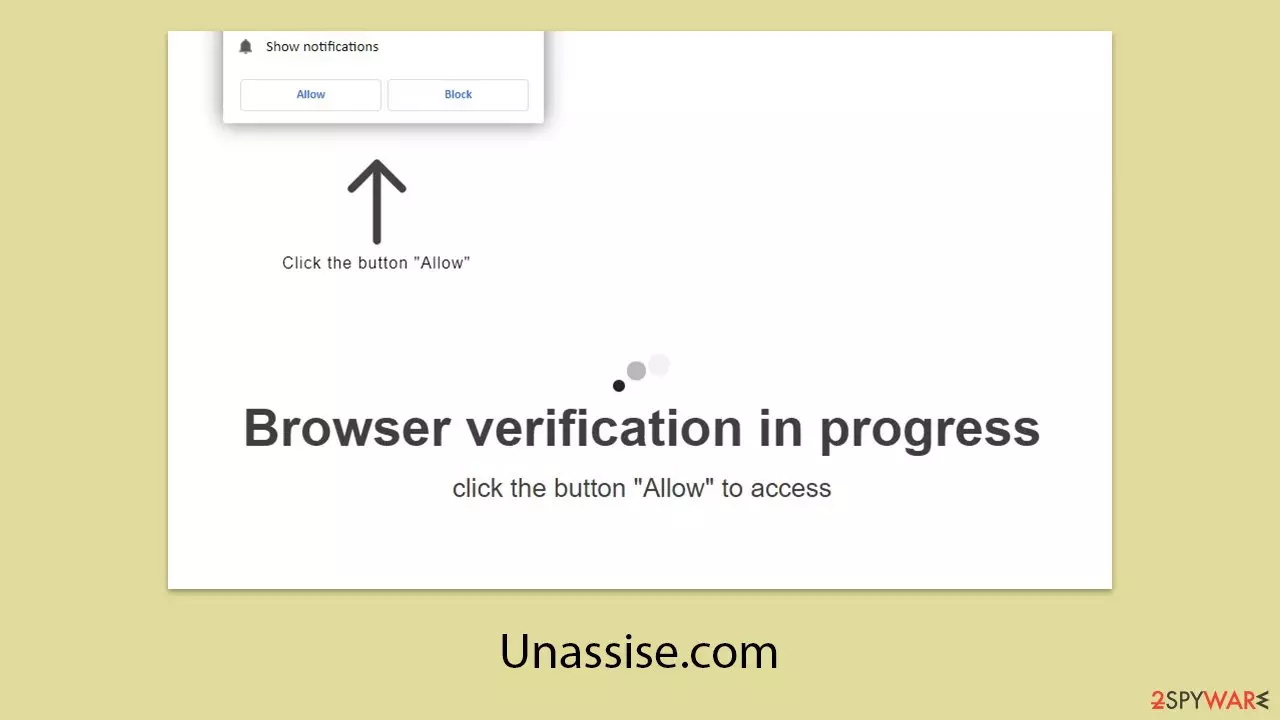
Unassise.com is a typical push notification scam site designed to generate revenue from users clicking on ads. Users often find themselves on such sites after visiting high-risk websites, like torrent sites or illegal streaming services. These redirects can happen when a fake link is clicked or a malicious script automatically directs users to the scam site.
On Unassise.com, visitors usually see a pop-up asking if they want to enable push notifications, accompanied by a background image urging them to click the “Allow” button. Agreeing to this will enable the site to send notifications, resulting in intrusive, annoying, and potentially harmful advertisements appearing directly on their desktops.
Consequently, users are bombarded with Unassise.com ads regardless of what they are doing. These pop-ups can vary widely in content, ranging from legitimate product advertisements to phishing attempts and get-rich-quick scams. We strongly advise against interacting with these notifications and recommend following our guide to remove them.
| Name | Unassise.com |
| Type | Push notifications, ads, scam, pop-ups |
| Distribution | The website gains access to deliver any information as soon as the “Allow” button is pressed within the push notification prompt |
| Symptoms | Notifications show up at the bottom-right corner of the screen – these include fraudulent content and links to potentially dangerous websites |
| Risks | You might suffer from monetary losses, install malware or potentially unwanted programs, or disclose sensitive data to cybercriminals |
| Removal | Access browser settings to stop intrusive push notifications. After that, make sure that your system is not infected with adware or malware – scan it with SpyHunterCombo Cleaner |
| Other tips | We recommend using FortectIntego to fix any virus damage that might have occurred due to a system infection. The app can also remove various trackers for better privacy |
Users venture to malicious sites accidentally
People do not go to websites like Unassise.com on purpose. In fact, typing the URL directly into the address bar usually doesn’t work. Instead, users are redirected there by accident, which benefits scammers since such mistakes are easy to make.
The most common cause of these redirects is clicking on a deceptive link elsewhere. For instance, peer-to-peer networks often use fake “Download” buttons and misleading links that take users to potentially harmful websites. Additionally, some high-risk websites use automatic scripts to redirect visitors without any user action.
To avoid such websites, we advise steering clear of them because they often contain malware and can lead to other dangerous sites. For better protection, it’s a good idea to use a reliable ad-blocker along with security software that includes web defense features.
The scamming techniques used
The unexpected arrival on websites like Unassise.com often surprises users, leading them to make poor decisions. The site takes advantage of this surprise element by presenting seemingly harmless prompts. Users are asked to confirm their age or prove they are not robots, which are common social engineering tactics used in online scams.
The main goal of scammers on Unassise.com is to trick users into thinking that clicking the “Allow” button is necessary for a different reason. They use manipulative messages and images that are common across many push notification scam sites. Some examples of these deceptive prompts are:
- If you are 18+, click Allow
- Click Allow to confirm that you are not a robot
- Click “Allow” to win the prize and get it in our shop!
- Please tap Allow to continue
- Click “Allow” to start downloading, etc.

Users need to remember that allowing push notifications means Unassise.com can send various types of content, including misleading links and fake messages, through the browser’s API whenever it is open or running in the background.
Thankfully, stopping these intrusive notifications is not difficult if you know the steps. The following section provides detailed instructions on how to disable these notifications, ensuring a safer browsing experience.
Removing unwanted push notifications
Push notifications are often misunderstood, even though they are common on many websites. This confusion arises because many users have never interacted with them before. When unexpected pop-ups appear on their screens, people frequently assume their systems are infected with a virus, which is a natural reaction.
However, push notifications are not caused by adware or other types of computer infections. They appear only if a user has permitted a website to show them through a push notification prompt. Therefore, traditional virus removal methods will not work for eliminating Unassise.com ads. Instead, you need to go into your browser settings and block the URL of the website to stop it from delivering malicious links and ads.
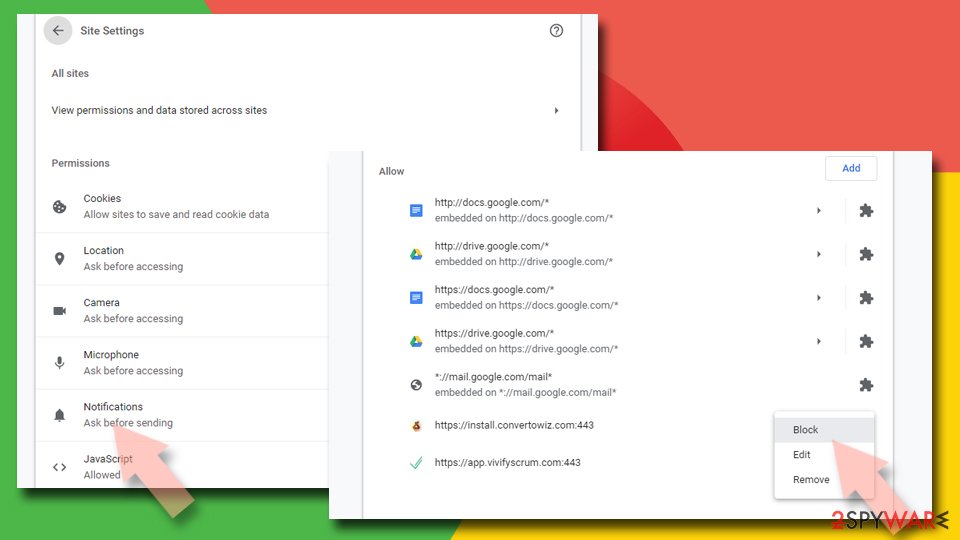
Google Chrome (desktop)
- Open the Google Chrome browser and go to Menu > Settings.
- Scroll down and click on Advanced.
- Locate the Privacy and security section and pick Site Settings > Notifications.
- Look at the Allow section and look for a suspicious URL.
- Click the three vertical dots next to it and pick Block. This should remove unwanted notifications from Google Chrome.

Mozilla Firefox
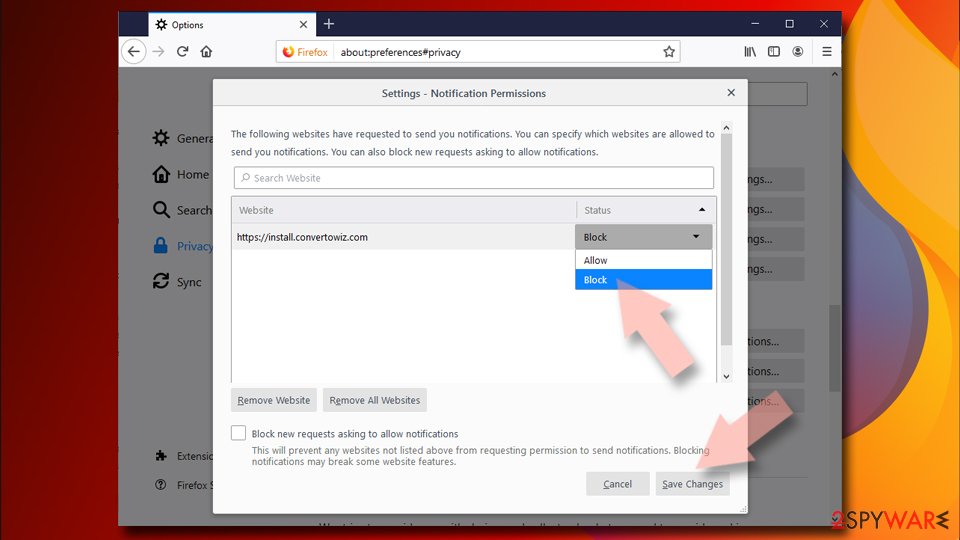
- Open Mozilla Firefox and go to Menu > Options.
- Click on Privacy & Security section.
- Under Permissions, you should be able to see Notifications. Click the Settings button next to it.
- In the Settings – Notification Permissions window, click on the drop-down menu by the URL in question.
- Select Block and then click on Save Changes. This should remove unwanted notifications from Mozilla Firefox.

MS Edge (Chromium)
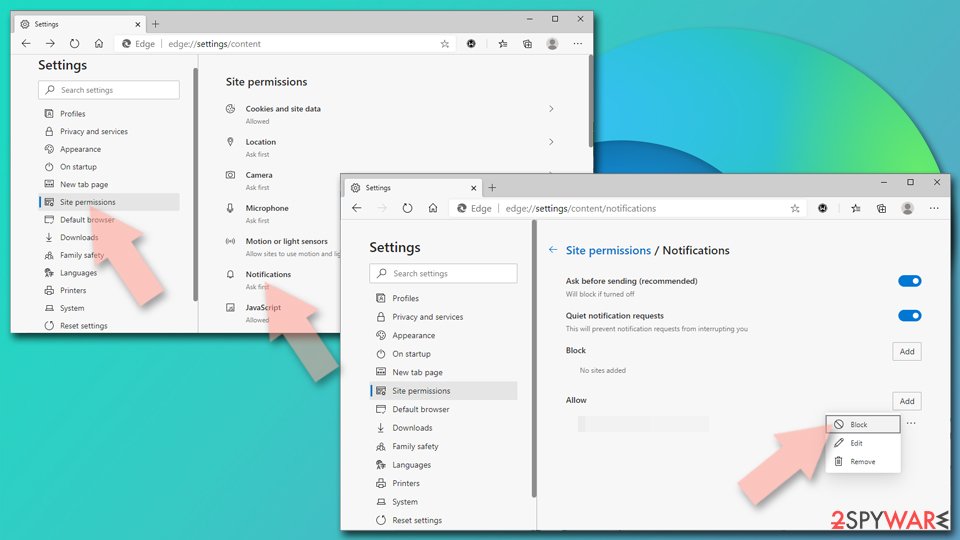
- Open Microsoft Edge, and go to Settings.
- Select Site permissions.
- Go to Notifications on the right.
- Under Allow, you will find the unwanted entry.
- Click on More actions and select Block.

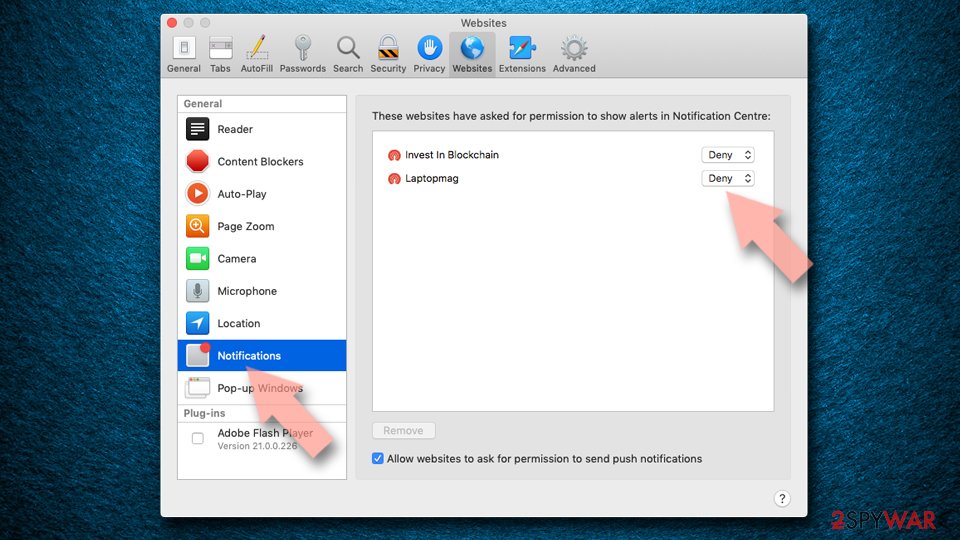
Safari
- Click on Safari > Preferences…
- Go to the Websites tab and, under General, select Notifications.
- Select the web address in question, click the drop-down menu and select Deny.

Internet Explorer
- Open Internet Explorer, and click on the Gear icon at the top-right of the window.
- Select Internet options and go to the Privacy tab.
- In the Pop-up Blocker section, click on Settings.
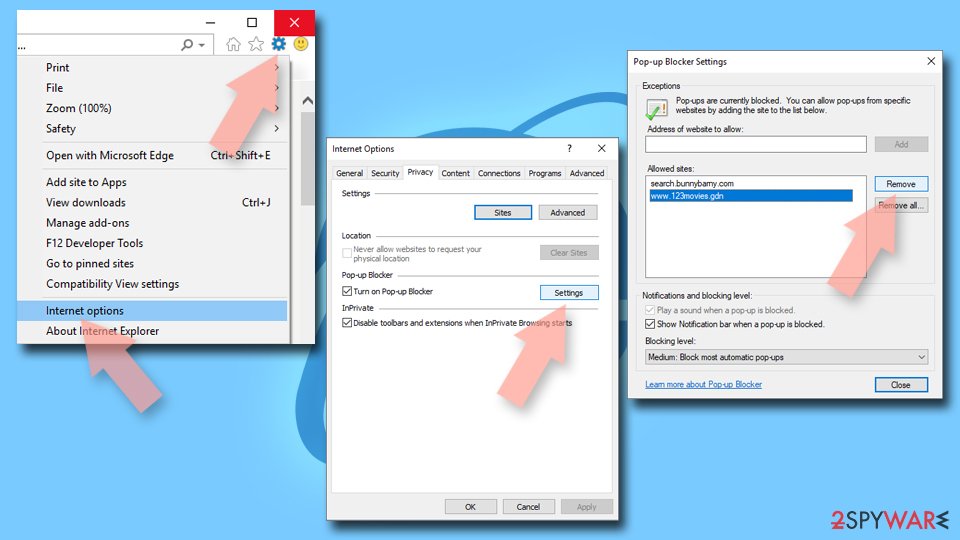
- Locate the web address in question under Allowed sites and pick Remove.

Don't forget to check your system
If you often see ads while browsing or receive misleading notifications asking for personal information or prompting you to download malicious software, it's essential to check your device for infections. Many people mistakenly think that push notifications are equivalent to a virus infection when they come from fraudulent sources. In reality, push notifications operate at the system level because you must have allowed them at some point, either knowingly or unknowingly.
It's important to understand that those affected by adware or other types of malware might be redirected to suspicious websites more frequently and encounter more ads while online. Therefore, we recommend performing a full system scan with reliable anti-malware software, e.g., SpyHunterCombo Cleaner or MalwarebytesMalwarebytes. While you can uninstall unwanted programs from your system or remove browser extensions manually, some malware programs might not be easily detectable to regular users.
If you prefer to remove threats manually, follow the instructions provided below. For those who want to clear their browser from cookies and other trackers automatically, consider using a tool like FortectIntego – it can also resolve any stability issues that may arise after removing malware from your system.
Uninstall from Windows
Uninstall from Windows 10/8:
- Type Control Panel into the Windows search box and open the result.
- Under Programs, select Uninstall a program.


Uninstall from Windows 7/XP:
- Click on Windows Start > Control Panel (Windows XP users should click on Add/Remove Programs).
- In Control Panel, select Programs > Uninstall a program.


Remove the unwanted program:
- In the Programs and Features window, look for any recently installed suspicious entries, select them, and click Uninstall.
- If User Account Control appears, click Yes to confirm, then complete the removal.


Delete from macOS
Remove the unwanted application:
- From the menu bar, select Go > Applications.
- In the Applications folder, look for any suspicious entries, then drag them to Trash (or right-click and pick Move to Trash).


Delete leftover files and folders:
- Select Go > Go to Folder.
- Enter /Library/Application Support and remove any suspicious folders related to the unwanted program.
- Repeat the same check in the /Library/LaunchAgents and /Library/LaunchDaemons folders, deleting any suspicious entries.

- Finally, empty the Trash to permanently remove the leftovers.

Remove from Microsoft Edge
Delete unwanted extensions from MS Edge:
- Select Menu (three horizontal dots at the top-right of the browser window) and pick Extensions.
- From the list, pick the extension and click on the Gear icon.
- Click Remove.


Clear cookies and other browser data:
- Click on the Menu (three horizontal dots at the top-right of the browser window) and select Settings > Privacy, search, and services..
- Under Clear browsing data, pick Choose what to clear.
- Select Cookies and other site data and Cached images and files. (apart from passwords, although you might want to include Media licenses as well, if applicable) and click on Clear.


Restore new tab and homepage settings:
- Click the menu icon and choose Settings.
- Then find On startup section.
- Click Remove next to any suspicious startup page.
Reset MS Edge if the above steps did not work:
- Press on Ctrl + Shift + Esc to open Task Manager.
- Click on More details arrow at the bottom of the window.
- Select Details tab.
- Now scroll down and locate every entry with Microsoft Edge name in it. Right-click on each of them and select End Task to stop MS Edge from running.


Instructions for Chromium-based Edge
Delete extensions from MS Edge (Chromium):
- Open Edge and click select Settings > Extensions.
- Delete unwanted extensions by clicking Remove.


Clear cache and site data:
- Click on Menu and go to Settings.
- Select Privacy, search and services.
- Under Clear browsing data, pick Choose what to clear.
- Under Time range, pick All time.
- Select Clear now.


Reset Chromium-based MS Edge:
- Click on Menu and select Settings.
- On the left side, pick Reset settings.
- Select Restore settings to their default values.
- Confirm with Reset.
- This will disable extensions and reset startup pages but will not delete bookmarks, saved passwords, or browsing history.


Remove from Mozilla Firefox (FF)
Remove dangerous extensions:
- Open Mozilla Firefox browser and click on the Menu (three horizontal lines at the top-right of the window).
- Select Add-ons.
- In here, select the unwanted extension and click Remove.


Reset the homepage:
- Click three horizontal lines at the top right corner to open the menu.
- Choose Settings.
- Under Home, set your preferred homepage and new tab settings.
Clear cookies and site data:
- Click Menu and pick Settings.
- Go to Privacy & Security section.
- Scroll down to locate Cookies and Site Data.
- Click on Clear Data...
- Select Cookies and Site Data and Temporary cached files and pages, then click Clear.


Reset Mozilla Firefox
If clearing the browser as explained above did not help, reset Mozilla Firefox:
- Open Mozilla Firefox browser and click the Menu.
- Go to Help and then choose Troubleshooting Information.

- Under Give Firefox a tune up section, click on Refresh Firefox...
- Once the pop-up shows up, confirm the action by pressing on Refresh Firefox.



Remove from Google Chrome
Delete malicious extensions from Google Chrome:
- Open Google Chrome, click on the Menu (three vertical dots at the top-right corner) and select More tools > Extensions.
- In the newly opened window, you will see all the installed extensions. Uninstall all suspicious extensions related to the unwanted program by clicking Remove.


Clear cache and web data from Chrome:
- Click on Menu and pick Settings.
- Under Privacy and security, select Clear browsing data.
- Select Browsing history, Cookies and other site data, as well as Cached images and files.
- Click Clear data.


Change your homepage:
- Click menu and choose Settings.
- Look for a suspicious site in the On startup section.
- Click on Open a specific or set of pages and click on three dots to find the Remove option.
Reset Google Chrome:
If the previous methods did not help you, reset Google Chrome to eliminate all the unwanted components:
- Click on Menu and select Settings.
- In the Settings, scroll down and click Advanced.
- Scroll down and locate Reset and clean up section.
- Now click Restore settings to their original defaults.
- Confirm with Reset settings.


Delete from Safari
Remove dangerous extensions:
- Open Safari, click Safari in the menu at the top-left of the screen, and select Preferences.
- Go to the Extensions tab, look for any suspicious entries, and click Uninstall to remove them.


Clear history and website data:
- Click Safari in the menu and pick Clear History.
- Set Clear to all history and confirm with Clear History.


Reset Safari:
- Click Safari in the menu and select Preferences > Advanced.
- Enable Show Develop menu in menu bar.
- From the menu bar, click Develop and select Empty Caches.


Did this guide help?
Be the first to comment