

Extreme Blocker is a browser-based application that should keep users from intrusive ads
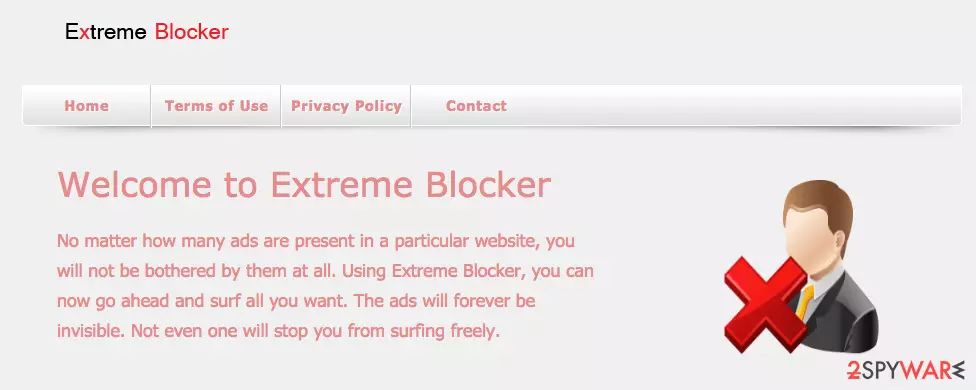
Extreme Blocker is an adware-type program that may initiate various changes on each of your web browsers and then may lead you to various troubles. In fact, it is no malicious program itself. However, it may easily infiltrate your computer behind your back and may implement suspicious activities there. For this reason, it has already been categorized as a potentially unwanted program.
Once inside, it modifies web browsers' settings and enables the displaying of various advertisements. It can work on all the most popular web browsers, including:
- Google Chrome,
- Mozilla Firefox,
- Internet Explorer,
- Safari,
- Others.
It doesn't matter which one you will use. Its advertisements may start chasing you everywhere. 'Ads by Extreme Blocker' may appear in various forms, such as pop-ups, pop-unders, banners, in-text links, interstitials, and so on. Moreover, they may be displayed over other advertisements that are already present on your web browsers.
| Name | Extreme Blocker |
| Type | Adware, potentially unwanted program |
| Alleged functionality | The plugin should provide advertisement blocks when browsing online |
| Distribution | Software bundling |
| Dangers | Shady ads might lead you to the installation of other potentially unwanted programs |
| Removal | The best solution is to remove the article's culprit by using anti-malware tools |
| System fix | In some cases, files might get damaged, resulting in errors and performance or stability issues. If you encounter such problems, use FortectIntego |
No matter how tempting Ads by Extreme Blocker look, you should never click them because you may be redirected to a suspicious third-party website and offered to buy something you don't need. So please, do not fall into this trick as you may end up with another adware on your computer or may get tricked into revealing your sensitive data to online scammers.
Be aware that in some cases, this browser add-on may hijack your homepage and default search engine. To avoid this, the only thing that you can do is to remove the virus along with its registry entries. Do not rush into editing such parts of the system yourself and rely on FortectIntego for the system fixes.
For the removal, we highly recommend using trustworthy anti-malware software. Such free tools as MalwarebytesMalwarebytes and SpyHunterCombo Cleaner are more than capable of removing any potentially unwanted program and will block you from installing such annoying software in the future.
'Ads by Extreme Blocker' typically appear on each web browser after the installation of an adware-type program. Such programs come inside the system in a bundle with free software. Unfortunately, users fall into downloading bundled programs when they install free programs recklessly and do not pay enough attention to the installation process.
Avoid suspicious content online to keep the PC virus-free
If Extreme Blocker gets inside a computer, it may cause serious troubles by displaying intrusive advertisements and redirecting to suspicious websites. Therefore, if you want to avoid infiltration of such and similar programs, you should pay more attention while installing various questionable download managers or video streaming software.
Please do not rely on not reputable websites because they are distributing programs with additional components as well. For this reason, you should always read the End-User Licence Agreement and Privacy Policy of a program that you are going to install because these sections usually disclose if the program carries third-party advertisements.
Moreover, in order to opt-out of additional components, such as add-ons, toolbars, plug-ins, or extensions, select Advanced or Custom installation, which shows all available checkboxes and allows to deselect unwanted ones. In case your computer has already been infected with the adware virus, and you are experiencing its suspicious activities, you should not ignore its presence and remove it from a system right now.
Remove Extreme Blocker virus with AV tools
If you are suffering from constant redirects, pop-up ads, and similar issues, you should remove adware responsible for it without any delay. You can do that with the help of a reputable anti-spyware or manually. You can find our suggested anti-spyware programs and manual removal guidelines down below.
The automatic Extreme Blocker removal is a more recommended option because these applications can install other programs or files to keep the persistence and run other processes on the machine. Unfortunately, these additional features also mean that PUP can damage some functions. So do not forget to check the machine using PC repair tools too.
Uninstall from Windows
Uninstall from Windows 10/8:
- Type Control Panel into the Windows search box and open the result.
- Under Programs, select Uninstall a program.


Uninstall from Windows 7/XP:
- Click on Windows Start > Control Panel (Windows XP users should click on Add/Remove Programs).
- In Control Panel, select Programs > Uninstall a program.


Remove the unwanted program:
- In the Programs and Features window, look for any recently installed suspicious entries, select them, and click Uninstall.
- If User Account Control appears, click Yes to confirm, then complete the removal.


Delete from macOS
Remove the unwanted application:
- From the menu bar, select Go > Applications.
- In the Applications folder, look for any suspicious entries, then drag them to Trash (or right-click and pick Move to Trash).


Delete leftover files and folders:
- Select Go > Go to Folder.
- Enter /Library/Application Support and remove any suspicious folders related to the unwanted program.
- Repeat the same check in the /Library/LaunchAgents and /Library/LaunchDaemons folders, deleting any suspicious entries.

- Finally, empty the Trash to permanently remove the leftovers.

Remove from Microsoft Edge
Delete unwanted extensions from MS Edge:
- Select Menu (three horizontal dots at the top-right of the browser window) and pick Extensions.
- From the list, pick the extension and click on the Gear icon.
- Click Remove.


Clear cookies and other browser data:
- Click on the Menu (three horizontal dots at the top-right of the browser window) and select Settings > Privacy, search, and services..
- Under Clear browsing data, pick Choose what to clear.
- Select Cookies and other site data and Cached images and files. (apart from passwords, although you might want to include Media licenses as well, if applicable) and click on Clear.


Restore new tab and homepage settings:
- Click the menu icon and choose Settings.
- Then find On startup section.
- Click Remove next to any suspicious startup page.
Reset MS Edge if the above steps did not work:
- Press on Ctrl + Shift + Esc to open Task Manager.
- Click on More details arrow at the bottom of the window.
- Select Details tab.
- Now scroll down and locate every entry with Microsoft Edge name in it. Right-click on each of them and select End Task to stop MS Edge from running.


Instructions for Chromium-based Edge
Delete extensions from MS Edge (Chromium):
- Open Edge and click select Settings > Extensions.
- Delete unwanted extensions by clicking Remove.


Clear cache and site data:
- Click on Menu and go to Settings.
- Select Privacy, search and services.
- Under Clear browsing data, pick Choose what to clear.
- Under Time range, pick All time.
- Select Clear now.


Reset Chromium-based MS Edge:
- Click on Menu and select Settings.
- On the left side, pick Reset settings.
- Select Restore settings to their default values.
- Confirm with Reset.
- This will disable extensions and reset startup pages but will not delete bookmarks, saved passwords, or browsing history.


Remove from Mozilla Firefox (FF)
Remove dangerous extensions:
- Open Mozilla Firefox browser and click on the Menu (three horizontal lines at the top-right of the window).
- Select Add-ons.
- In here, select the unwanted extension and click Remove.


Reset the homepage:
- Click three horizontal lines at the top right corner to open the menu.
- Choose Settings.
- Under Home, set your preferred homepage and new tab settings.
Clear cookies and site data:
- Click Menu and pick Settings.
- Go to Privacy & Security section.
- Scroll down to locate Cookies and Site Data.
- Click on Clear Data...
- Select Cookies and Site Data and Temporary cached files and pages, then click Clear.


Reset Mozilla Firefox
If clearing the browser as explained above did not help, reset Mozilla Firefox:
- Open Mozilla Firefox browser and click the Menu.
- Go to Help and then choose Troubleshooting Information.

- Under Give Firefox a tune up section, click on Refresh Firefox...
- Once the pop-up shows up, confirm the action by pressing on Refresh Firefox.



Remove from Google Chrome
Delete malicious extensions from Google Chrome:
- Open Google Chrome, click on the Menu (three vertical dots at the top-right corner) and select More tools > Extensions.
- In the newly opened window, you will see all the installed extensions. Uninstall all suspicious extensions related to the unwanted program by clicking Remove.


Clear cache and web data from Chrome:
- Click on Menu and pick Settings.
- Under Privacy and security, select Clear browsing data.
- Select Browsing history, Cookies and other site data, as well as Cached images and files.
- Click Clear data.


Change your homepage:
- Click menu and choose Settings.
- Look for a suspicious site in the On startup section.
- Click on Open a specific or set of pages and click on three dots to find the Remove option.
Reset Google Chrome:
If the previous methods did not help you, reset Google Chrome to eliminate all the unwanted components:
- Click on Menu and select Settings.
- In the Settings, scroll down and click Advanced.
- Scroll down and locate Reset and clean up section.
- Now click Restore settings to their original defaults.
- Confirm with Reset settings.


Delete from Safari
Remove dangerous extensions:
- Open Safari, click Safari in the menu at the top-left of the screen, and select Preferences.
- Go to the Extensions tab, look for any suspicious entries, and click Uninstall to remove them.


Clear history and website data:
- Click Safari in the menu and pick Clear History.
- Set Clear to all history and confirm with Clear History.


Reset Safari:
- Click Safari in the menu and select Preferences > Advanced.
- Enable Show Develop menu in menu bar.
- From the menu bar, click Develop and select Empty Caches.


Did this guide help?
Be the first to comment