

SearchAssist.net search engine might not be that trustworthy
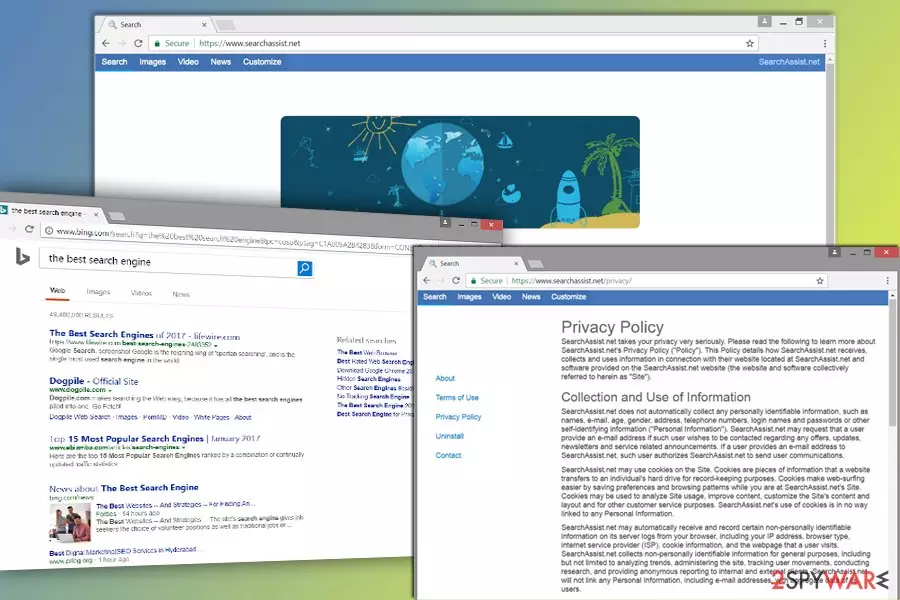
SearchAssist.net is one of those search engines that can be set to appear on victim's browser without user's permission or knowledge. In the official website, developers offer to install SearchAssist.me plugin and use their services. However, if it were the one and the only distribution method, we wouldn’t be talking about this app.
This browser plugin or website may appear on your Internet Explorer, Google Chrome or Mozilla Firefox after one careless software installation accident[1]. This browser hijacker spreads hidden in the software packages, and you can easily experience SearchAssist.net hijack when rushing with the installation of the new program.
Once inside your PC, it alters all your browsers’ settings and forces you to see this domain every time you decide to browse the Internet. Even though it looks like an ordinary search engine and might resemble a well-known Google, you should not trust it as much as the search giant.
This shady program is capable of modifying search results. That means that instead of organic results, you may find lots of sponsored links and ads. NoVirus.uk experts[2] explain that the hijacker communicates with Trovi redirect virus to serve sponsored results and collect users' search queries.
At the moment of writing, the final page that the victim gets landed on after visiting Trovi.com is Bing. However, cybersecurity specialists have already warned users that it may be just temporary and shady modifications with serious consequences may show up any minute. In no time, you need to remove SearchAssist.net virus from your computer.
So-called virus (which in reality is rather a browser hijacker than a virus) may not only play with your search results but also bombard you with various pop-up ads[3] and may even track your browsing habits[4] in order to get more knowledge about your activity on the Internet.
If you have thought that SearchAssist.net redirect activity is harmless, you should think again because such information as search terms, most visited websites, time that is spent on each of them, data that is entered, etc. may reveal a little bit too much about you.

That's why we highly recommend keeping it private. For full SearchAssist.net removal, you should waste no time and scan your PC with updated anti-spyware, for instance FortectIntego. We recommend opting for automatic elimination instead of manual because it’s the quickest and easiest way to investigate computer’s system.
It might take ages looking for potentially dangerous components that may be related to the browser hijacker without any help. However, if you feel capable and having enough skills, you can try manual removal option which was created by our experts.
Currently known versions of SearchAssist
MyPrivacyAssistant.com virus. MyPrivacyAssistant search will be set as your default one if you install a suspicious program that is widely known as a “browser hijacker.” Just like the initial version, it aims to serve sponsored search results collected from various ad networks.
What is more, My Privacy Assistant gathers search results from Trovi, which is an infamous provider of modified search results. It's best to avoid these search tools if you want to enjoy secure browsing sessions. To remove these programs, you might need to use anti-spyware software since they tend to hide themselves in the computer system to protect themselves from unexpected removal.
Users install unwanted browser extensions without realizing it
Just like any other potentially unwanted program, SearchAssist.net virus spreads around using “bundling.”[5] Unfortunately but we can't say what programs have been involved in its distribution. That's why you should try to be careful when downloading ANY free application.
The first thing that you have to remember is that you should dedicate some time for reading end user's license agreement, privacy policy and similar information about your free program. If you decided that everything is clear, make sure you select Custom or Advanced installation method of the freeware.
This method will help you to see what “optional” components are trying to get inside your PC system. Please, opt out of this and similar unknown search engines, browser add-ons[6], toolbars, plugins, and extensions.
Efficient ways to complete SearchAssist.net removal
Earlier we have mentioned that manual SearchAssist.net removal requires exploring affected computer’s system. Below you can find guidelines how to do it. Make sure you remove all hijacker-related components and fix all web browsers. If you leave something, you may experience another hijack.
What is more, don't forget to fix your web browsers. The hijacker is compatible with Internet Explorer, Google Chrome, and Mozilla Firefox; however, we recommend checking other browsers as well. If you have no experience in such activities, we highly recommend opting for automatic removal.
Not only this method saves times but also assures that all PUPs and malicious components are deleted from the machine. To remove SearchAssist.net automatically, you have to install the anti-spyware program, update it and run a full system scan.
Uninstall from Windows
Uninstall from Windows 10/8:
- Type Control Panel into the Windows search box and open the result.
- Under Programs, select Uninstall a program.


Uninstall from Windows 7/XP:
- Click on Windows Start > Control Panel (Windows XP users should click on Add/Remove Programs).
- In Control Panel, select Programs > Uninstall a program.


Remove the unwanted program:
- In the Programs and Features window, look for any recently installed suspicious entries, select them, and click Uninstall.
- If User Account Control appears, click Yes to confirm, then complete the removal.


Delete from macOS
Remove the unwanted application:
- From the menu bar, select Go > Applications.
- In the Applications folder, look for any suspicious entries, then drag them to Trash (or right-click and pick Move to Trash).


Delete leftover files and folders:
- Select Go > Go to Folder.
- Enter /Library/Application Support and remove any suspicious folders related to the unwanted program.
- Repeat the same check in the /Library/LaunchAgents and /Library/LaunchDaemons folders, deleting any suspicious entries.

- Finally, empty the Trash to permanently remove the leftovers.

Reset Internet Explorer
Remove dangerous add-ons:
- Open Internet Explorer, click on the Gear icon (IE menu) on the top-right corner of the browser
- Pick Manage Add-ons.
- You will see a Manage Add-ons window. Here, look for suspicious plugins. Click on these entries and select Disable.


Change your homepage if it was altered:
- Open IE and click on the Gear icon.
- Select Internet Options.
- In the General tab, delete the Home page address and replace it by your preferred one (for example, Google.com).
- Click Apply and then select OK.


Delete temporary files:
- Press on the Gear icon and select Internet Options.
- Under Browsing history, click Delete...
- Select relevant fields and press Delete.


Reset Internet Explorer:
- Click on Gear icon > Internet options and select Advanced tab.
- Select Reset.
- In the new window, check Delete personal settings and select Reset.


Remove from Microsoft Edge
Delete unwanted extensions from MS Edge:
- Select Menu (three horizontal dots at the top-right of the browser window) and pick Extensions.
- From the list, pick the extension and click on the Gear icon.
- Click Remove.


Clear cookies and other browser data:
- Click on the Menu (three horizontal dots at the top-right of the browser window) and select Settings > Privacy, search, and services..
- Under Clear browsing data, pick Choose what to clear.
- Select Cookies and other site data and Cached images and files. (apart from passwords, although you might want to include Media licenses as well, if applicable) and click on Clear.


Restore new tab and homepage settings:
- Click the menu icon and choose Settings.
- Then find On startup section.
- Click Remove next to any suspicious startup page.
Reset MS Edge if the above steps did not work:
- Press on Ctrl + Shift + Esc to open Task Manager.
- Click on More details arrow at the bottom of the window.
- Select Details tab.
- Now scroll down and locate every entry with Microsoft Edge name in it. Right-click on each of them and select End Task to stop MS Edge from running.


Instructions for Chromium-based Edge
Delete extensions from MS Edge (Chromium):
- Open Edge and click select Settings > Extensions.
- Delete unwanted extensions by clicking Remove.


Clear cache and site data:
- Click on Menu and go to Settings.
- Select Privacy, search and services.
- Under Clear browsing data, pick Choose what to clear.
- Under Time range, pick All time.
- Select Clear now.


Reset Chromium-based MS Edge:
- Click on Menu and select Settings.
- On the left side, pick Reset settings.
- Select Restore settings to their default values.
- Confirm with Reset.
- This will disable extensions and reset startup pages but will not delete bookmarks, saved passwords, or browsing history.


Remove from Mozilla Firefox (FF)
Remove dangerous extensions:
- Open Mozilla Firefox browser and click on the Menu (three horizontal lines at the top-right of the window).
- Select Add-ons.
- In here, select the unwanted extension and click Remove.


Reset the homepage:
- Click three horizontal lines at the top right corner to open the menu.
- Choose Settings.
- Under Home, set your preferred homepage and new tab settings.
Clear cookies and site data:
- Click Menu and pick Settings.
- Go to Privacy & Security section.
- Scroll down to locate Cookies and Site Data.
- Click on Clear Data...
- Select Cookies and Site Data and Temporary cached files and pages, then click Clear.


Reset Mozilla Firefox
If clearing the browser as explained above did not help, reset Mozilla Firefox:
- Open Mozilla Firefox browser and click the Menu.
- Go to Help and then choose Troubleshooting Information.

- Under Give Firefox a tune up section, click on Refresh Firefox...
- Once the pop-up shows up, confirm the action by pressing on Refresh Firefox.



Remove from Google Chrome
Delete malicious extensions from Google Chrome:
- Open Google Chrome, click on the Menu (three vertical dots at the top-right corner) and select More tools > Extensions.
- In the newly opened window, you will see all the installed extensions. Uninstall all suspicious extensions related to the unwanted program by clicking Remove.


Clear cache and web data from Chrome:
- Click on Menu and pick Settings.
- Under Privacy and security, select Clear browsing data.
- Select Browsing history, Cookies and other site data, as well as Cached images and files.
- Click Clear data.


Change your homepage:
- Click menu and choose Settings.
- Look for a suspicious site in the On startup section.
- Click on Open a specific or set of pages and click on three dots to find the Remove option.
Reset Google Chrome:
If the previous methods did not help you, reset Google Chrome to eliminate all the unwanted components:
- Click on Menu and select Settings.
- In the Settings, scroll down and click Advanced.
- Scroll down and locate Reset and clean up section.
- Now click Restore settings to their original defaults.
- Confirm with Reset settings.


Delete from Safari
Remove dangerous extensions:
- Open Safari, click Safari in the menu at the top-left of the screen, and select Preferences.
- Go to the Extensions tab, look for any suspicious entries, and click Uninstall to remove them.


Clear history and website data:
- Click Safari in the menu and pick Clear History.
- Set Clear to all history and confirm with Clear History.


Reset Safari:
- Click Safari in the menu and select Preferences > Advanced.
- Enable Show Develop menu in menu bar.
- From the menu bar, click Develop and select Empty Caches.


Did this guide help?
2 comments
Janet
It looked like a realiable search engine. I cant believe it! It seems that I have to remove this search engine...
Kalev
I was looking for a new search engine as well. You know, I just thought I would like to try something new. I have been using searchassist.net for few months, and I noticed some strange ads popping up. Now I realised that I shouldnt have tolerated them. Ive just recently heard that hackers can infect ads and spread viruses, and tools like this help them. Its horrible!