

Alibaba ads – unwanted pop-ups and other disruptions that disturb users' web browsing sessions
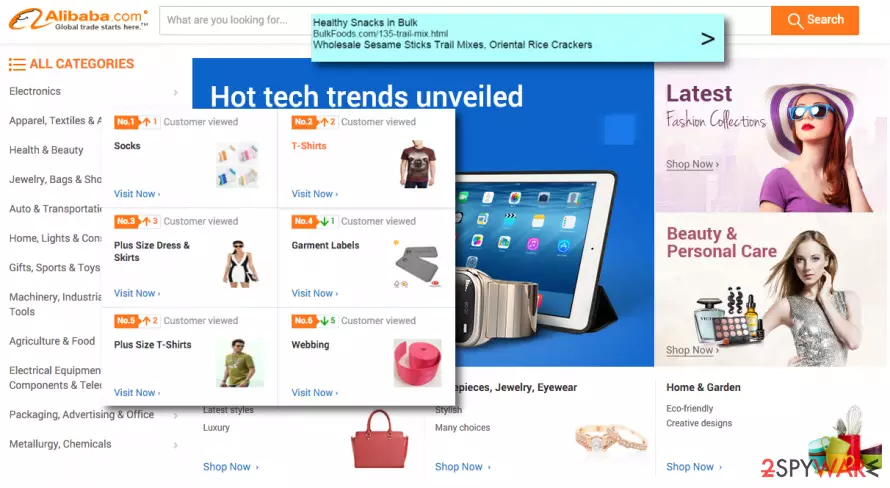
Offer.alibaba.com is a site that is closely related to a potentially unwanted program (PUP)[1], more precisely – adware.[2] This ad-supported software usually gets installed together with free applications from third-party websites and performs a variety of changes to Google Chrome, Internet Explorer, Mozilla Firefox, Safari or another browser. After these modifications, Offer.alibaba.com ads, pop-ups, in-text links, and other content start appearing on most websites that users visit. Some of these ads can be quite persistent. As a result, people have begun using “Alibaba spyware” term to describe their issue.
| Name | Offer.alibaba.com |
| Type | Adware/PUP |
| Infiltration | Software bundling, third-party sites |
| Symptoms | Intrusive ads appear on all browsers, advertising Alibaba services; redirects to other suspicious sites; other browser changes |
| Affected browsers | Google Chrome, Internet Explorer, Mozilla Firefox, Safari, Opera, etc. |
| Risk factors | Loss of money, malware infection, personal information leakage |
| Termination | Either employ security software or use our manual instructions below |
| Recovery | Install and run a scan with FortectIntego |
Once Alibaba virus gets into the system, it inserts its specific code into your browser. Afterward, expect redirects to the shopping website and multiple advertisements cramming the computer screen.
Such marketing technique can be used for promoting various sellers, such as Alibaba, Amazon, Aliexpress and other online shopping websites. However, in some cases, developers of Offer.Alibaba.com virus can trigger redirects to unsafe sites or start causing such activity without user's approval. Keep in mind that gaining revenue is the main aim of these developers.
There’s no doubt that these Offer.Alibaba.com commercial offers may appear to be very intrusive and disruptive. Excessive advertising is the browsing feature which might infuriate some users. Therefore, it would be best to remove Alibaba virus as soon as possible.
Offer.alibaba.com ads may convince you into thinking that these they inform users about the best current deals and offers and biggest discounts. However, it has been revealed that the adware may misguide you to other advertising domains which might be “enhanced” with infected elements.
Thus, if you want to minimize your chances of becoming a victim of cyber crime[3] or accidentally installing a malicious program, it is time you should start Alibaba virus removal. Keep in min that PUP uses cookies and other tracking technologies to spy on your browsing experience in order to give personalized advertisements which you might be willing to click more.

Those users, who are extremely concerned about the security of privacy, may start to worry. The Offer.alibaba.com service collects information about your:
- search queries,
- visited pages,
- web browser's type,
- language,
- software/hardware information,
- PC's IP address,
- approximate geolocation,
- email address,
- and so on.
The problem is that some of the data which is collected by Alibaba virus may still contain personally identifiable information that the user may not be keen on disclosing. Though the majority of legitimate websites also gather non-personal information, almost every adware application may transfer this data to its partner companies. The result of this transfer comes as the numerous personalized commercial offers start popping up in your browser.
Due to Offer.alibaba.com redirect tendency, the commercial offers may mislead you to affiliated domains. The problem is that they may not be secure. We highly recommend you to look for the best deals by yourself because it is unlikely that these ads can offer the lowest price of the lowest.
Thus, if you are dealing with annoying redirects and shopping offers, you should dedicate some time and get rid of Offer.alibaba.com ads. The quickest method to uninstall the PUP which is responsible for showing them is to scan the device with FortectIntego. However, you can follow manual removal guide too.

Adware can get into inattentive computer users’ PCs
This potentially unwanted program targets different users all around the world. Whether if you are a shopping enthusiast or just occasionally use the services of shopping domains, hijack may take place. It occurred when you recklessly rushed through the steps of an installation procedure of software you downloaded from the internet.
Researchers from faravirus.ro[4] claim that freeware and shareware[5] happen to be carriers of PUPs. When users do not pay enough attention, they overlook the attachments and voilà – the adware settles on the computer.
In order to trace such irrelevant add-ons, it's paramount to choose “Advanced” or “Custom” installation option (instead of “Quick” or “Recommended) and follow each step attentively. If you fail to spot this and similar attachments, each of them are installed by default.
Remove Offer.alibaba.com adware from the device
Speaking of Alibaba virus removal options, we highly recommend using the automatic option. Install anti-spyware application and let it perform the elimination. Usually, it does not require much of your time. Thus, you can be sure that the adware is completely exterminated.
Alternatively, you can remove offer.alibaba.com ads manually. Locate the instructions below. Remember to pay attention and precision when implementing each step of the guidelines. If you leave some of the adware-related components, these annoying activities get back to the system.
Uninstall from Windows
Uninstall from Windows 10/8:
- Type Control Panel into the Windows search box and open the result.
- Under Programs, select Uninstall a program.


Uninstall from Windows 7/XP:
- Click on Windows Start > Control Panel (Windows XP users should click on Add/Remove Programs).
- In Control Panel, select Programs > Uninstall a program.


Remove the unwanted program:
- In the Programs and Features window, look for any recently installed suspicious entries, select them, and click Uninstall.
- If User Account Control appears, click Yes to confirm, then complete the removal.


Delete from macOS
Remove the unwanted application:
- From the menu bar, select Go > Applications.
- In the Applications folder, look for any suspicious entries, then drag them to Trash (or right-click and pick Move to Trash).


Delete leftover files and folders:
- Select Go > Go to Folder.
- Enter /Library/Application Support and remove any suspicious folders related to the unwanted program.
- Repeat the same check in the /Library/LaunchAgents and /Library/LaunchDaemons folders, deleting any suspicious entries.

- Finally, empty the Trash to permanently remove the leftovers.

Reset Internet Explorer
Remove dangerous add-ons:
- Open Internet Explorer, click on the Gear icon (IE menu) on the top-right corner of the browser
- Pick Manage Add-ons.
- You will see a Manage Add-ons window. Here, look for suspicious plugins. Click on these entries and select Disable.


Change your homepage if it was altered:
- Open IE and click on the Gear icon.
- Select Internet Options.
- In the General tab, delete the Home page address and replace it by your preferred one (for example, Google.com).
- Click Apply and then select OK.


Delete temporary files:
- Press on the Gear icon and select Internet Options.
- Under Browsing history, click Delete...
- Select relevant fields and press Delete.


Reset Internet Explorer:
- Click on Gear icon > Internet options and select Advanced tab.
- Select Reset.
- In the new window, check Delete personal settings and select Reset.


Remove from Microsoft Edge
Delete unwanted extensions from MS Edge:
- Select Menu (three horizontal dots at the top-right of the browser window) and pick Extensions.
- From the list, pick the extension and click on the Gear icon.
- Click Remove.


Clear cookies and other browser data:
- Click on the Menu (three horizontal dots at the top-right of the browser window) and select Settings > Privacy, search, and services..
- Under Clear browsing data, pick Choose what to clear.
- Select Cookies and other site data and Cached images and files. (apart from passwords, although you might want to include Media licenses as well, if applicable) and click on Clear.


Restore new tab and homepage settings:
- Click the menu icon and choose Settings.
- Then find On startup section.
- Click Remove next to any suspicious startup page.
Reset MS Edge if the above steps did not work:
- Press on Ctrl + Shift + Esc to open Task Manager.
- Click on More details arrow at the bottom of the window.
- Select Details tab.
- Now scroll down and locate every entry with Microsoft Edge name in it. Right-click on each of them and select End Task to stop MS Edge from running.


Instructions for Chromium-based Edge
Delete extensions from MS Edge (Chromium):
- Open Edge and click select Settings > Extensions.
- Delete unwanted extensions by clicking Remove.


Clear cache and site data:
- Click on Menu and go to Settings.
- Select Privacy, search and services.
- Under Clear browsing data, pick Choose what to clear.
- Under Time range, pick All time.
- Select Clear now.


Reset Chromium-based MS Edge:
- Click on Menu and select Settings.
- On the left side, pick Reset settings.
- Select Restore settings to their default values.
- Confirm with Reset.
- This will disable extensions and reset startup pages but will not delete bookmarks, saved passwords, or browsing history.


Remove from Mozilla Firefox (FF)
Remove dangerous extensions:
- Open Mozilla Firefox browser and click on the Menu (three horizontal lines at the top-right of the window).
- Select Add-ons.
- In here, select the unwanted extension and click Remove.


Reset the homepage:
- Click three horizontal lines at the top right corner to open the menu.
- Choose Settings.
- Under Home, set your preferred homepage and new tab settings.
Clear cookies and site data:
- Click Menu and pick Settings.
- Go to Privacy & Security section.
- Scroll down to locate Cookies and Site Data.
- Click on Clear Data...
- Select Cookies and Site Data and Temporary cached files and pages, then click Clear.


Reset Mozilla Firefox
If clearing the browser as explained above did not help, reset Mozilla Firefox:
- Open Mozilla Firefox browser and click the Menu.
- Go to Help and then choose Troubleshooting Information.

- Under Give Firefox a tune up section, click on Refresh Firefox...
- Once the pop-up shows up, confirm the action by pressing on Refresh Firefox.



Remove from Google Chrome
Delete malicious extensions from Google Chrome:
- Open Google Chrome, click on the Menu (three vertical dots at the top-right corner) and select More tools > Extensions.
- In the newly opened window, you will see all the installed extensions. Uninstall all suspicious extensions related to the unwanted program by clicking Remove.


Clear cache and web data from Chrome:
- Click on Menu and pick Settings.
- Under Privacy and security, select Clear browsing data.
- Select Browsing history, Cookies and other site data, as well as Cached images and files.
- Click Clear data.


Change your homepage:
- Click menu and choose Settings.
- Look for a suspicious site in the On startup section.
- Click on Open a specific or set of pages and click on three dots to find the Remove option.
Reset Google Chrome:
If the previous methods did not help you, reset Google Chrome to eliminate all the unwanted components:
- Click on Menu and select Settings.
- In the Settings, scroll down and click Advanced.
- Scroll down and locate Reset and clean up section.
- Now click Restore settings to their original defaults.
- Confirm with Reset settings.


Delete from Safari
Remove dangerous extensions:
- Open Safari, click Safari in the menu at the top-left of the screen, and select Preferences.
- Go to the Extensions tab, look for any suspicious entries, and click Uninstall to remove them.


Clear history and website data:
- Click Safari in the menu and pick Clear History.
- Set Clear to all history and confirm with Clear History.


Reset Safari:
- Click Safari in the menu and select Preferences > Advanced.
- Enable Show Develop menu in menu bar.
- From the menu bar, click Develop and select Empty Caches.


Did this guide help?
Be the first to comment