

“Ads by Surf Secure,” “Surf Secure deals,” “Surf Secure ads” shop up on my screen the whole time. These ads send me annoying shopping offers and similar unnecessary stuff. How can I get these ads off my screen? They really annoy me!
Why do Surf Secure ads show up on my screen?
If “ads by Surf Secure” started to appear on your computer screen, be careful – it indicates that your computer was hijacked by Surf Secure adware. Of course, this program can be installed by your wish as well. Its download link can also be found on the official website of it. However, in the most of the cases, people complain that this adware application somehow was installed on the computer without their consent. This can happen because this application is mostly spread as an addition to other free programs or shareware. Many computer users tend to trust Default or Standard installation settings – they usually believe that these settings are customized in order to install software safely. Wrong! These settings usually include suggestions to install ‘optional downloads,’ which will be automatically installed together with your preferred program. To refuse to install these additions, you have to opt for Advanced or Custom installation mode. Then, you should receive a list of software recommendations, and you have to deselect the agreements to install them. If you have already noticed the suspicious ads, proceed reading on page 2 to find Surf Secure removal guide.
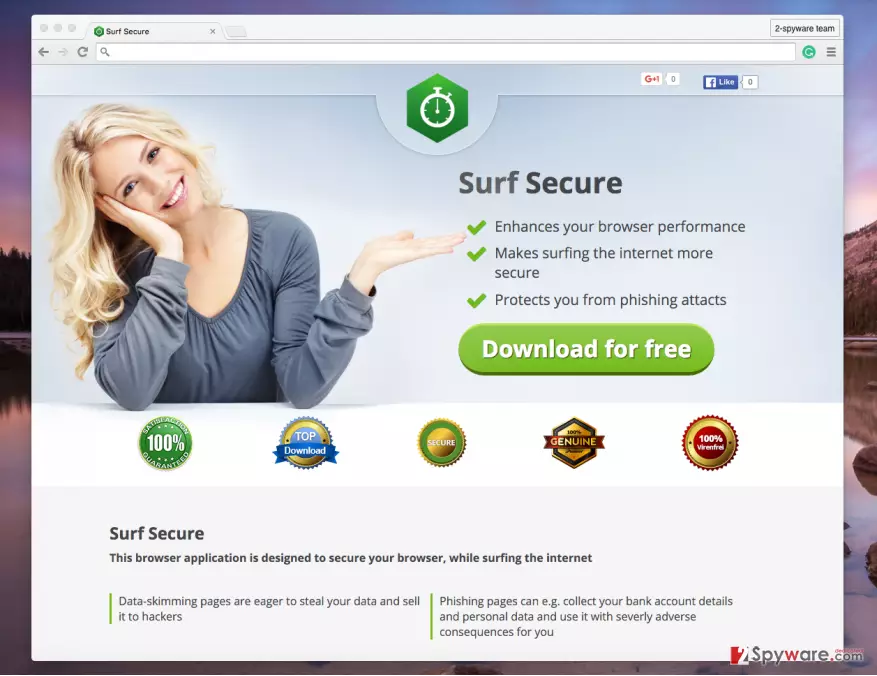
What happens if Surf Secure hijacks the computer system?
If this program succeeds to enter your computer seamlessly, it installs Surf Secure extension to your web browser or a few of them, depending on how many different Internet browsers you have installed on your machine. It can affect Internet Explorer, Mozilla Firefox, Google Chrome, Safari and other Internet browsers. Once it installs its extension, it starts to track what websites do you go to, what search terms do you use, what links do you click on and similar data. All of this helps Surf Secure PUP (potentially unwanted program) understand your needs and interests. It simply finds out what topics attract you; based on the data collected, it selects advertisements from its server and starts to display them for you in a form of pop-ups or banners placed on the websites that you visit. We strongly recommend not to click on these ads as they can lead you to suspicious third-party websites.
In some cases, clicking on SurfSecure ads might even open pages that you were not expecting to visit; sadly, some of these websites can belong to untrustworthy third-party companies. Keep in mind that such websites sometimes offer to install free apps, updates, or other content for free – we suggest avoiding such proposals as you can never be sure whether the website provides a safe or a malicious file. To stay away from potential dangers to your computer, we do not recommend using Surf Secure software at all. You can remove it manually or with an anti-spyware software. We recommend using one of the following anti-spyware programs:
How to remove it?
For some computer users, software removal process can be an easy task to do. However, not all computer users are experienced, and that is completely normal. That is why we have provided the manual Surf Secure virus removal guide – you can find comprehensive instructions how to get this computer parasite out of the system below the article.
However, we strongly recommend checking your system with an automatic spyware removal tool. Keep in mind that it can detect computer threats that are hard to notice as they tend to function in the background processes silently.
Uninstall from Windows
Uninstall from Windows 10/8:
- Type Control Panel into the Windows search box and open the result.
- Under Programs, select Uninstall a program.


Uninstall from Windows 7/XP:
- Click on Windows Start > Control Panel (Windows XP users should click on Add/Remove Programs).
- In Control Panel, select Programs > Uninstall a program.


Remove the unwanted program:
- In the Programs and Features window, look for any recently installed suspicious entries, select them, and click Uninstall.
- If User Account Control appears, click Yes to confirm, then complete the removal.


Delete from macOS
Remove the unwanted application:
- From the menu bar, select Go > Applications.
- In the Applications folder, look for any suspicious entries, then drag them to Trash (or right-click and pick Move to Trash).


Delete leftover files and folders:
- Select Go > Go to Folder.
- Enter /Library/Application Support and remove any suspicious folders related to the unwanted program.
- Repeat the same check in the /Library/LaunchAgents and /Library/LaunchDaemons folders, deleting any suspicious entries.

- Finally, empty the Trash to permanently remove the leftovers.

Remove from Microsoft Edge
Delete unwanted extensions from MS Edge:
- Select Menu (three horizontal dots at the top-right of the browser window) and pick Extensions.
- From the list, pick the extension and click on the Gear icon.
- Click Remove.


Clear cookies and other browser data:
- Click on the Menu (three horizontal dots at the top-right of the browser window) and select Settings > Privacy, search, and services..
- Under Clear browsing data, pick Choose what to clear.
- Select Cookies and other site data and Cached images and files. (apart from passwords, although you might want to include Media licenses as well, if applicable) and click on Clear.


Restore new tab and homepage settings:
- Click the menu icon and choose Settings.
- Then find On startup section.
- Click Remove next to any suspicious startup page.
Reset MS Edge if the above steps did not work:
- Press on Ctrl + Shift + Esc to open Task Manager.
- Click on More details arrow at the bottom of the window.
- Select Details tab.
- Now scroll down and locate every entry with Microsoft Edge name in it. Right-click on each of them and select End Task to stop MS Edge from running.


Instructions for Chromium-based Edge
Delete extensions from MS Edge (Chromium):
- Open Edge and click select Settings > Extensions.
- Delete unwanted extensions by clicking Remove.


Clear cache and site data:
- Click on Menu and go to Settings.
- Select Privacy, search and services.
- Under Clear browsing data, pick Choose what to clear.
- Under Time range, pick All time.
- Select Clear now.


Reset Chromium-based MS Edge:
- Click on Menu and select Settings.
- On the left side, pick Reset settings.
- Select Restore settings to their default values.
- Confirm with Reset.
- This will disable extensions and reset startup pages but will not delete bookmarks, saved passwords, or browsing history.


Remove from Mozilla Firefox (FF)
Remove dangerous extensions:
- Open Mozilla Firefox browser and click on the Menu (three horizontal lines at the top-right of the window).
- Select Add-ons.
- In here, select the unwanted extension and click Remove.


Reset the homepage:
- Click three horizontal lines at the top right corner to open the menu.
- Choose Settings.
- Under Home, set your preferred homepage and new tab settings.
Clear cookies and site data:
- Click Menu and pick Settings.
- Go to Privacy & Security section.
- Scroll down to locate Cookies and Site Data.
- Click on Clear Data...
- Select Cookies and Site Data and Temporary cached files and pages, then click Clear.


Reset Mozilla Firefox
If clearing the browser as explained above did not help, reset Mozilla Firefox:
- Open Mozilla Firefox browser and click the Menu.
- Go to Help and then choose Troubleshooting Information.

- Under Give Firefox a tune up section, click on Refresh Firefox...
- Once the pop-up shows up, confirm the action by pressing on Refresh Firefox.



Remove from Google Chrome
Delete malicious extensions from Google Chrome:
- Open Google Chrome, click on the Menu (three vertical dots at the top-right corner) and select More tools > Extensions.
- In the newly opened window, you will see all the installed extensions. Uninstall all suspicious extensions related to the unwanted program by clicking Remove.


Clear cache and web data from Chrome:
- Click on Menu and pick Settings.
- Under Privacy and security, select Clear browsing data.
- Select Browsing history, Cookies and other site data, as well as Cached images and files.
- Click Clear data.


Change your homepage:
- Click menu and choose Settings.
- Look for a suspicious site in the On startup section.
- Click on Open a specific or set of pages and click on three dots to find the Remove option.
Reset Google Chrome:
If the previous methods did not help you, reset Google Chrome to eliminate all the unwanted components:
- Click on Menu and select Settings.
- In the Settings, scroll down and click Advanced.
- Scroll down and locate Reset and clean up section.
- Now click Restore settings to their original defaults.
- Confirm with Reset settings.


Delete from Safari
Remove dangerous extensions:
- Open Safari, click Safari in the menu at the top-left of the screen, and select Preferences.
- Go to the Extensions tab, look for any suspicious entries, and click Uninstall to remove them.


Clear history and website data:
- Click Safari in the menu and pick Clear History.
- Set Clear to all history and confirm with Clear History.


Reset Safari:
- Click Safari in the menu and select Preferences > Advanced.
- Enable Show Develop menu in menu bar.
- From the menu bar, click Develop and select Empty Caches.


Did this guide help?
5 comments
Rupert8
These ads used to appear when I opened the Ebay website. I shop there a lot, but could not realize where do these ads come from. My cousin helped me to remove it. You should never install Surf Secure, it is a nerve-wracking program!
Kyoto
SurfSecure installed itself without my permission!!!!
Paulina
So happy to finally get rid of this virus. It delivers an unbelievable number of ads - it is extremely interrupting activity! Is it even a legal program at all?
glaze1870
Ive spotted these advertisements on Amazon
oTIS
Yup its legal, but that it cant be denied that it is just a crapware that is completely useless