

Can I trust Search.fvpimageviewer.com?
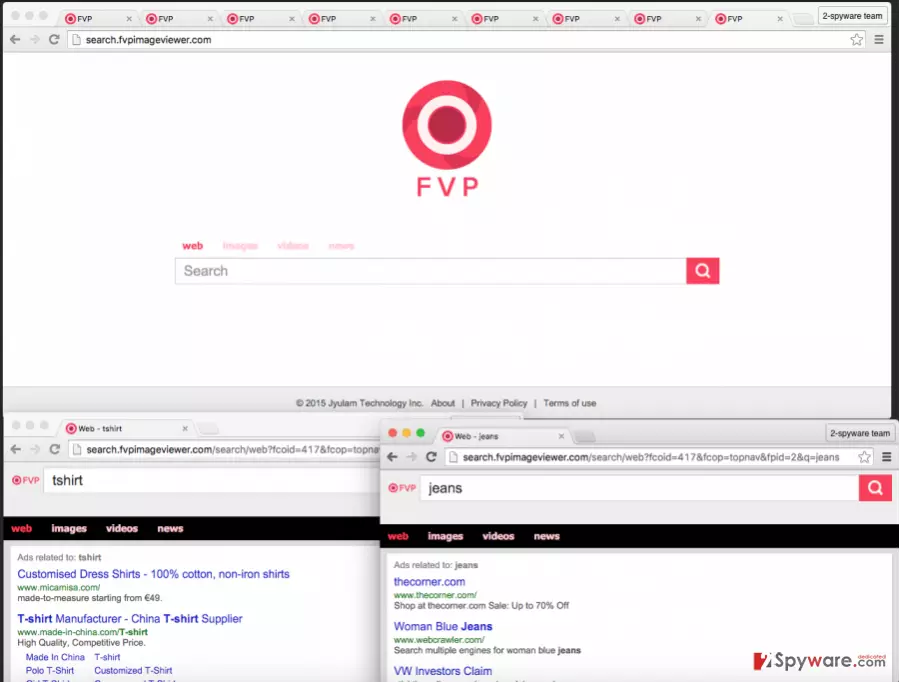
Search.fvpimageviewer.com is a misleading search engine, developed by Jyulam Technology Inc. You shouldn’t replace your favorite search engine with this one because it can show you sponsored search results filled with misleading links and pop-up ads. According to 2-spyware.com researchers, these links can redirect you to questionable websites that have nothing to do with your search queries. If you don’t want to end up on a malicious domain, you need to stay away from this search site. Of course, it can also show up on your computer without your permission as it has been actively distributed together with the questionable software called FVP Image Viewer. Be careful with this software because it is deemed to be a potentially unwanted program (PUP) and has also been used to spread Search2.fvpimageviewer.com and Search4.fvpimageviewer.com hijackers. Each of these search engines are identical and should never be used for searching. If you have noticed any of them instead of your homepage or the default search engine, do NOT ignore these changes. In this case, make sure you remove Search.fvpimageviewer.com from your computer together with each of its components. The easiest way to eliminate it from your PC is to use FortectIntego.
What are the main cons of this browser hijacker?
Looking like a regular search engine, Search.fvpimageviewer.com and its versions do not look suspicious. However, you should have already noticed that it is capable of replacing your homepage without your permission. Moreover, you should gradually notice more and more problems while keeping this hijacker on your computer. Let us provide a list of the main inconveniences caused by this browser hijacker:
- This doubtfully reliable application diminishes the system performance.
- It replaces browser’s homepage and does not allow to replace it with another web page.
- The search service this page provides is deceptive: it displays sponsored search results and causes ads to third party websites. Keep in mind that some search outcomes might be corrupted and carry delusive hyperlinks that can cause Search.fvpimageviewer.com redirect on your web browser.
- Be careful because this PUP might aim to reroute you to unreliable third-party websites that are affiliated with this program; some of such websites may promote critical applications (spyware or malware). You should bypass high-risk web sources at all times; do not agree to install questionable programs because they might be malicious.
- It is also known that this hijacker is capable of spying on your activity online. Once inside and active, this dubious application tracks what websites do you visit, what files do you download, what links do you click on, how much time do you spend on particular websites, what do you search for on the Internet and so on. If you prefer to keep such information for yourself, you should perform a quick Search.fvpimageviewer.com removal on your system.
How did Search.fvpimageviewer.com hijack my computer?
This browser hijacker is mostly distributed via corrupted software installers. To avoid installing it, or any other potentially unwanted apps, you should follow several simple commands how to safely install any kind of software:
- Make sure you download programs only from verified and safe web sources.
- Read Terms of Use form – it is a very important document, and it provides ALL the needed information about the software that you want to install.
- Aim to install software in Advanced or Custom installation mode. If you choose to install it via Default or Standard mode, you risk ending up with additional programs on your system.
- To make sure you will install only the program that you wish to get, deselect ALL suggestions to download and install optional freeware. Do not take the risk downloading unfamiliar programs – they might be dangerous.
Remember these steps every time you download a new program to your PC. However, if Search.fvpimageviewer.com has already affected your system, you need to remove it ASAP.
Search.fvpimageviewer.com removal procedure
Rather than providing useful search service, Search.fvpimageviewer.com virus causes numerous problems that can be eliminated only by removing this browser hijacker from the system. Otherwise, your computer system can be infected with other viruses, such as adware, other hijackers and even ransomware. Luckily, it is not a disastrous computer virus, so it can be removed quite easily. To eliminate it from your computer, you can use two different methods. First of all, you can install one of anti-spyware programs that are given below. These programs have been approved by various security researchers, so there is no doubt that they can help you clean your computer automatically. However, if you don’t want to remove Search.fvpimageviewer.com automatically, you can do that with the help of steps that are given below. In this case, you must be patient and attentive while performing these steps to prevent unexpected problems on your computer. More details about Search.fvpimageviewer.com removal are given here:
Uninstall from Windows
Uninstall from Windows 10/8:
- Type Control Panel into the Windows search box and open the result.
- Under Programs, select Uninstall a program.


Uninstall from Windows 7/XP:
- Click on Windows Start > Control Panel (Windows XP users should click on Add/Remove Programs).
- In Control Panel, select Programs > Uninstall a program.


Remove the unwanted program:
- In the Programs and Features window, look for any recently installed suspicious entries, select them, and click Uninstall.
- If User Account Control appears, click Yes to confirm, then complete the removal.


Delete from macOS
Remove the unwanted application:
- From the menu bar, select Go > Applications.
- In the Applications folder, look for any suspicious entries, then drag them to Trash (or right-click and pick Move to Trash).


Delete leftover files and folders:
- Select Go > Go to Folder.
- Enter /Library/Application Support and remove any suspicious folders related to the unwanted program.
- Repeat the same check in the /Library/LaunchAgents and /Library/LaunchDaemons folders, deleting any suspicious entries.

- Finally, empty the Trash to permanently remove the leftovers.

Reset Internet Explorer
Remove dangerous add-ons:
- Open Internet Explorer, click on the Gear icon (IE menu) on the top-right corner of the browser
- Pick Manage Add-ons.
- You will see a Manage Add-ons window. Here, look for suspicious plugins. Click on these entries and select Disable.


Change your homepage if it was altered:
- Open IE and click on the Gear icon.
- Select Internet Options.
- In the General tab, delete the Home page address and replace it by your preferred one (for example, Google.com).
- Click Apply and then select OK.


Delete temporary files:
- Press on the Gear icon and select Internet Options.
- Under Browsing history, click Delete...
- Select relevant fields and press Delete.


Reset Internet Explorer:
- Click on Gear icon > Internet options and select Advanced tab.
- Select Reset.
- In the new window, check Delete personal settings and select Reset.


Remove from Microsoft Edge
Delete unwanted extensions from MS Edge:
- Select Menu (three horizontal dots at the top-right of the browser window) and pick Extensions.
- From the list, pick the extension and click on the Gear icon.
- Click Remove.


Clear cookies and other browser data:
- Click on the Menu (three horizontal dots at the top-right of the browser window) and select Settings > Privacy, search, and services..
- Under Clear browsing data, pick Choose what to clear.
- Select Cookies and other site data and Cached images and files. (apart from passwords, although you might want to include Media licenses as well, if applicable) and click on Clear.


Restore new tab and homepage settings:
- Click the menu icon and choose Settings.
- Then find On startup section.
- Click Remove next to any suspicious startup page.
Reset MS Edge if the above steps did not work:
- Press on Ctrl + Shift + Esc to open Task Manager.
- Click on More details arrow at the bottom of the window.
- Select Details tab.
- Now scroll down and locate every entry with Microsoft Edge name in it. Right-click on each of them and select End Task to stop MS Edge from running.


Instructions for Chromium-based Edge
Delete extensions from MS Edge (Chromium):
- Open Edge and click select Settings > Extensions.
- Delete unwanted extensions by clicking Remove.


Clear cache and site data:
- Click on Menu and go to Settings.
- Select Privacy, search and services.
- Under Clear browsing data, pick Choose what to clear.
- Under Time range, pick All time.
- Select Clear now.


Reset Chromium-based MS Edge:
- Click on Menu and select Settings.
- On the left side, pick Reset settings.
- Select Restore settings to their default values.
- Confirm with Reset.
- This will disable extensions and reset startup pages but will not delete bookmarks, saved passwords, or browsing history.


Remove from Mozilla Firefox (FF)
Remove dangerous extensions:
- Open Mozilla Firefox browser and click on the Menu (three horizontal lines at the top-right of the window).
- Select Add-ons.
- In here, select the unwanted extension and click Remove.


Reset the homepage:
- Click three horizontal lines at the top right corner to open the menu.
- Choose Settings.
- Under Home, set your preferred homepage and new tab settings.
Clear cookies and site data:
- Click Menu and pick Settings.
- Go to Privacy & Security section.
- Scroll down to locate Cookies and Site Data.
- Click on Clear Data...
- Select Cookies and Site Data and Temporary cached files and pages, then click Clear.


Reset Mozilla Firefox
If clearing the browser as explained above did not help, reset Mozilla Firefox:
- Open Mozilla Firefox browser and click the Menu.
- Go to Help and then choose Troubleshooting Information.

- Under Give Firefox a tune up section, click on Refresh Firefox...
- Once the pop-up shows up, confirm the action by pressing on Refresh Firefox.



Remove from Google Chrome
Delete malicious extensions from Google Chrome:
- Open Google Chrome, click on the Menu (three vertical dots at the top-right corner) and select More tools > Extensions.
- In the newly opened window, you will see all the installed extensions. Uninstall all suspicious extensions related to the unwanted program by clicking Remove.


Clear cache and web data from Chrome:
- Click on Menu and pick Settings.
- Under Privacy and security, select Clear browsing data.
- Select Browsing history, Cookies and other site data, as well as Cached images and files.
- Click Clear data.


Change your homepage:
- Click menu and choose Settings.
- Look for a suspicious site in the On startup section.
- Click on Open a specific or set of pages and click on three dots to find the Remove option.
Reset Google Chrome:
If the previous methods did not help you, reset Google Chrome to eliminate all the unwanted components:
- Click on Menu and select Settings.
- In the Settings, scroll down and click Advanced.
- Scroll down and locate Reset and clean up section.
- Now click Restore settings to their original defaults.
- Confirm with Reset settings.


Delete from Safari
Remove dangerous extensions:
- Open Safari, click Safari in the menu at the top-left of the screen, and select Preferences.
- Go to the Extensions tab, look for any suspicious entries, and click Uninstall to remove them.


Clear history and website data:
- Click Safari in the menu and pick Clear History.
- Set Clear to all history and confirm with Clear History.


Reset Safari:
- Click Safari in the menu and select Preferences > Advanced.
- Enable Show Develop menu in menu bar.
- From the menu bar, click Develop and select Empty Caches.


Did this guide help?
4 comments
Aleksandr
removed it, the instructions are good.
caithl.the.fine
This browser parasite is a pain in the ass that refuses to go away!!!!!!! I lost my patience and installed SpyHunter, now I realize that I wasted my time trying to remove this threat manually. SpyHunter fixed this in minutes.
leo990
Search.fvpimageviewer.com is totally worthless. I regret installing FVP.
KenZ0
i know right. i installed FVP image viewer too, and this search engine showed up right after I finished the installation. It set itself as the homepage and new tab page as well. glad that i have removed it already