

MyFastDial Two New Tab virus: how serious is it?
After reinstalling your operating system or simply because you want to renew your browser, you might need to choose a new browsing tool. If you ran into MyFastDial Two New Tab virus, stay alerted since it is not a legitimate search engine but a browser hijacker. Thus, its primary mission is to mislead you to possibly fraudulent websites and swarm up the screen with countless of ads. Additionally, the hijacker installs related files which pose a challenge for users who want to get rid of this potentially unwanted program easily. Thus, initiate MyFastDial Two New Tab removal as soon as possible.
Before proceeding to the section where we will explain how to get rid of this hijacker, it is useful to know what it does and how it spreads. This hijacker is a sequel to another browser hijacker called MyFastDial One New Tab. Speaking of the negative aspects of this PUP, the most distinctive is MyFastDial Two New Tab redirect. When you start using this search engine, you might notice altered search results. After several attempts to enter a seemingly legitimate web page, you end up in an unknown website offering you to bet on a national team or play games. It is likely that myfastdialtwonewtab will redirect to the websites with commercial content as well. There you might various references and links to other websites. Note that such hyperlinks might be hiding unpleasant tricks – viruses, for example, ransomware. Surely, you don’t want to deal with it, because it encrypts private data and then demands a large amount of money in exchange for it.
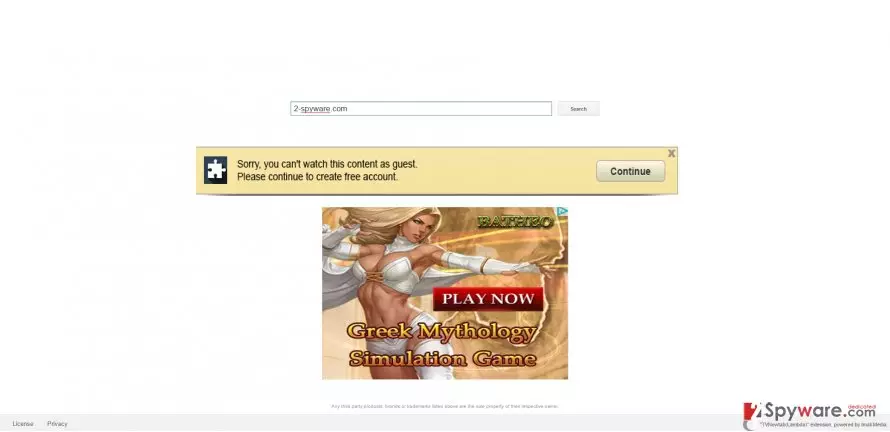
Additionally, MyFastDial Two New Tab browser hijacker might install so-called “helper elements” which prevent you from removing the hijacker quickly. They change the settings on the registry, thus, deleting the URL address from the primary browser settings is not sufficient to delete My Fast Dial Two New Tab completely. In order to get rid of it, you might need to install malware removal tool, e.g., FortectIntego. Bear in mind that the hijacker collects your non-personal information which includes browsing frequency, search entries, and IP address as well. Later on, it might be shared with third-parties which, afterward, generate ads specifically created according to personal preferences. Consequently, customized advertisements may start assaulting your computer. That is why we encourage you to remove MyFastDial Two New Tab.
When does the hiacker enter the PC?
Usually, MyFastDial Two New Tab hijack occurs when users download new software without being aware that several attachments come along with it. They are usually disguised under “Recommended” settings. Thus, when the installation process is finished, pre-marked attachments get installed as well. In order to avoid them, it is necessary to follow these steps. First of all, download a program from its official website. Afterward, choose “Advanced” settings. However, be wary that some spammers might hide unwanted applications under the latter mode as well. Thus, check all possible installation modes and only when you are sure that no additional programs invade your computer, finish the installation.
Remove MyFastDial Two New Tab from your computer
There are two solutions to the effective elimination of this hijacker. We advise you to install an anti-spyware application to quickly and efficiently delete MyFastDial Two New Tab virus. The software also serves as a guardian of the operating system by blocking not only adware but more serious virtual threats as well. Secondly, you may choose usual MyFastDial Two New Tab removal. Find the elimination instructions created by cyber security specialists or use the ones below. Carefully executing each step is of utmost importance in order to get rid of the hijacker.
Uninstall from Windows
Uninstall from Windows 10/8:
- Type Control Panel into the Windows search box and open the result.
- Under Programs, select Uninstall a program.


Uninstall from Windows 7/XP:
- Click on Windows Start > Control Panel (Windows XP users should click on Add/Remove Programs).
- In Control Panel, select Programs > Uninstall a program.


Remove the unwanted program:
- In the Programs and Features window, look for any recently installed suspicious entries, select them, and click Uninstall.
- If User Account Control appears, click Yes to confirm, then complete the removal.


Delete from macOS
Remove the unwanted application:
- From the menu bar, select Go > Applications.
- In the Applications folder, look for any suspicious entries, then drag them to Trash (or right-click and pick Move to Trash).


Delete leftover files and folders:
- Select Go > Go to Folder.
- Enter /Library/Application Support and remove any suspicious folders related to the unwanted program.
- Repeat the same check in the /Library/LaunchAgents and /Library/LaunchDaemons folders, deleting any suspicious entries.

- Finally, empty the Trash to permanently remove the leftovers.

Remove from Microsoft Edge
Delete unwanted extensions from MS Edge:
- Select Menu (three horizontal dots at the top-right of the browser window) and pick Extensions.
- From the list, pick the extension and click on the Gear icon.
- Click Remove.


Clear cookies and other browser data:
- Click on the Menu (three horizontal dots at the top-right of the browser window) and select Settings > Privacy, search, and services..
- Under Clear browsing data, pick Choose what to clear.
- Select Cookies and other site data and Cached images and files. (apart from passwords, although you might want to include Media licenses as well, if applicable) and click on Clear.


Restore new tab and homepage settings:
- Click the menu icon and choose Settings.
- Then find On startup section.
- Click Remove next to any suspicious startup page.
Reset MS Edge if the above steps did not work:
- Press on Ctrl + Shift + Esc to open Task Manager.
- Click on More details arrow at the bottom of the window.
- Select Details tab.
- Now scroll down and locate every entry with Microsoft Edge name in it. Right-click on each of them and select End Task to stop MS Edge from running.


Instructions for Chromium-based Edge
Delete extensions from MS Edge (Chromium):
- Open Edge and click select Settings > Extensions.
- Delete unwanted extensions by clicking Remove.


Clear cache and site data:
- Click on Menu and go to Settings.
- Select Privacy, search and services.
- Under Clear browsing data, pick Choose what to clear.
- Under Time range, pick All time.
- Select Clear now.


Reset Chromium-based MS Edge:
- Click on Menu and select Settings.
- On the left side, pick Reset settings.
- Select Restore settings to their default values.
- Confirm with Reset.
- This will disable extensions and reset startup pages but will not delete bookmarks, saved passwords, or browsing history.


Remove from Mozilla Firefox (FF)
Remove dangerous extensions:
- Open Mozilla Firefox browser and click on the Menu (three horizontal lines at the top-right of the window).
- Select Add-ons.
- In here, select the unwanted extension and click Remove.


Reset the homepage:
- Click three horizontal lines at the top right corner to open the menu.
- Choose Settings.
- Under Home, set your preferred homepage and new tab settings.
Clear cookies and site data:
- Click Menu and pick Settings.
- Go to Privacy & Security section.
- Scroll down to locate Cookies and Site Data.
- Click on Clear Data...
- Select Cookies and Site Data and Temporary cached files and pages, then click Clear.


Reset Mozilla Firefox
If clearing the browser as explained above did not help, reset Mozilla Firefox:
- Open Mozilla Firefox browser and click the Menu.
- Go to Help and then choose Troubleshooting Information.

- Under Give Firefox a tune up section, click on Refresh Firefox...
- Once the pop-up shows up, confirm the action by pressing on Refresh Firefox.



Remove from Google Chrome
Delete malicious extensions from Google Chrome:
- Open Google Chrome, click on the Menu (three vertical dots at the top-right corner) and select More tools > Extensions.
- In the newly opened window, you will see all the installed extensions. Uninstall all suspicious extensions related to the unwanted program by clicking Remove.


Clear cache and web data from Chrome:
- Click on Menu and pick Settings.
- Under Privacy and security, select Clear browsing data.
- Select Browsing history, Cookies and other site data, as well as Cached images and files.
- Click Clear data.


Change your homepage:
- Click menu and choose Settings.
- Look for a suspicious site in the On startup section.
- Click on Open a specific or set of pages and click on three dots to find the Remove option.
Reset Google Chrome:
If the previous methods did not help you, reset Google Chrome to eliminate all the unwanted components:
- Click on Menu and select Settings.
- In the Settings, scroll down and click Advanced.
- Scroll down and locate Reset and clean up section.
- Now click Restore settings to their original defaults.
- Confirm with Reset settings.


Delete from Safari
Remove dangerous extensions:
- Open Safari, click Safari in the menu at the top-left of the screen, and select Preferences.
- Go to the Extensions tab, look for any suspicious entries, and click Uninstall to remove them.


Clear history and website data:
- Click Safari in the menu and pick Clear History.
- Set Clear to all history and confirm with Clear History.


Reset Safari:
- Click Safari in the menu and select Preferences > Advanced.
- Enable Show Develop menu in menu bar.
- From the menu bar, click Develop and select Empty Caches.


Did this guide help?
2 comments
Ronald
Next time, its gonna be myfastdial three tab.;)
Dereck
Does any anti-spyware work against this hijacker?..