

The crucial information about search.searchhdrp.com virus
You might have run into search.searchhdrp.com virus when you were searching for a new search engine. Unfortunately, your choice is not the right one. IT specialists classify this website as a browser hijacker for its ability to sneak into the computer and change the browser settings by force. What is more, you might get irritated after being unable to return to your previous search engine or eliminate the hijacker easily. Before it roots deeper into your system, remove search.searchhdrp.com virus right away. Use FortectIntego to help you.
Initially, the website does not trigger any suspicions. When you enter it, a message emerges saying that HD Radio Player has been installed. It grants you the ability to listen to the radio right from the browser. Since it is created by HD Radio Player Ltd, the hijacker also provides access to other music streaming websites – Spotify, SoundCloud, Pandora, and iHeart. As you can see, this website is sponsored by external companies. Consequently, you might see their respective offers and banners as well. Within a short period of time, the increasing amount of advertisements may become a pain in the neck.
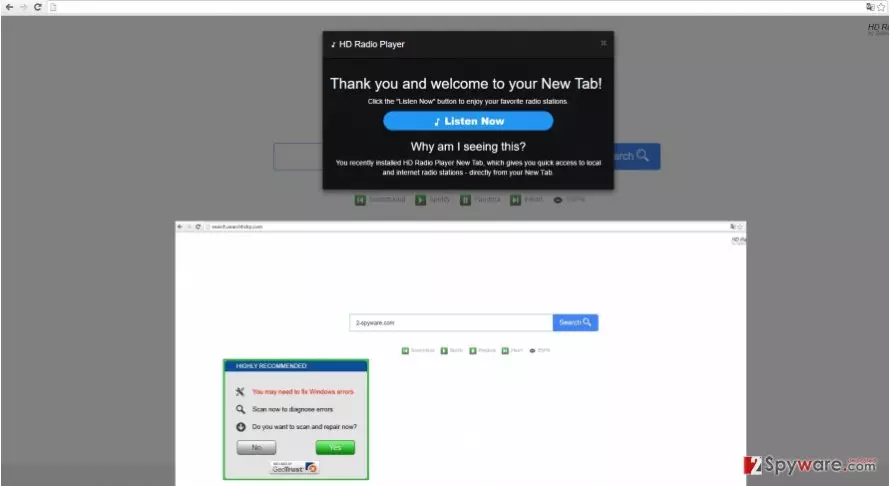
Search.searchhdrp.com redirect is another highly annoying feature. Once you enter a specific search result, you may blow a fuse after realizing that you have to ward off several redirects to reach the wanted website. Keep in mind that those redirect websites might not always be secure. Thus, the sooner you exit them, the better. Searchhdrp is not a legitimate search engine you can trust because it fails to provide relevant and objective search results.
As mentioned before, it only redirects you to sponsored or unknown domains. The informational and trustful websites are presented only in lower positions while advertising web pages are forwarded to top ranks. Lastly, every time you access the browsing tool the popping notification offering you to listen to the radio becomes too irritating. All in all, these arguments should convince you to proceed to search.searchhdrp.com removal.
How is this hijacker distributed?
It’s not difficult for this hijacker to slip into your computer if you often tend to install new programs. Perhaps, recently you installed a new one as well. As a result of quick and reckless installation, search.searchhdrp.com browser hijacker used the opportunity to invade your system. When you finished the installation wizard, you overlooked that there was a tiny add-on which hid search.searchhdrp.com. Since its checkbox was already pre-marked, the hijacker successfully entered your computer. In order to reduce the risk of search.searchhdrp.com hijack in the future, you should change your sequence of actions. Upon installing new software, choose “Advanced” mode. Only when all unnecessary add-ons are unchecked, you can finish the installation guide without any worries.
Search.searchhdrp.com removal guide
You can eliminate the hijacker in two ways – automatically and manually. If you prefer doing things accurately and calmly, choose the latter method. Pay attention while going through each stage. It is crucial not only to remove search.searchhdrp.com but its additional “helper elements” which might be scattered across the registry. Thus, some users might find this task bothersome. That is why we advise installing a powerful anti-spyware application. It is used to dealing with search.searchhdrp.com virus, adware and another sort of PUPs and malware. This option might be more reliable since the software detects potentially malicious files better.
Uninstall from Windows
Uninstall from Windows 10/8:
- Type Control Panel into the Windows search box and open the result.
- Under Programs, select Uninstall a program.


Uninstall from Windows 7/XP:
- Click on Windows Start > Control Panel (Windows XP users should click on Add/Remove Programs).
- In Control Panel, select Programs > Uninstall a program.


Remove the unwanted program:
- In the Programs and Features window, look for any recently installed suspicious entries, select them, and click Uninstall.
- If User Account Control appears, click Yes to confirm, then complete the removal.


Delete from macOS
Remove the unwanted application:
- From the menu bar, select Go > Applications.
- In the Applications folder, look for any suspicious entries, then drag them to Trash (or right-click and pick Move to Trash).


Delete leftover files and folders:
- Select Go > Go to Folder.
- Enter /Library/Application Support and remove any suspicious folders related to the unwanted program.
- Repeat the same check in the /Library/LaunchAgents and /Library/LaunchDaemons folders, deleting any suspicious entries.

- Finally, empty the Trash to permanently remove the leftovers.

Remove from Microsoft Edge
Delete unwanted extensions from MS Edge:
- Select Menu (three horizontal dots at the top-right of the browser window) and pick Extensions.
- From the list, pick the extension and click on the Gear icon.
- Click Remove.


Clear cookies and other browser data:
- Click on the Menu (three horizontal dots at the top-right of the browser window) and select Settings > Privacy, search, and services..
- Under Clear browsing data, pick Choose what to clear.
- Select Cookies and other site data and Cached images and files. (apart from passwords, although you might want to include Media licenses as well, if applicable) and click on Clear.


Restore new tab and homepage settings:
- Click the menu icon and choose Settings.
- Then find On startup section.
- Click Remove next to any suspicious startup page.
Reset MS Edge if the above steps did not work:
- Press on Ctrl + Shift + Esc to open Task Manager.
- Click on More details arrow at the bottom of the window.
- Select Details tab.
- Now scroll down and locate every entry with Microsoft Edge name in it. Right-click on each of them and select End Task to stop MS Edge from running.


Instructions for Chromium-based Edge
Delete extensions from MS Edge (Chromium):
- Open Edge and click select Settings > Extensions.
- Delete unwanted extensions by clicking Remove.


Clear cache and site data:
- Click on Menu and go to Settings.
- Select Privacy, search and services.
- Under Clear browsing data, pick Choose what to clear.
- Under Time range, pick All time.
- Select Clear now.


Reset Chromium-based MS Edge:
- Click on Menu and select Settings.
- On the left side, pick Reset settings.
- Select Restore settings to their default values.
- Confirm with Reset.
- This will disable extensions and reset startup pages but will not delete bookmarks, saved passwords, or browsing history.


Remove from Mozilla Firefox (FF)
Remove dangerous extensions:
- Open Mozilla Firefox browser and click on the Menu (three horizontal lines at the top-right of the window).
- Select Add-ons.
- In here, select the unwanted extension and click Remove.


Reset the homepage:
- Click three horizontal lines at the top right corner to open the menu.
- Choose Settings.
- Under Home, set your preferred homepage and new tab settings.
Clear cookies and site data:
- Click Menu and pick Settings.
- Go to Privacy & Security section.
- Scroll down to locate Cookies and Site Data.
- Click on Clear Data...
- Select Cookies and Site Data and Temporary cached files and pages, then click Clear.


Reset Mozilla Firefox
If clearing the browser as explained above did not help, reset Mozilla Firefox:
- Open Mozilla Firefox browser and click the Menu.
- Go to Help and then choose Troubleshooting Information.

- Under Give Firefox a tune up section, click on Refresh Firefox...
- Once the pop-up shows up, confirm the action by pressing on Refresh Firefox.



Remove from Google Chrome
Delete malicious extensions from Google Chrome:
- Open Google Chrome, click on the Menu (three vertical dots at the top-right corner) and select More tools > Extensions.
- In the newly opened window, you will see all the installed extensions. Uninstall all suspicious extensions related to the unwanted program by clicking Remove.


Clear cache and web data from Chrome:
- Click on Menu and pick Settings.
- Under Privacy and security, select Clear browsing data.
- Select Browsing history, Cookies and other site data, as well as Cached images and files.
- Click Clear data.


Change your homepage:
- Click menu and choose Settings.
- Look for a suspicious site in the On startup section.
- Click on Open a specific or set of pages and click on three dots to find the Remove option.
Reset Google Chrome:
If the previous methods did not help you, reset Google Chrome to eliminate all the unwanted components:
- Click on Menu and select Settings.
- In the Settings, scroll down and click Advanced.
- Scroll down and locate Reset and clean up section.
- Now click Restore settings to their original defaults.
- Confirm with Reset settings.


Delete from Safari
Remove dangerous extensions:
- Open Safari, click Safari in the menu at the top-left of the screen, and select Preferences.
- Go to the Extensions tab, look for any suspicious entries, and click Uninstall to remove them.


Clear history and website data:
- Click Safari in the menu and pick Clear History.
- Set Clear to all history and confirm with Clear History.


Reset Safari:
- Click Safari in the menu and select Preferences > Advanced.
- Enable Show Develop menu in menu bar.
- From the menu bar, click Develop and select Empty Caches.


Did this guide help?
3 comments
Sandra
If not for that popping HD Radio Player message, I would have continued to use this search engine. I didnt know that it was a browser hijacker.
Aaron
Why would you set this questionable website as your main search engine when you can use Google.
Jimmy
Even the title of this virus gives out that it is not trustful website.