

Reasons to avoid ArcadeTropics ads
If you like to play games online, you might accidentally run into ArcadeTropics virus. You might not have the slightest idea about this program being an adware-type application. This adware is suggested as a tool that allows users to pay “premium” games on its official website. In exchange for the ability to play these games, the user is asked to install this ad-supported application. If the user agrees to install it, soon enough, the computer screen will be flooded with Arcade Tropics ads. It is not recommended to click on these ads as they can be highly dangerous. For example, they may lead you to the websites with potentially malignant content. All in all, IT experts advise not have any potentially hazardous applications on the PC. Therefore, we recommend you to start ArcadeTropics removal shortly. It is not worth keeping this ad-supported software on your PC not only because its advertisements are highly annoying, but also because you can access all these “premium” games for free – the entire internet is full of websites offering to play these games for free.
Regarding the design and the Privacy Policy of this adware, it seems that this website is yet another creation of the same company which published GamesCystal, GamesLagoon, and DonutArcade gaming websites. Taking a look at the Privacy Policy provisions might also help you determine what kind of website you are using. The owners of arcadetropics(dot)com state that they can collect and use your personally non-identifiable information for marketing purposes. Besides, they mention that third-parties which display their advertisements on this website might do so as well.
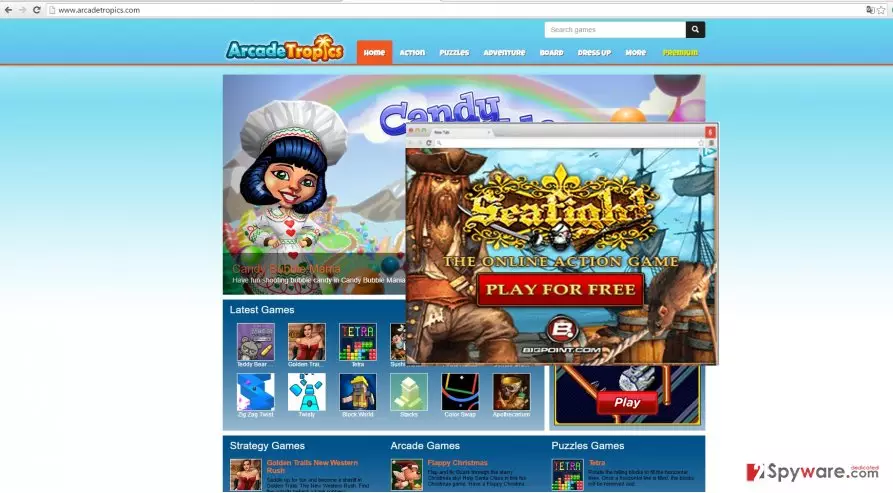
In relation to this, the website keeps a record of so-called technical information. It includes the data of your visited websites, frequent search entries, IP address, etc. Therefore, it might be used for generating more relevant advertisements matching your interests. However, the majority of users dislike being constantly spied upon, so we recommend you to remove ArcadeTropics. For that purpose, FortectIntego comes in handy. When you click on one of the advertisements of this adware you might find yourself not only in related gaming websites but in advertising or even gambling domains as well. The latter might be stuffed with various distracting banners and links which, on their behalf, redirect to potentially malevolent websites. Thus, although this ad-supported program is not itself malicious, due to ArcadeTropics redirect issue your PC might be infected with various sorts of malware.
Distribution methods
It tends to spread via “bundling” strategy. The main principle of this technique is that questionable programs, like Arcade Tropics, attach themselves to popular free programs. It is a common unspoken rule not to read the installation instructions. Due to such behavior, the majority of Internet users accidentally install adware, browser hijackers, and other unwanted stuff. If you are interested in how you can detect ArcadeTropics hijack on time, take note of these tips. First of all, develop a habit of opting for “Custom” installation mode. Afterward, go through each installation stage carefully to spot any pre-marked applications. Usually, they disguise unnecessary programs. Bear in mind that some scammers tend to hide adware under “Custom” settings or incorporate the adware into “Terms of Use.” Thus only after you thoroughly check the latter settings as well, you may end the installation process. However, you can just go to the official website of this program and agree to install it after opening “Premium” game section.
Tips on how to effectively remove ArcadeTropics ads
Luckily, it is quite easy to put an end to ArcadeTropics virus. Install an anti-spyware program, which will delete the PUP with a blink of an eye. If you update it regularly, the software will also ensure full-time protection. In addition, you can complete effective ArcadeTropics removal manually. Use the guidelines provided below. Lastly, check your system for additional adware-type programs. Eliminate all unnecessary applications to reduce the risk of adware infecting your computer again.
Uninstall from Windows
Uninstall from Windows 10/8:
- Type Control Panel into the Windows search box and open the result.
- Under Programs, select Uninstall a program.


Uninstall from Windows 7/XP:
- Click on Windows Start > Control Panel (Windows XP users should click on Add/Remove Programs).
- In Control Panel, select Programs > Uninstall a program.


Remove the unwanted program:
- In the Programs and Features window, look for any recently installed suspicious entries, select them, and click Uninstall.
- If User Account Control appears, click Yes to confirm, then complete the removal.


Delete from macOS
Remove the unwanted application:
- From the menu bar, select Go > Applications.
- In the Applications folder, look for any suspicious entries, then drag them to Trash (or right-click and pick Move to Trash).


Delete leftover files and folders:
- Select Go > Go to Folder.
- Enter /Library/Application Support and remove any suspicious folders related to the unwanted program.
- Repeat the same check in the /Library/LaunchAgents and /Library/LaunchDaemons folders, deleting any suspicious entries.

- Finally, empty the Trash to permanently remove the leftovers.

Remove from Microsoft Edge
Delete unwanted extensions from MS Edge:
- Select Menu (three horizontal dots at the top-right of the browser window) and pick Extensions.
- From the list, pick the extension and click on the Gear icon.
- Click Remove.


Clear cookies and other browser data:
- Click on the Menu (three horizontal dots at the top-right of the browser window) and select Settings > Privacy, search, and services..
- Under Clear browsing data, pick Choose what to clear.
- Select Cookies and other site data and Cached images and files. (apart from passwords, although you might want to include Media licenses as well, if applicable) and click on Clear.


Restore new tab and homepage settings:
- Click the menu icon and choose Settings.
- Then find On startup section.
- Click Remove next to any suspicious startup page.
Reset MS Edge if the above steps did not work:
- Press on Ctrl + Shift + Esc to open Task Manager.
- Click on More details arrow at the bottom of the window.
- Select Details tab.
- Now scroll down and locate every entry with Microsoft Edge name in it. Right-click on each of them and select End Task to stop MS Edge from running.


Instructions for Chromium-based Edge
Delete extensions from MS Edge (Chromium):
- Open Edge and click select Settings > Extensions.
- Delete unwanted extensions by clicking Remove.


Clear cache and site data:
- Click on Menu and go to Settings.
- Select Privacy, search and services.
- Under Clear browsing data, pick Choose what to clear.
- Under Time range, pick All time.
- Select Clear now.


Reset Chromium-based MS Edge:
- Click on Menu and select Settings.
- On the left side, pick Reset settings.
- Select Restore settings to their default values.
- Confirm with Reset.
- This will disable extensions and reset startup pages but will not delete bookmarks, saved passwords, or browsing history.


Remove from Mozilla Firefox (FF)
Remove dangerous extensions:
- Open Mozilla Firefox browser and click on the Menu (three horizontal lines at the top-right of the window).
- Select Add-ons.
- In here, select the unwanted extension and click Remove.


Reset the homepage:
- Click three horizontal lines at the top right corner to open the menu.
- Choose Settings.
- Under Home, set your preferred homepage and new tab settings.
Clear cookies and site data:
- Click Menu and pick Settings.
- Go to Privacy & Security section.
- Scroll down to locate Cookies and Site Data.
- Click on Clear Data...
- Select Cookies and Site Data and Temporary cached files and pages, then click Clear.


Reset Mozilla Firefox
If clearing the browser as explained above did not help, reset Mozilla Firefox:
- Open Mozilla Firefox browser and click the Menu.
- Go to Help and then choose Troubleshooting Information.

- Under Give Firefox a tune up section, click on Refresh Firefox...
- Once the pop-up shows up, confirm the action by pressing on Refresh Firefox.



Remove from Google Chrome
Delete malicious extensions from Google Chrome:
- Open Google Chrome, click on the Menu (three vertical dots at the top-right corner) and select More tools > Extensions.
- In the newly opened window, you will see all the installed extensions. Uninstall all suspicious extensions related to the unwanted program by clicking Remove.


Clear cache and web data from Chrome:
- Click on Menu and pick Settings.
- Under Privacy and security, select Clear browsing data.
- Select Browsing history, Cookies and other site data, as well as Cached images and files.
- Click Clear data.


Change your homepage:
- Click menu and choose Settings.
- Look for a suspicious site in the On startup section.
- Click on Open a specific or set of pages and click on three dots to find the Remove option.
Reset Google Chrome:
If the previous methods did not help you, reset Google Chrome to eliminate all the unwanted components:
- Click on Menu and select Settings.
- In the Settings, scroll down and click Advanced.
- Scroll down and locate Reset and clean up section.
- Now click Restore settings to their original defaults.
- Confirm with Reset settings.


Delete from Safari
Remove dangerous extensions:
- Open Safari, click Safari in the menu at the top-left of the screen, and select Preferences.
- Go to the Extensions tab, look for any suspicious entries, and click Uninstall to remove them.


Clear history and website data:
- Click Safari in the menu and pick Clear History.
- Set Clear to all history and confirm with Clear History.


Reset Safari:
- Click Safari in the menu and select Preferences > Advanced.
- Enable Show Develop menu in menu bar.
- From the menu bar, click Develop and select Empty Caches.


Did this guide help?
2 comments
Tommy
Yet again another adware.
Henry
These games are only for toddlers.