

What is known about the search2.fvpimageviewer.com virus?
Search2.fvpimageviewer.com virus is a cyber infection associated with a widespread category of viruses called browser hijackers. These questionable programs enter the users computers disguised as legitimate search engines, offering search services as well as some other valuable features which supposedly should facilitate the browsing. In reality, services of such search engines are usually very low-end. Instead of displaying relevant information, the search results are overshadowed by sponsored ads and links leading to websites this virus collaborates with. The worst thing about this program is that the search2.fvpimageviewer.com hijack often occurs without the users’ permission and stays on the browser despite the attempts to remove it. So, the users are simply forced to dig through the modified search results in search of actually relevant information. If you would rather use reliable search engines such as Google, Yahoo or Bing, take care of the search2.fvpimageviewer.com removal as soon as possible and take back the comfort of finding information quickly.
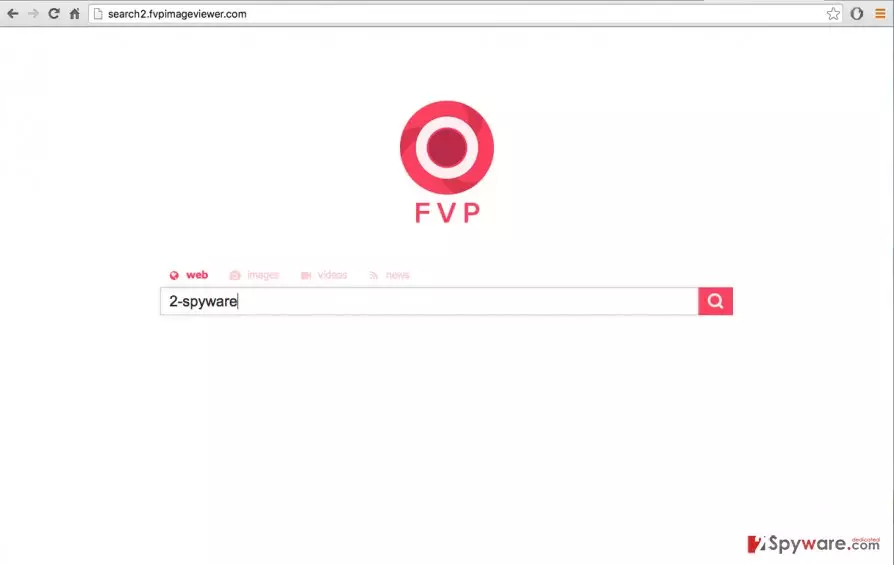
Having search2.fvpimageviewer.com malware installed on your computer obliges you to act more careful while browsing online. Security experts on the other hand, suggest refraining from browsing entirely. This way, you will decrease the chances of being exposed to search2.fvpimageviewer.com redirect issue and, hopefully, save your computer from potential cyber infections. Remember, though that the virus may install additional components on your browser which may help it inject corrupted links and suspicious advertisements on reputable sites as well. This means in order to banish the virus from your computer you will have to remove search2.fvpimageviewer.com executive file and track down all the additional components it might have installed on your computer as well. You will need a sophisticated antivirus software to do the job. We recommend applying FortectIntego for this purpose.
How can you stop this browser hijacker from entering your PC?
As we have already mentioned, search2.fvpimageviewer.com can infiltrate the system without any straightforward permission. So how can you make sure your device is safe from browser hijackers like these? First of all, you must have your system equipped with a sophisticated antivirus software. Make sure this utility is updated and able to fend off viruses in real time. Do not forget to update the system itself, too. The newest software updates contain valuable patches that eliminate system vulnerabilities and ensure the system fits the latest security standards. Finally, take some time while installing new programs on your computer as well. Inspect the downloaded software and scan it with an antivirus utility before proceeding with the installation. Also, choose Advanced/Custom mode to be able to manage the additional software package material. Search2.fvpimageviewer.com malware will definitely find it more difficult to slip through if you follow all the mentioned steps closely.
Search2.fvpimageviewer.com removal techniques:
There is nothing more annoying than constantly being redirected to a site that is completely useless or even dangerous. Luckily, you can avoid that by uninstalling search2.fvpimageviewer.com from your computer. You can do that in two ways: manually or automatically. When choosing between the two, keep in mind that virus components may be scattered throughout your computer which may significantly burden the search2.fvpimageviewer.com removal. It is always recommended to go for the automatic virus elimination tools because they are able to scan the entire system and indicate a variety of potential threats which would be difficult to recognize manually. But before you download such as tool into your system make sure that you are obtaining the latest version of the software. If you still wish to remove search2.fvpimageviewer.com manually, we recommend reading through our expert-prepared virus elimination guide presented below.
Uninstall from Windows
Uninstall from Windows 10/8:
- Type Control Panel into the Windows search box and open the result.
- Under Programs, select Uninstall a program.


Uninstall from Windows 7/XP:
- Click on Windows Start > Control Panel (Windows XP users should click on Add/Remove Programs).
- In Control Panel, select Programs > Uninstall a program.


Remove the unwanted program:
- In the Programs and Features window, look for any recently installed suspicious entries, select them, and click Uninstall.
- If User Account Control appears, click Yes to confirm, then complete the removal.


Delete from macOS
Remove the unwanted application:
- From the menu bar, select Go > Applications.
- In the Applications folder, look for any suspicious entries, then drag them to Trash (or right-click and pick Move to Trash).


Delete leftover files and folders:
- Select Go > Go to Folder.
- Enter /Library/Application Support and remove any suspicious folders related to the unwanted program.
- Repeat the same check in the /Library/LaunchAgents and /Library/LaunchDaemons folders, deleting any suspicious entries.

- Finally, empty the Trash to permanently remove the leftovers.

Remove from Microsoft Edge
Delete unwanted extensions from MS Edge:
- Select Menu (three horizontal dots at the top-right of the browser window) and pick Extensions.
- From the list, pick the extension and click on the Gear icon.
- Click Remove.


Clear cookies and other browser data:
- Click on the Menu (three horizontal dots at the top-right of the browser window) and select Settings > Privacy, search, and services..
- Under Clear browsing data, pick Choose what to clear.
- Select Cookies and other site data and Cached images and files. (apart from passwords, although you might want to include Media licenses as well, if applicable) and click on Clear.


Restore new tab and homepage settings:
- Click the menu icon and choose Settings.
- Then find On startup section.
- Click Remove next to any suspicious startup page.
Reset MS Edge if the above steps did not work:
- Press on Ctrl + Shift + Esc to open Task Manager.
- Click on More details arrow at the bottom of the window.
- Select Details tab.
- Now scroll down and locate every entry with Microsoft Edge name in it. Right-click on each of them and select End Task to stop MS Edge from running.


Instructions for Chromium-based Edge
Delete extensions from MS Edge (Chromium):
- Open Edge and click select Settings > Extensions.
- Delete unwanted extensions by clicking Remove.


Clear cache and site data:
- Click on Menu and go to Settings.
- Select Privacy, search and services.
- Under Clear browsing data, pick Choose what to clear.
- Under Time range, pick All time.
- Select Clear now.


Reset Chromium-based MS Edge:
- Click on Menu and select Settings.
- On the left side, pick Reset settings.
- Select Restore settings to their default values.
- Confirm with Reset.
- This will disable extensions and reset startup pages but will not delete bookmarks, saved passwords, or browsing history.


Remove from Mozilla Firefox (FF)
Remove dangerous extensions:
- Open Mozilla Firefox browser and click on the Menu (three horizontal lines at the top-right of the window).
- Select Add-ons.
- In here, select the unwanted extension and click Remove.


Reset the homepage:
- Click three horizontal lines at the top right corner to open the menu.
- Choose Settings.
- Under Home, set your preferred homepage and new tab settings.
Clear cookies and site data:
- Click Menu and pick Settings.
- Go to Privacy & Security section.
- Scroll down to locate Cookies and Site Data.
- Click on Clear Data...
- Select Cookies and Site Data and Temporary cached files and pages, then click Clear.


Reset Mozilla Firefox
If clearing the browser as explained above did not help, reset Mozilla Firefox:
- Open Mozilla Firefox browser and click the Menu.
- Go to Help and then choose Troubleshooting Information.

- Under Give Firefox a tune up section, click on Refresh Firefox...
- Once the pop-up shows up, confirm the action by pressing on Refresh Firefox.



Remove from Google Chrome
Delete malicious extensions from Google Chrome:
- Open Google Chrome, click on the Menu (three vertical dots at the top-right corner) and select More tools > Extensions.
- In the newly opened window, you will see all the installed extensions. Uninstall all suspicious extensions related to the unwanted program by clicking Remove.


Clear cache and web data from Chrome:
- Click on Menu and pick Settings.
- Under Privacy and security, select Clear browsing data.
- Select Browsing history, Cookies and other site data, as well as Cached images and files.
- Click Clear data.


Change your homepage:
- Click menu and choose Settings.
- Look for a suspicious site in the On startup section.
- Click on Open a specific or set of pages and click on three dots to find the Remove option.
Reset Google Chrome:
If the previous methods did not help you, reset Google Chrome to eliminate all the unwanted components:
- Click on Menu and select Settings.
- In the Settings, scroll down and click Advanced.
- Scroll down and locate Reset and clean up section.
- Now click Restore settings to their original defaults.
- Confirm with Reset settings.


Delete from Safari
Remove dangerous extensions:
- Open Safari, click Safari in the menu at the top-left of the screen, and select Preferences.
- Go to the Extensions tab, look for any suspicious entries, and click Uninstall to remove them.


Clear history and website data:
- Click Safari in the menu and pick Clear History.
- Set Clear to all history and confirm with Clear History.


Reset Safari:
- Click Safari in the menu and select Preferences > Advanced.
- Enable Show Develop menu in menu bar.
- From the menu bar, click Develop and select Empty Caches.


Did this guide help?
1 comment
Gilbert
Ridiculous! It took me ages to get rid of this nasty infection!