

The essential information about Hao123Tab virus
Hao123Tab belongs to the category of browser plug-ins. The owners of this plug-in promote this website as a must-have Chrome plug-in sorts out websites and delivers the most relevant to you. However, such interference only ends up in multiple pop-ups flooding your browser. In addition, this questionable browser plug-in may add unwanted toolbars and change your search engine to Hao123.com. Thus, if you do not to suffer from numerous irritating outcomes, make a rush to remove Hao123Tab virus right now. FortectIntego is the program which significantly speeds up the removal process.
This questionable plug-in is suspected to be a subsidiary website of Hao123.com. Though the latter is a Chinese social website filled with untrustful content tempting you to visit certain websites, this plug causes looks less unreliable. It is written in proper English promoting this browser extension as a useful tool aiding the users to access current trends and find relevant information in just a few clicks.
However, you should not take this bait as your computer may be flooded with tons of unwanted consequences. One of them is Hao123Tab redirect. Most likely, when you install this extension, you may fail to reach wanted websites in time. In other words, you may get redirected to advertising or pornographic websites which shelter highly aggressive viruses. Thus, after such visit, your operating system might be severely infected with minor or more serious malware.
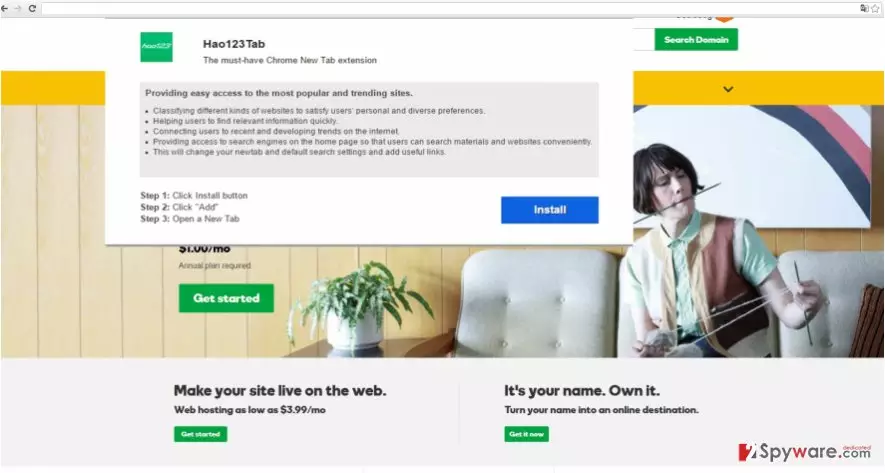
In addition, Hao123Tab.com collects both, non-personal and personal information. Not only your search entries and visited websites are tracked, but the plug-in can also collect data such as your email address, name, and surname, other sensitive information. This data is said to be compiled for the purposes to improve Hao123Tab services. Taking into account the unreliability of this plug-in, the gathered information might be “accidentally” leaked to third-parties. The least annoying effect of such bargain results in an increased amount of advertisements.
When did Hao123Tab hijack my PC?
It happened when you recklessly installed a new program. Unfortunately, this PUP successfully infiltrates hundreds of computers because few users pay attention while installing new software. Thus, the checkbox of the plug-in usually can be found under “Basic” settings. When users choose them and finish the guide, the PUP successfully tiptoes into the system. In order not to get infected by the plug-in again, you should install a new application with more cautiousness. Opt for “Custom” settings and then watch for any unwanted programs. If you find any, untick them one by one. Lastly, let us proceed to Hao123Tab removal.
Can I quickly and effectively remove Hao123Tab?
In that case, we offer to install a trustworthy anti-spyware application. It will take care of Hao123Tab virus and ensure that there are no remaining files left. It will also proof-check your operating system for other potentially unwanted files and programs on the computer. If you update the security software daily, you will experience all its benefits. Alternatively, it is possible to conduct manual Hao123Tab removal as well. Make sure you go through each step of the guidelines precisely and attentively. Do not miss even the slightest detail so that there would be no risk of getting infected with this plug-in in the future.
Uninstall from Windows
Uninstall from Windows 10/8:
- Type Control Panel into the Windows search box and open the result.
- Under Programs, select Uninstall a program.


Uninstall from Windows 7/XP:
- Click on Windows Start > Control Panel (Windows XP users should click on Add/Remove Programs).
- In Control Panel, select Programs > Uninstall a program.


Remove the unwanted program:
- In the Programs and Features window, look for any recently installed suspicious entries, select them, and click Uninstall.
- If User Account Control appears, click Yes to confirm, then complete the removal.


Delete from macOS
Remove the unwanted application:
- From the menu bar, select Go > Applications.
- In the Applications folder, look for any suspicious entries, then drag them to Trash (or right-click and pick Move to Trash).


Delete leftover files and folders:
- Select Go > Go to Folder.
- Enter /Library/Application Support and remove any suspicious folders related to the unwanted program.
- Repeat the same check in the /Library/LaunchAgents and /Library/LaunchDaemons folders, deleting any suspicious entries.

- Finally, empty the Trash to permanently remove the leftovers.

Remove from Microsoft Edge
Delete unwanted extensions from MS Edge:
- Select Menu (three horizontal dots at the top-right of the browser window) and pick Extensions.
- From the list, pick the extension and click on the Gear icon.
- Click Remove.


Clear cookies and other browser data:
- Click on the Menu (three horizontal dots at the top-right of the browser window) and select Settings > Privacy, search, and services..
- Under Clear browsing data, pick Choose what to clear.
- Select Cookies and other site data and Cached images and files. (apart from passwords, although you might want to include Media licenses as well, if applicable) and click on Clear.


Restore new tab and homepage settings:
- Click the menu icon and choose Settings.
- Then find On startup section.
- Click Remove next to any suspicious startup page.
Reset MS Edge if the above steps did not work:
- Press on Ctrl + Shift + Esc to open Task Manager.
- Click on More details arrow at the bottom of the window.
- Select Details tab.
- Now scroll down and locate every entry with Microsoft Edge name in it. Right-click on each of them and select End Task to stop MS Edge from running.


Instructions for Chromium-based Edge
Delete extensions from MS Edge (Chromium):
- Open Edge and click select Settings > Extensions.
- Delete unwanted extensions by clicking Remove.


Clear cache and site data:
- Click on Menu and go to Settings.
- Select Privacy, search and services.
- Under Clear browsing data, pick Choose what to clear.
- Under Time range, pick All time.
- Select Clear now.


Reset Chromium-based MS Edge:
- Click on Menu and select Settings.
- On the left side, pick Reset settings.
- Select Restore settings to their default values.
- Confirm with Reset.
- This will disable extensions and reset startup pages but will not delete bookmarks, saved passwords, or browsing history.


Remove from Mozilla Firefox (FF)
Remove dangerous extensions:
- Open Mozilla Firefox browser and click on the Menu (three horizontal lines at the top-right of the window).
- Select Add-ons.
- In here, select the unwanted extension and click Remove.


Reset the homepage:
- Click three horizontal lines at the top right corner to open the menu.
- Choose Settings.
- Under Home, set your preferred homepage and new tab settings.
Clear cookies and site data:
- Click Menu and pick Settings.
- Go to Privacy & Security section.
- Scroll down to locate Cookies and Site Data.
- Click on Clear Data...
- Select Cookies and Site Data and Temporary cached files and pages, then click Clear.


Reset Mozilla Firefox
If clearing the browser as explained above did not help, reset Mozilla Firefox:
- Open Mozilla Firefox browser and click the Menu.
- Go to Help and then choose Troubleshooting Information.

- Under Give Firefox a tune up section, click on Refresh Firefox...
- Once the pop-up shows up, confirm the action by pressing on Refresh Firefox.



Remove from Google Chrome
Delete malicious extensions from Google Chrome:
- Open Google Chrome, click on the Menu (three vertical dots at the top-right corner) and select More tools > Extensions.
- In the newly opened window, you will see all the installed extensions. Uninstall all suspicious extensions related to the unwanted program by clicking Remove.


Clear cache and web data from Chrome:
- Click on Menu and pick Settings.
- Under Privacy and security, select Clear browsing data.
- Select Browsing history, Cookies and other site data, as well as Cached images and files.
- Click Clear data.


Change your homepage:
- Click menu and choose Settings.
- Look for a suspicious site in the On startup section.
- Click on Open a specific or set of pages and click on three dots to find the Remove option.
Reset Google Chrome:
If the previous methods did not help you, reset Google Chrome to eliminate all the unwanted components:
- Click on Menu and select Settings.
- In the Settings, scroll down and click Advanced.
- Scroll down and locate Reset and clean up section.
- Now click Restore settings to their original defaults.
- Confirm with Reset settings.


Delete from Safari
Remove dangerous extensions:
- Open Safari, click Safari in the menu at the top-left of the screen, and select Preferences.
- Go to the Extensions tab, look for any suspicious entries, and click Uninstall to remove them.


Clear history and website data:
- Click Safari in the menu and pick Clear History.
- Set Clear to all history and confirm with Clear History.


Reset Safari:
- Click Safari in the menu and select Preferences > Advanced.
- Enable Show Develop menu in menu bar.
- From the menu bar, click Develop and select Empty Caches.


Did this guide help?
2 comments
Darren
What are these redirects to Chinese website?!
Morris
Where does one even come across such plug-ins?