

What is Search.yourtelevisioncenter.com?
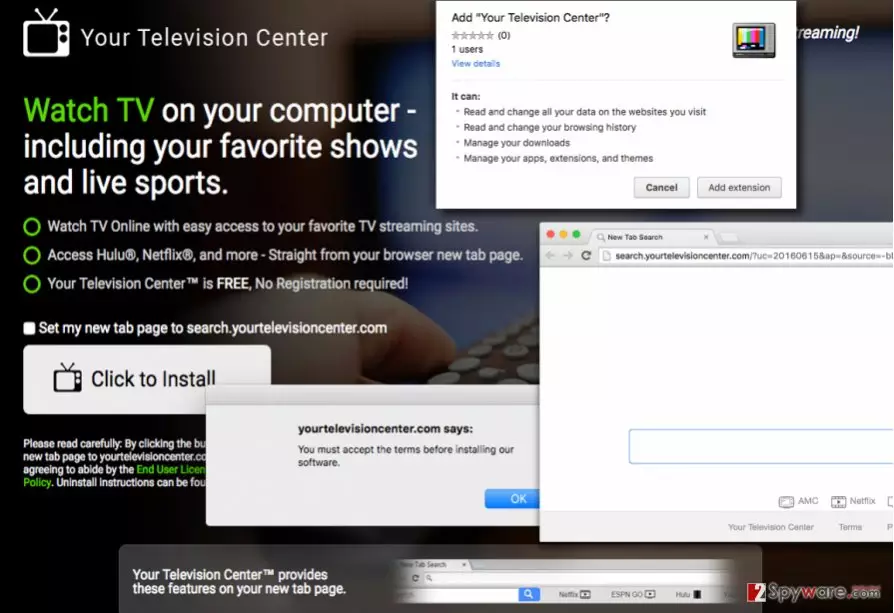
Search.yourtelevisioncenter.com is set up as your homepage and as well new tab page if your computer is infected with Search.yourtelevisioncenter.com virus. It is a highly suspicious application, which can infiltrate your computer without asking for your permission. It spreads mostly via modified software installers, and once it gets inside the computer system, it adds Your Television Center extension to every web browser. We have discovered that this extension has suspicious permissions, including the following:
- Read and change all your data on websites you visit;
- Read and change your browsing history;
- Manage your downloads;
- Manage your apps, extensions, and themes.
Now, the third and the fourth points seem suspicious. Why would this extension want to manage your downloads? It makes us feel that this program can make arbitrary decisions and download programs to your computer. Be very careful, because potentially unwanted programs (PUP) cannot be trusted. We have added this program to “browser hijackers” category since it hijacks user’s browsers and attempts to control user’s browsing sessions partly. As we have already mentioned, it replaces the previous homepage and new tab page with Search.yourtelevisioncenter.com, seeking to convince the user to search the web via it. Our advice is to stay away from this search as far as you can, as it can redirect you to shady web pages instead of opening Internet sites that you might be trying to access.
Some of its search results can be associated with untrustworthy third-party companies, which want to promote their web pages. It might be that the author of Your Television Center generates pay-per-click revenue by rerouting users to predetermined Internet sites and advertising them. If you do not aspire to be rerouted to shady Internet places, remove Search.yourtelevisioncenter.com redirect virus without a delay. You can remove it by using an anti-spyware software, for example, FortectIntego.
How did it hijack your computer system?
Search.yourtelevisioncenter.com hijack occurs when the computer user installs a software bundle. PUPs are often presented as “suggested programs” in installers of other free programs, but computer users often do not notice information about them as they tend to rely on pre-selected installation settings (Default or Standard). Such deceptive installers do not provide any information what exactly these additional programs do, nor provide instructions how to uninstall them. Therefore, it is better to avoid installing such shady pieces of software at all. To reject them, choose Custom/Advanced settings and then deselect all optional items added to the program that you have downloaded.
You can also download this dubious application from its official website, but it seems that not many computer users install it by their choice. Therefore, there is no doubt that the main distribution method used to spread this software is software bundling.
How to stop Search.yourtelevisioncenter.com redirects?
To ensure the security of your computer system, we strongly recommend you to remove Search.yourtelevisioncenter.com virus from your computer. Do not let this low-level computer threat reside in your computer and carry out suspicious activities behind your back. You can delete this PUP in two different ways. The first method requires to have an anti-spyware program, so if you do not have one, download and install it. You can use the program that we recommend (SpyHunter). Then scan your PC with it and wait until it detects and removes all threats from your PC. In case you do not have any willingness to use automatic spyware removal tool to delete this browser hijacker from your computer, then just follow these Search.yourtelevisioncenter.com removal instructions and eliminate it with your own hands.
Uninstall from Windows
Uninstall from Windows 10/8:
- Type Control Panel into the Windows search box and open the result.
- Under Programs, select Uninstall a program.


Uninstall from Windows 7/XP:
- Click on Windows Start > Control Panel (Windows XP users should click on Add/Remove Programs).
- In Control Panel, select Programs > Uninstall a program.


Remove the unwanted program:
- In the Programs and Features window, look for any recently installed suspicious entries, select them, and click Uninstall.
- If User Account Control appears, click Yes to confirm, then complete the removal.


Delete from macOS
Remove the unwanted application:
- From the menu bar, select Go > Applications.
- In the Applications folder, look for any suspicious entries, then drag them to Trash (or right-click and pick Move to Trash).


Delete leftover files and folders:
- Select Go > Go to Folder.
- Enter /Library/Application Support and remove any suspicious folders related to the unwanted program.
- Repeat the same check in the /Library/LaunchAgents and /Library/LaunchDaemons folders, deleting any suspicious entries.

- Finally, empty the Trash to permanently remove the leftovers.

Remove from Microsoft Edge
Delete unwanted extensions from MS Edge:
- Select Menu (three horizontal dots at the top-right of the browser window) and pick Extensions.
- From the list, pick the extension and click on the Gear icon.
- Click Remove.


Clear cookies and other browser data:
- Click on the Menu (three horizontal dots at the top-right of the browser window) and select Settings > Privacy, search, and services..
- Under Clear browsing data, pick Choose what to clear.
- Select Cookies and other site data and Cached images and files. (apart from passwords, although you might want to include Media licenses as well, if applicable) and click on Clear.


Restore new tab and homepage settings:
- Click the menu icon and choose Settings.
- Then find On startup section.
- Click Remove next to any suspicious startup page.
Reset MS Edge if the above steps did not work:
- Press on Ctrl + Shift + Esc to open Task Manager.
- Click on More details arrow at the bottom of the window.
- Select Details tab.
- Now scroll down and locate every entry with Microsoft Edge name in it. Right-click on each of them and select End Task to stop MS Edge from running.


Instructions for Chromium-based Edge
Delete extensions from MS Edge (Chromium):
- Open Edge and click select Settings > Extensions.
- Delete unwanted extensions by clicking Remove.


Clear cache and site data:
- Click on Menu and go to Settings.
- Select Privacy, search and services.
- Under Clear browsing data, pick Choose what to clear.
- Under Time range, pick All time.
- Select Clear now.


Reset Chromium-based MS Edge:
- Click on Menu and select Settings.
- On the left side, pick Reset settings.
- Select Restore settings to their default values.
- Confirm with Reset.
- This will disable extensions and reset startup pages but will not delete bookmarks, saved passwords, or browsing history.


Remove from Mozilla Firefox (FF)
Remove dangerous extensions:
- Open Mozilla Firefox browser and click on the Menu (three horizontal lines at the top-right of the window).
- Select Add-ons.
- In here, select the unwanted extension and click Remove.


Reset the homepage:
- Click three horizontal lines at the top right corner to open the menu.
- Choose Settings.
- Under Home, set your preferred homepage and new tab settings.
Clear cookies and site data:
- Click Menu and pick Settings.
- Go to Privacy & Security section.
- Scroll down to locate Cookies and Site Data.
- Click on Clear Data...
- Select Cookies and Site Data and Temporary cached files and pages, then click Clear.


Reset Mozilla Firefox
If clearing the browser as explained above did not help, reset Mozilla Firefox:
- Open Mozilla Firefox browser and click the Menu.
- Go to Help and then choose Troubleshooting Information.

- Under Give Firefox a tune up section, click on Refresh Firefox...
- Once the pop-up shows up, confirm the action by pressing on Refresh Firefox.



Remove from Google Chrome
Delete malicious extensions from Google Chrome:
- Open Google Chrome, click on the Menu (three vertical dots at the top-right corner) and select More tools > Extensions.
- In the newly opened window, you will see all the installed extensions. Uninstall all suspicious extensions related to the unwanted program by clicking Remove.


Clear cache and web data from Chrome:
- Click on Menu and pick Settings.
- Under Privacy and security, select Clear browsing data.
- Select Browsing history, Cookies and other site data, as well as Cached images and files.
- Click Clear data.


Change your homepage:
- Click menu and choose Settings.
- Look for a suspicious site in the On startup section.
- Click on Open a specific or set of pages and click on three dots to find the Remove option.
Reset Google Chrome:
If the previous methods did not help you, reset Google Chrome to eliminate all the unwanted components:
- Click on Menu and select Settings.
- In the Settings, scroll down and click Advanced.
- Scroll down and locate Reset and clean up section.
- Now click Restore settings to their original defaults.
- Confirm with Reset settings.


Delete from Safari
Remove dangerous extensions:
- Open Safari, click Safari in the menu at the top-left of the screen, and select Preferences.
- Go to the Extensions tab, look for any suspicious entries, and click Uninstall to remove them.


Clear history and website data:
- Click Safari in the menu and pick Clear History.
- Set Clear to all history and confirm with Clear History.


Reset Safari:
- Click Safari in the menu and select Preferences > Advanced.
- Enable Show Develop menu in menu bar.
- From the menu bar, click Develop and select Empty Caches.


Did this guide help?
4 comments
Qraze
finally I have got rid of this nasty browser infection.... i didnt want to use Search.yourtelevisioncenter.com search engine, I immediately noticed that there is something wrong with it. if you want to use it, dont!
Olly
hijacked my browser without my permission, so disappointing! now I am scared - what if it has downloaded more malware into my computer??
Roslyn
Dude this virus affected my PC too, I am worried, scanned my computer but the only threat is Your Television Center, I guess I have removed it just on time!
Jeff
thanks, uninstalled it