

How does DEDCryptor virus act on an infected computer?
DEDCryptor is a ransomware-type threat, which is an updated version of EDA2 virus. It works just like Locky, CryptXXX, and other similar viruses do. DEDCryptor ransomware aims to lock all of the victim’s files using the AES-256 algorithm, making them inaccessible. It is also worth mentioning that it adds .ded file extensions to encrypted data, making it easier to understand which files have been encrypted and which ones were not.
DEDCryptor malware differs from other ransomware variants because it does not create any ransom notes when the encryption process is done. It only replaces victim’s desktop wallpaper with an image, which simply informs the victim that all files have been encrypted, and the decryption tool costs 2 Bitcoins. At the time of research, 2 BTC were equal to 1475 USD. The virus does not provide any instructions on how to buy Bitcoins and where to send them to, but it leaves a contact email (dedcrypt@sigaint(.)org) so that the victim can get in touch with the cyber criminals for further information. The cyber criminals also leave a warning stating that the decryption key is valid only for 24 hours. As we can see, crooks urge the victim to make the money transfer as quickly as possible.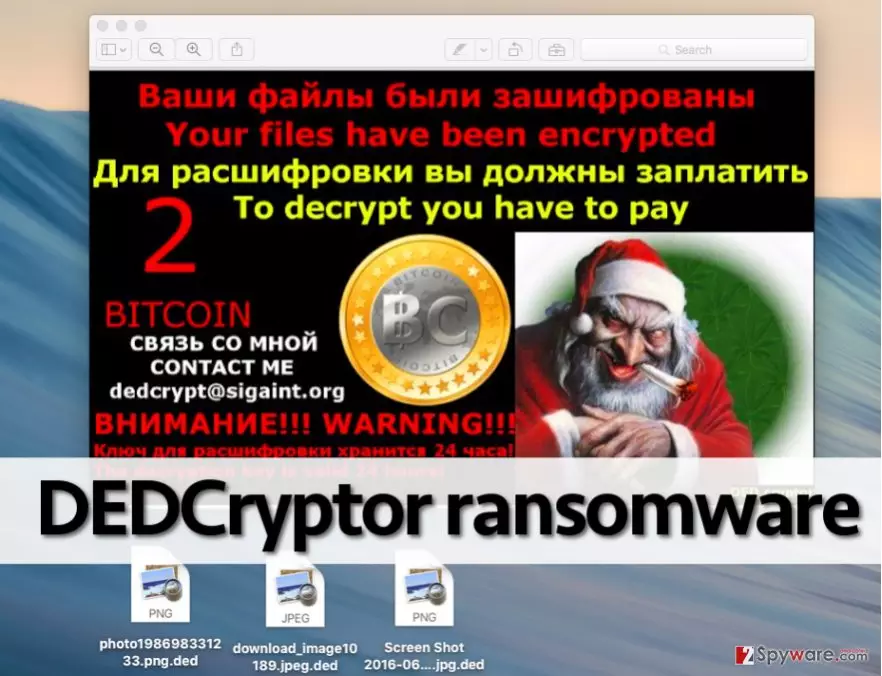
There are a few reasons why you should not pay the ransom. First of all, frauds might not send you the decryption key; Second, it might not work at all; and third, it might work, but it can also be complemented with infectious files that can wreak havoc on your computer system again. Therefore, we do not advise you to pay the ransom; otherwise, you will take the risk of losing quite a considerable amount of money. Do not forget that this virus makes your computer very vulnerable to other infections, so it goes without saying that you must remove DEDCryptor from your PC as soon as possible. You can delete it by running a dependable malware removal tool, for instance, FortectIntego.
How does this ransomware spread?
You should take ransomware threat seriously, because if such virus infiltrates the computer and encrypts all files on it, you cannot recover your files anyhow except from a backup. Therefore, it is advisable to take precautions and backup your files in advance. If you do not know how to backup data, we recommend reading this article – How to backup? Cyber security experts also advise using several different layers of protection for the best results, so do not forget to install a reputable anti-malware program on your computer.
Cyber criminals typically send this virus’ executive file to victims via email, therefore, do not open suspicious emails that come from unknown senders. Also, never download programs from shady websites or pop-up ads. Crooks tend to spread ransomware via malvertising, too, so keep in mind that a bogus Java or Flash Player update might not only update these programs but also install malware on your PC.
How to remove DEDCryptor and decrypt files?
If you do not plan to transfer the required amount of money to criminals, uninstall this malware without a delay. Without a doubt, DEDCryptor removal is not an easy thing to do, so be patient. You should not even attempt to do it manually unless you are an advanced IT specialist. We recommend you to follow the instructions given below and prepare your computer before running the anti-malware program. Most likely, DEDCryptor ransomware will attempt to prevent you from removing it, but in most cases, this problem can be solved by booting the computer in a Safe Mode.
Unfortunately, there is no way to decrypt data that has been affected by DEDCryptor virus. Sometimes computer security experts manage to come up with a decryption tools for certain viruses, but it all depends on how complicated the encryption technique that the virus uses is.
Did this guide help?
4 comments
2-Spyware team
Dear users,
Unfortunately, but currently there is no way to decrypt files locked by DEDCrypt.
2-Spyware team.
Heather
This has encrypted my files... Please inform me when the decryptor gets released I am ready to wait !!!
Heather2691730 at gmail dot com
victim
so how do I decrypt files
Natali1990
I dont believe its possible... They have mentioned that in the article