

What dangers can veracrypt@india.com.xtbl ransomware bring?
Veracrypt@india.com.xtbl virus is a malicious cyber threat which was purposefully created to generate profit for its developers. The method it uses to extort money from the victims is based on infiltrating the system, encrypting the files with a complex cipher and demanding the victim to pay for the ability to access their files again. As if data encryption and asking for ransom is not enough, the cyber criminals also threaten to destroy the files if the ransom is not paid in time. It is highly unlikely, though that the cyber criminals will offer you the decryption solution even after you follow their commands. It is more common to hear complaints that the decryption tool was not functional or was not received at all. Therefore, there is a risk of losing not only your data but your money as well. Needless to say, you should not risk that and hurry to remove veracrypt@india.com.xtbl from your device instead of trying to contact the virus creators. We suggest already successful-proven malware-fighting utility, such as FortectIntego to get rid of the virus.
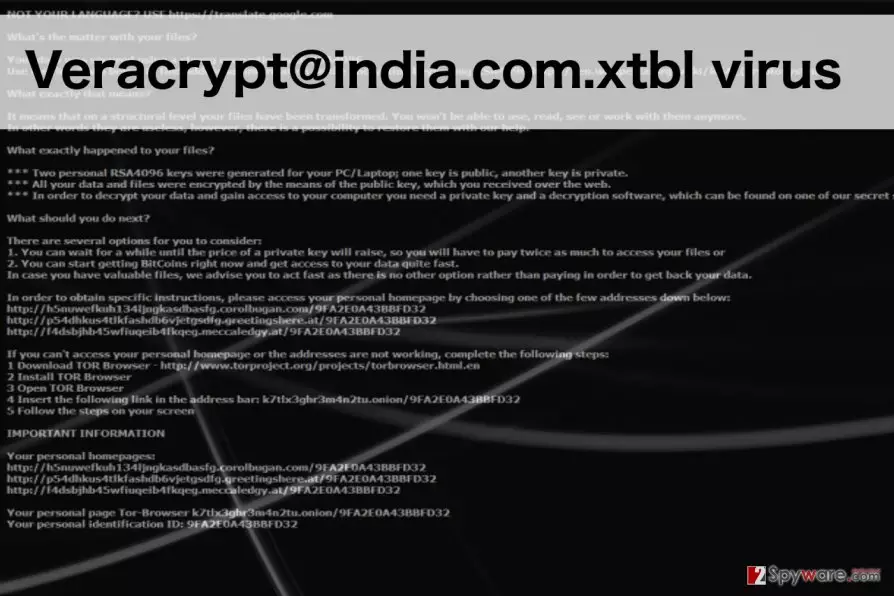
Veracrypt@india.com virus is one of those cyber threats that attempt to look professional even when they are clearly malicious. It allows you to send its creators a test file to make sure their offered decryption service actually works. The criminals may send the decrypted file simply as a hook, so it would be naive to think that all of the files on the computer will be decrypted the same way. In fact, the .veracrypt@india.com.xtbl file extension that the virus adds to the infected files may remain intact even after the supposed file decryption is carried out. Thus, you should not make any reckless transactions but proceed with the veracrypt@india.com.xtbl removal instead. To ensure the better protection of your future files, you should carefully rethink your computer’s security and keep a backup of your data on an external drive.
What are the most typical places to encounter this virus?
Ransomware viruses are dangerous not only because of their aggressive behavior but also because there are many ways through which they can infect the computers. Although, the most typical place to encounter a ransomware virus is your email. In particular your Spam folder. The infectious email may be disguised as a speeding ticket, invoice document or some other supposedly important information. When you download such a file, the virus may be immediately activated. Of course, you can have your computer infiltrated if you behave recklessly online: download software from unreputable websites, click on fake lottery-winning ads or other suspicious advertisements, etc. Therefore, you should be careful and always think one step ahead before acting, because you may easily end up with the malicious veracrypt@india.com.xtbl virus on your PC.
Easy veracrypt@india.com.xtbl removal recommendations:
Usually, ransomware removal takes time, and various challenges arise during the process. Luckily, we have analyzed this virus and come up with the best solution to the veracrypt@india.com.xtbl removal. What you have to do first is to obtain a reputable antivirus software and try running an automatic scan of your device. In most cases this step will be enough to detect and eliminate the virus. However, if there are some interferences and the antivirus is experiencing errors, do not worry. Scroll down to find instructions which should help you decontaminate the virus, run the scan again and remove veracrypt@india.com.xtbl from your device for good.
Did this guide help?
1 comment
jipee
Are the ransomware viruses the most aggressive today? Cause they keep on coming and there seems to be no end of them