

LiveShoppers ads will not help you to save money when shopping online
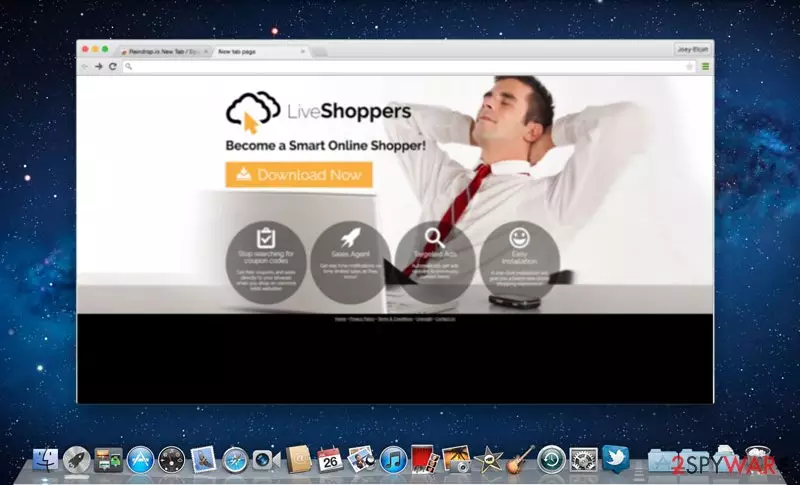
LiveShoppers is promoted as a tool that helps to boost online shopping experience to a new level and save money. However, these are just beautiful promises. It works as a potentially unwanted program (PUP) and adware[1] which floods browser with suspicious ads, pop-ups, and other commercial offers.
Windows OS users might sigh with relief because this adware mainly attacks Mac OS X.[2] When LiveShoppers virus enters the system, it might alter browser’s settings and display latest hot deals and the ability to provide free coupons.
However, such impression remains until they notice a number of pop-ups covering their computer screens. Also, since this PUP is adware, it may act quite aggressive regarding the commercial offers shown by other online companies. If you expect to receive objective information in LiveShoppers ads, you may be disappointed.
The analysis of the PUP showed that adware might deliver fake shopping offers that redirect to questionable an even phishing shops.[3] Therefore, you should be aware of these LiveShoppers redirect tendencies and do not trust great shopping deals.
In addition, you might also notice the suggestions to install additional programs which seemingly assist in the online shopping process. Decline them instantly because it is unlikely that adware-type application promotes practical and legitimate software.
Moreover, this PUP collects not only non-personal (browsing history, search queries, IP address) but personal information as well. The latter is used for delivering personalized LiveShoppers pop-ups and shopping offers. The former is exploited for marketing and service improving purposes. In either case, the final result will be an enormous amount of advertisements flooding your browser.
As you can see, LiveShoppers removal is necessary for protecting both – your privacy and computer. After the installation of this PUP, you might be tricked to download malicious content to your PC or reveal credit card information[4] to cyber criminals. Therefore, it’s better to uninstall this shady app immediately.
If it arrived on the system in a bundle, you should remove LiveShoppers automatically with anti-malware tool. FortectIntego or your preferred security tool can quickly detect and eliminate it from the system. However, if you prefer manual elimination, you can find the instructions at the end of the article.

Adware distribution relies on bundling
As mentioned before, the adware can be found on its official website. Alternatively, if you did not intend to install it willingly, it might have sneaked into your device along with recently installed free file converter or driver updater. Unfortunately, few users give a second look before installing a new application. As a result of this vice, the unwanted programs, like Live Shoppers easily invade computers.
Security experts from Hungary[5] say that there are two main rules that you should follow:
- Select “Advanced” installation mode to spot any add-ons, which are usually automatically pre-marked.
- Unmark the checkboxes to disable the installation of the unwanted attachments.
Uninstall LiveShoppers adware
The method leading to fastest elimination, is, certainly, the automatic one. The anti-spyware program will remove LiveShoppers virus in a few minutes. However, once the system scan is over, you should also reset each of the web browsers to delete tracking cookies and other adware-related entries.
However, this PUP is not a complex nor a serious cyber threat so you can delete it the usual way as well. Manual instructions will guide you to the complete LiveShoppers removal. Find the guidelines provided below. Carefully and attentively go through each installation stage not to miss any detail.
Uninstall from Windows
Uninstall from Windows 10/8:
- Type Control Panel into the Windows search box and open the result.
- Under Programs, select Uninstall a program.


Uninstall from Windows 7/XP:
- Click on Windows Start > Control Panel (Windows XP users should click on Add/Remove Programs).
- In Control Panel, select Programs > Uninstall a program.


Remove the unwanted program:
- In the Programs and Features window, look for any recently installed suspicious entries, select them, and click Uninstall.
- If User Account Control appears, click Yes to confirm, then complete the removal.


Delete from macOS
Remove the unwanted application:
- From the menu bar, select Go > Applications.
- In the Applications folder, look for any suspicious entries, then drag them to Trash (or right-click and pick Move to Trash).


Delete leftover files and folders:
- Select Go > Go to Folder.
- Enter /Library/Application Support and remove any suspicious folders related to the unwanted program.
- Repeat the same check in the /Library/LaunchAgents and /Library/LaunchDaemons folders, deleting any suspicious entries.

- Finally, empty the Trash to permanently remove the leftovers.

Reset Internet Explorer
Remove dangerous add-ons:
- Open Internet Explorer, click on the Gear icon (IE menu) on the top-right corner of the browser
- Pick Manage Add-ons.
- You will see a Manage Add-ons window. Here, look for suspicious plugins. Click on these entries and select Disable.


Change your homepage if it was altered:
- Open IE and click on the Gear icon.
- Select Internet Options.
- In the General tab, delete the Home page address and replace it by your preferred one (for example, Google.com).
- Click Apply and then select OK.


Delete temporary files:
- Press on the Gear icon and select Internet Options.
- Under Browsing history, click Delete...
- Select relevant fields and press Delete.


Reset Internet Explorer:
- Click on Gear icon > Internet options and select Advanced tab.
- Select Reset.
- In the new window, check Delete personal settings and select Reset.


Remove from Microsoft Edge
Delete unwanted extensions from MS Edge:
- Select Menu (three horizontal dots at the top-right of the browser window) and pick Extensions.
- From the list, pick the extension and click on the Gear icon.
- Click Remove.


Clear cookies and other browser data:
- Click on the Menu (three horizontal dots at the top-right of the browser window) and select Settings > Privacy, search, and services..
- Under Clear browsing data, pick Choose what to clear.
- Select Cookies and other site data and Cached images and files. (apart from passwords, although you might want to include Media licenses as well, if applicable) and click on Clear.


Restore new tab and homepage settings:
- Click the menu icon and choose Settings.
- Then find On startup section.
- Click Remove next to any suspicious startup page.
Reset MS Edge if the above steps did not work:
- Press on Ctrl + Shift + Esc to open Task Manager.
- Click on More details arrow at the bottom of the window.
- Select Details tab.
- Now scroll down and locate every entry with Microsoft Edge name in it. Right-click on each of them and select End Task to stop MS Edge from running.


Instructions for Chromium-based Edge
Delete extensions from MS Edge (Chromium):
- Open Edge and click select Settings > Extensions.
- Delete unwanted extensions by clicking Remove.


Clear cache and site data:
- Click on Menu and go to Settings.
- Select Privacy, search and services.
- Under Clear browsing data, pick Choose what to clear.
- Under Time range, pick All time.
- Select Clear now.


Reset Chromium-based MS Edge:
- Click on Menu and select Settings.
- On the left side, pick Reset settings.
- Select Restore settings to their default values.
- Confirm with Reset.
- This will disable extensions and reset startup pages but will not delete bookmarks, saved passwords, or browsing history.


Remove from Mozilla Firefox (FF)
Remove dangerous extensions:
- Open Mozilla Firefox browser and click on the Menu (three horizontal lines at the top-right of the window).
- Select Add-ons.
- In here, select the unwanted extension and click Remove.


Reset the homepage:
- Click three horizontal lines at the top right corner to open the menu.
- Choose Settings.
- Under Home, set your preferred homepage and new tab settings.
Clear cookies and site data:
- Click Menu and pick Settings.
- Go to Privacy & Security section.
- Scroll down to locate Cookies and Site Data.
- Click on Clear Data...
- Select Cookies and Site Data and Temporary cached files and pages, then click Clear.


Reset Mozilla Firefox
If clearing the browser as explained above did not help, reset Mozilla Firefox:
- Open Mozilla Firefox browser and click the Menu.
- Go to Help and then choose Troubleshooting Information.

- Under Give Firefox a tune up section, click on Refresh Firefox...
- Once the pop-up shows up, confirm the action by pressing on Refresh Firefox.



Remove from Google Chrome
Delete malicious extensions from Google Chrome:
- Open Google Chrome, click on the Menu (three vertical dots at the top-right corner) and select More tools > Extensions.
- In the newly opened window, you will see all the installed extensions. Uninstall all suspicious extensions related to the unwanted program by clicking Remove.


Clear cache and web data from Chrome:
- Click on Menu and pick Settings.
- Under Privacy and security, select Clear browsing data.
- Select Browsing history, Cookies and other site data, as well as Cached images and files.
- Click Clear data.


Change your homepage:
- Click menu and choose Settings.
- Look for a suspicious site in the On startup section.
- Click on Open a specific or set of pages and click on three dots to find the Remove option.
Reset Google Chrome:
If the previous methods did not help you, reset Google Chrome to eliminate all the unwanted components:
- Click on Menu and select Settings.
- In the Settings, scroll down and click Advanced.
- Scroll down and locate Reset and clean up section.
- Now click Restore settings to their original defaults.
- Confirm with Reset settings.


Delete from Safari
Remove dangerous extensions:
- Open Safari, click Safari in the menu at the top-left of the screen, and select Preferences.
- Go to the Extensions tab, look for any suspicious entries, and click Uninstall to remove them.


Clear history and website data:
- Click Safari in the menu and pick Clear History.
- Set Clear to all history and confirm with Clear History.


Reset Safari:
- Click Safari in the menu and select Preferences > Advanced.
- Enable Show Develop menu in menu bar.
- From the menu bar, click Develop and select Empty Caches.


Did this guide help?
2 comments
Lucy
The discounts are too small!
Miranda
I used this program for a while, I didnt see anything wrong with it. Though the amount of pop-ups is really annoying at times.