

Is search.abstractbaby.com virus considered to be a threat?
Search.abstractbaby.com virus targets your computer despite whether you tend to surf the Web daily or if you occasionally look up for a small piece of the information. Once this browser hijacker invades your browser, it will cause a series of unpleasant disturbances. The majority of users do not differentiate a hijacker from a legitimate search engine. In this article, we will present you the most negative aspects of this PUP and suggest search.abstractbaby.com removal methods.
First of all, the majority of browsers hijacker have completely random titles, such as this one – Abstract Baby Search. Thus, the title should be considered a proper suggestion not to use this hijacker. Secondly, this questionable browsing tool uses a questionable database for delivering search engines. In this case, it employs Yahoo database for delivering search targets. However, you might notice that there are more advertising websites presented as search results. In addition, since this hijacker employs a filter, you might encounter search.abstractbaby.com redirect problem. This hijacker is supported by third-parties so you might unwillingly find yourself in their domains. The latter websites often happen to be advertising, gaming or gambling domains so you should be aware that they might hide unwanted “surprises” – malware within. Therefore, you should remove search.abstractbaby.com as soon as possible. You can use FortectIntego to help you.
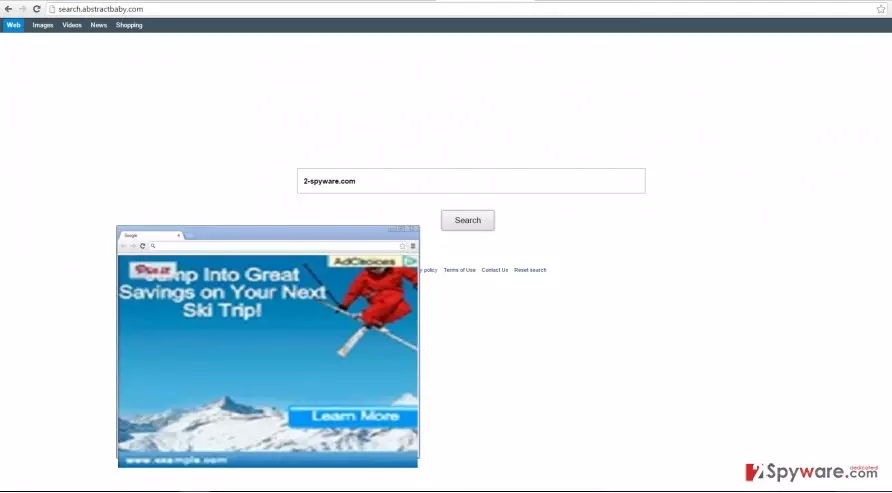
Furthermore, the hijacker collects information about your online activity. This information includes your search entries, IP address, and browsing frequency. Such data is collected by many legitimate websites. However, this browsing tool may share it with third-parties. As a result, your browser may be overcrowded with the personalized advertisements designed according to your own preferences. Moreover, the PUP may also transfer your personal information in statistical form to anonymous online companies. Do not get surprised if after such bargain, your Inbox folder is crammed with spam emails.
The distribution techniques of the hijacker
It spreads the same way as other search engines of the same kind. The PUP attaches itself to freeware, specifically, under “Basic” settings. Unfortunately, users do not give it a second look before switching from one installation stage to another. Consequently, the add-on with search.abstractbaby.com remains unnoticed. If you are willing to prevent such infiltration in the future, make sure you opt for “Advanced” installation mode. After checking for potentially malicious and irrelevant pre-marked applications, initiate installing the primarily downloaded application.
Search.abstractbaby.com removal steps
You can successfully get rid of this hijacker if you opt for the automatic elimination. Install an anti-spyware application to quicken the process and ensure that the hijacker is fully deleted. It is crucial to locate and terminate all its related files. Otherwise, the risk of getting infected with the same or another questionable search engine remains high. The security application is more suitable for detecting malignant files which might be disguised as the legitimate ones. If you decide to track them manually, you might waste a lot more time and still miss a few. In any case, if you prefer uninstalling programs on your own, you can remove search.abstractbaby.com manually. Find the instructions below.
Uninstall from Windows
Uninstall from Windows 10/8:
- Type Control Panel into the Windows search box and open the result.
- Under Programs, select Uninstall a program.


Uninstall from Windows 7/XP:
- Click on Windows Start > Control Panel (Windows XP users should click on Add/Remove Programs).
- In Control Panel, select Programs > Uninstall a program.


Remove the unwanted program:
- In the Programs and Features window, look for any recently installed suspicious entries, select them, and click Uninstall.
- If User Account Control appears, click Yes to confirm, then complete the removal.


Delete from macOS
Remove the unwanted application:
- From the menu bar, select Go > Applications.
- In the Applications folder, look for any suspicious entries, then drag them to Trash (or right-click and pick Move to Trash).


Delete leftover files and folders:
- Select Go > Go to Folder.
- Enter /Library/Application Support and remove any suspicious folders related to the unwanted program.
- Repeat the same check in the /Library/LaunchAgents and /Library/LaunchDaemons folders, deleting any suspicious entries.

- Finally, empty the Trash to permanently remove the leftovers.

Remove from Microsoft Edge
Delete unwanted extensions from MS Edge:
- Select Menu (three horizontal dots at the top-right of the browser window) and pick Extensions.
- From the list, pick the extension and click on the Gear icon.
- Click Remove.


Clear cookies and other browser data:
- Click on the Menu (three horizontal dots at the top-right of the browser window) and select Settings > Privacy, search, and services..
- Under Clear browsing data, pick Choose what to clear.
- Select Cookies and other site data and Cached images and files. (apart from passwords, although you might want to include Media licenses as well, if applicable) and click on Clear.


Restore new tab and homepage settings:
- Click the menu icon and choose Settings.
- Then find On startup section.
- Click Remove next to any suspicious startup page.
Reset MS Edge if the above steps did not work:
- Press on Ctrl + Shift + Esc to open Task Manager.
- Click on More details arrow at the bottom of the window.
- Select Details tab.
- Now scroll down and locate every entry with Microsoft Edge name in it. Right-click on each of them and select End Task to stop MS Edge from running.


Instructions for Chromium-based Edge
Delete extensions from MS Edge (Chromium):
- Open Edge and click select Settings > Extensions.
- Delete unwanted extensions by clicking Remove.


Clear cache and site data:
- Click on Menu and go to Settings.
- Select Privacy, search and services.
- Under Clear browsing data, pick Choose what to clear.
- Under Time range, pick All time.
- Select Clear now.


Reset Chromium-based MS Edge:
- Click on Menu and select Settings.
- On the left side, pick Reset settings.
- Select Restore settings to their default values.
- Confirm with Reset.
- This will disable extensions and reset startup pages but will not delete bookmarks, saved passwords, or browsing history.


Remove from Mozilla Firefox (FF)
Remove dangerous extensions:
- Open Mozilla Firefox browser and click on the Menu (three horizontal lines at the top-right of the window).
- Select Add-ons.
- In here, select the unwanted extension and click Remove.


Reset the homepage:
- Click three horizontal lines at the top right corner to open the menu.
- Choose Settings.
- Under Home, set your preferred homepage and new tab settings.
Clear cookies and site data:
- Click Menu and pick Settings.
- Go to Privacy & Security section.
- Scroll down to locate Cookies and Site Data.
- Click on Clear Data...
- Select Cookies and Site Data and Temporary cached files and pages, then click Clear.


Reset Mozilla Firefox
If clearing the browser as explained above did not help, reset Mozilla Firefox:
- Open Mozilla Firefox browser and click the Menu.
- Go to Help and then choose Troubleshooting Information.

- Under Give Firefox a tune up section, click on Refresh Firefox...
- Once the pop-up shows up, confirm the action by pressing on Refresh Firefox.



Remove from Google Chrome
Delete malicious extensions from Google Chrome:
- Open Google Chrome, click on the Menu (three vertical dots at the top-right corner) and select More tools > Extensions.
- In the newly opened window, you will see all the installed extensions. Uninstall all suspicious extensions related to the unwanted program by clicking Remove.


Clear cache and web data from Chrome:
- Click on Menu and pick Settings.
- Under Privacy and security, select Clear browsing data.
- Select Browsing history, Cookies and other site data, as well as Cached images and files.
- Click Clear data.


Change your homepage:
- Click menu and choose Settings.
- Look for a suspicious site in the On startup section.
- Click on Open a specific or set of pages and click on three dots to find the Remove option.
Reset Google Chrome:
If the previous methods did not help you, reset Google Chrome to eliminate all the unwanted components:
- Click on Menu and select Settings.
- In the Settings, scroll down and click Advanced.
- Scroll down and locate Reset and clean up section.
- Now click Restore settings to their original defaults.
- Confirm with Reset settings.


Delete from Safari
Remove dangerous extensions:
- Open Safari, click Safari in the menu at the top-left of the screen, and select Preferences.
- Go to the Extensions tab, look for any suspicious entries, and click Uninstall to remove them.


Clear history and website data:
- Click Safari in the menu and pick Clear History.
- Set Clear to all history and confirm with Clear History.


Reset Safari:
- Click Safari in the menu and select Preferences > Advanced.
- Enable Show Develop menu in menu bar.
- From the menu bar, click Develop and select Empty Caches.


Did this guide help?
3 comments
Tammy
Do the owners really make a profit out of such activity?
Margaret
Thanks for the tutorial.
Chris
I messed up with the instructions, time to shift to the automatic removal option.