

Definition of Search.mywebs.pro virus
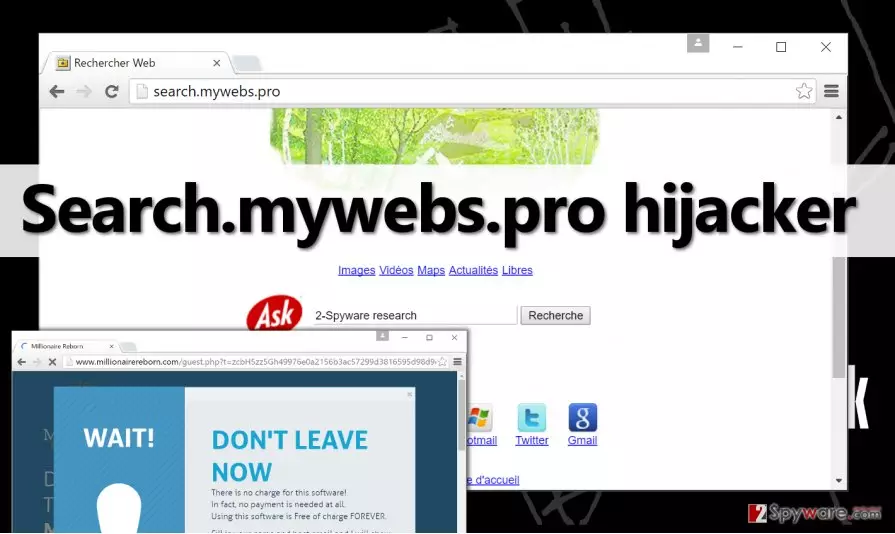
If your browser has been acting suspicious lately, there’s a great chance that it has been affected by Search.mywebs.pro virus. This controversial program is not as severe as ransomware or other malicious viruses, but it can greatly affect your browsing experience by causing redirects, displaying pop-up ads and causing other inconveniences. According to our research team, this potentially unwanted program (PUP) belongs to “browser hijackers” category, which means that it is designed to affect user’s web browsers only. Once installed, it inserts tracking cookies and modifies browser settings to make Search.mywebs.pro the main search engine, homepage, and new tab page address. This search engine is not well-known and, according to spyware researchers, serves many sponsored search outcomes. Bear in mind that clicking on these search results can take you to unexpected web places, which might cause danger to your computer system. Therefore, we suggest relying on a different search engine, but in order to remove Search.mywebs.pro, you should use either anti-spyware program like FortectIntego or use manual Search.mywebs.pro removal instructions presented at the end of this post.
Another occurrence you might encounter while using a computer infected with Search.mywebs.pro redirect virus is annoying web ads. These ads might show up in separate browser windows or new tabs, and advertise various shopping offers, price comparisons, freeware, and similar content. Be careful and do not be deceived by these ads because you can never know what lies behind them. You might be taken to highly questionable websites or even tricked into installing possibly dangerous software. Besides, these ads eventually are going to annoy you, so you will naturally want to get rid of them.
Distribution methods
You can set this URL as your homepage manually, but the vast of computer users discover this website in their browsers without an intention to set it as their home or new tab page. It is so because potentially unwanted programs like Search.mywebs.pro hijack user’s computers in a legitimate way. They are distributed alongside free applications as “suggested downloads” and can be easily opted out. However, it seems that not all computer users know how to opt out these additional downloads; consequently, they end up installing them. To avoid installing undesired programs, users should choose “Advanced” or “Custom” installation methods rather than pre-selected “Default” or “Standard” ones. You should also avoid selecting “Basic” or “Express” settings, too. Once you change setup settings to our recommended ones, make sure you deselect all additional components such as search tools, apps, add-ons and so on. Then you can finish the installation.
How to uninstall Search.mywebs.pro browser hijacker from my computer?
As we have already stated, it is better to keep the computer free of browser redirect viruses. That is why we advise you to remove Search.mywebs.pro virus without any hesitation. There are two different ways to complete this task. You can use anti-spyware software and let it detect all potentially unwanted programs and more critical pieces of software automatically, or, if you prefer, you can use these Search.mywebs.pro removal instructions that are given below this article and uninstall this suspicious program manually. Please be careful and complete all steps as instructed to get rid of this program entirely. Please do not hesitate and get in touch with our support team if you have any questions about this browser hijacker or its removal.
Uninstall from Windows
Uninstall from Windows 10/8:
- Type Control Panel into the Windows search box and open the result.
- Under Programs, select Uninstall a program.


Uninstall from Windows 7/XP:
- Click on Windows Start > Control Panel (Windows XP users should click on Add/Remove Programs).
- In Control Panel, select Programs > Uninstall a program.


Remove the unwanted program:
- In the Programs and Features window, look for any recently installed suspicious entries, select them, and click Uninstall.
- If User Account Control appears, click Yes to confirm, then complete the removal.


Delete from macOS
Remove the unwanted application:
- From the menu bar, select Go > Applications.
- In the Applications folder, look for any suspicious entries, then drag them to Trash (or right-click and pick Move to Trash).


Delete leftover files and folders:
- Select Go > Go to Folder.
- Enter /Library/Application Support and remove any suspicious folders related to the unwanted program.
- Repeat the same check in the /Library/LaunchAgents and /Library/LaunchDaemons folders, deleting any suspicious entries.

- Finally, empty the Trash to permanently remove the leftovers.

Remove from Microsoft Edge
Delete unwanted extensions from MS Edge:
- Select Menu (three horizontal dots at the top-right of the browser window) and pick Extensions.
- From the list, pick the extension and click on the Gear icon.
- Click Remove.


Clear cookies and other browser data:
- Click on the Menu (three horizontal dots at the top-right of the browser window) and select Settings > Privacy, search, and services..
- Under Clear browsing data, pick Choose what to clear.
- Select Cookies and other site data and Cached images and files. (apart from passwords, although you might want to include Media licenses as well, if applicable) and click on Clear.


Restore new tab and homepage settings:
- Click the menu icon and choose Settings.
- Then find On startup section.
- Click Remove next to any suspicious startup page.
Reset MS Edge if the above steps did not work:
- Press on Ctrl + Shift + Esc to open Task Manager.
- Click on More details arrow at the bottom of the window.
- Select Details tab.
- Now scroll down and locate every entry with Microsoft Edge name in it. Right-click on each of them and select End Task to stop MS Edge from running.


Instructions for Chromium-based Edge
Delete extensions from MS Edge (Chromium):
- Open Edge and click select Settings > Extensions.
- Delete unwanted extensions by clicking Remove.


Clear cache and site data:
- Click on Menu and go to Settings.
- Select Privacy, search and services.
- Under Clear browsing data, pick Choose what to clear.
- Under Time range, pick All time.
- Select Clear now.


Reset Chromium-based MS Edge:
- Click on Menu and select Settings.
- On the left side, pick Reset settings.
- Select Restore settings to their default values.
- Confirm with Reset.
- This will disable extensions and reset startup pages but will not delete bookmarks, saved passwords, or browsing history.


Remove from Mozilla Firefox (FF)
Remove dangerous extensions:
- Open Mozilla Firefox browser and click on the Menu (three horizontal lines at the top-right of the window).
- Select Add-ons.
- In here, select the unwanted extension and click Remove.


Reset the homepage:
- Click three horizontal lines at the top right corner to open the menu.
- Choose Settings.
- Under Home, set your preferred homepage and new tab settings.
Clear cookies and site data:
- Click Menu and pick Settings.
- Go to Privacy & Security section.
- Scroll down to locate Cookies and Site Data.
- Click on Clear Data...
- Select Cookies and Site Data and Temporary cached files and pages, then click Clear.


Reset Mozilla Firefox
If clearing the browser as explained above did not help, reset Mozilla Firefox:
- Open Mozilla Firefox browser and click the Menu.
- Go to Help and then choose Troubleshooting Information.

- Under Give Firefox a tune up section, click on Refresh Firefox...
- Once the pop-up shows up, confirm the action by pressing on Refresh Firefox.



Remove from Google Chrome
Delete malicious extensions from Google Chrome:
- Open Google Chrome, click on the Menu (three vertical dots at the top-right corner) and select More tools > Extensions.
- In the newly opened window, you will see all the installed extensions. Uninstall all suspicious extensions related to the unwanted program by clicking Remove.


Clear cache and web data from Chrome:
- Click on Menu and pick Settings.
- Under Privacy and security, select Clear browsing data.
- Select Browsing history, Cookies and other site data, as well as Cached images and files.
- Click Clear data.


Change your homepage:
- Click menu and choose Settings.
- Look for a suspicious site in the On startup section.
- Click on Open a specific or set of pages and click on three dots to find the Remove option.
Reset Google Chrome:
If the previous methods did not help you, reset Google Chrome to eliminate all the unwanted components:
- Click on Menu and select Settings.
- In the Settings, scroll down and click Advanced.
- Scroll down and locate Reset and clean up section.
- Now click Restore settings to their original defaults.
- Confirm with Reset settings.


Delete from Safari
Remove dangerous extensions:
- Open Safari, click Safari in the menu at the top-left of the screen, and select Preferences.
- Go to the Extensions tab, look for any suspicious entries, and click Uninstall to remove them.


Clear history and website data:
- Click Safari in the menu and pick Clear History.
- Set Clear to all history and confirm with Clear History.


Reset Safari:
- Click Safari in the menu and select Preferences > Advanced.
- Enable Show Develop menu in menu bar.
- From the menu bar, click Develop and select Empty Caches.


Did this guide help?
4 comments
Marxe
Oh, this hijacker has been bothering me for the last couple of days!
fable
So good to finally get rid of the program that caused Search.mywebs.pro redirects! I will continue using Google search, just like I did before this hijacker infected my pc.
Brav2
Reimage has uninstalled this in less than 10 minutes. Also, my PC is clean now.
Phoebe13
no more redirects! yay!