

Newpage16.site virus – why should you stay clear of it?
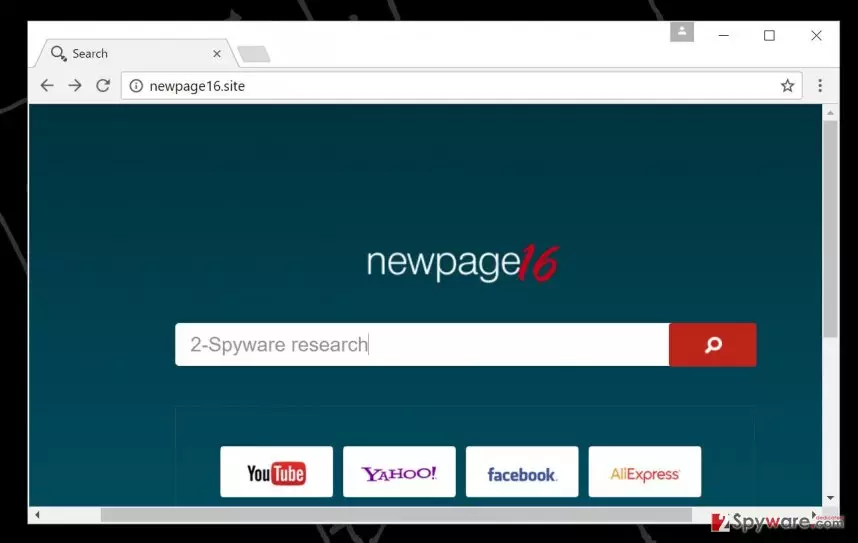
Newpage16.site virus is a bogus application that is mainly distributed via software packages. Users do not look for this application by their choice, so authors of it look for different ways of making people use this app. Due to its distribution methods and its modus operandi, this browser hijacker is assigned to potentially unwanted programs’ category, which means that security experts advise not to keep it on the computer. If you have discovered that your browser has been hijacked and now opens Newpage16.site on Startup, waste no time and remove Newpage16.site browser hijacker with an anti-spyware program like FortectIntego. If you already have a computer protection program, update it and scan your PC with it.
The reason why it is recommended to stay away from this suspicious page is that it presents a deceptive search tool. Although there are no signs that it might be not safe to use it, victims might believe that it is yet another regular search engine and that there is no difference whether to use it or a well-known one like Google. Sadly, there is a huge difference, because search results powered by this vague search tool can strongly disappoint you. They are filled with sponsored links and are not only annoying but hazardous as well. Clicking on these third-party links can cause redirection to highly dangerous sites, which most likely haven’t been endorsed by the Newpage16.site developer. For this reason, the indicated program is sometimes called as Newpage16.site redirect virus. Beware that untrustworthy third-party Internet sites can be cluttered with aggressive ads related to other insecure websites or downloads links to get free programs that can supposedly enhance your daily computer use. Sadly, such programs can appear to be malicious or at least highly annoying, so it is better to refuse to install them. What is more, the existence of the discussed browser hijacker does slow down the computer and make the web browser act suspiciously, and only Newpage16.site removal can solve these problems. Another suspicious fact that you might not like is that as long as it stays on the computer, this hijacker collects information about your browsing preferences, including your search queries, data related to search and browsing history. Later on, it might share such data with third-parties to deliver you tailored ads. That is why we suggest you to take actions immediately and use a different search engine instead.
How does this hijacker spread?
If you have been infected by this hijacker, then it means that you have missed the moment when this program has been offered to you. This typically happens during installation of another free program. Unfortunately, such suggestions are commonly hidden so that the user would miss them. Offers to install additional downloads are hidden behind auto-selected software installation options such as Default or Standard and sometimes – Express. To avoid misunderstandings, choose Custom or Advanced settings and if you see any suggested downloads, deselect the agreements to install them. Simply by performing this security check, you will prevent Newpage16.site hijack. Of course, this technique helps to stop any other potentially unwanted program from entering your PC.
What is the fastest way to remove Newpage16.site hijacker?
Do not waste your time trying to understand what is wrong with this search engine – it is created to deliver altered search results, and its primary target is to make you click on them. The more clicks it gathers, the more pay-per-click revenue it generates. To remove Newpage16.site virus, use an automatic spyware removal tool or remove it using instructions provided here.
Uninstall from Windows
Uninstall from Windows 10/8:
- Type Control Panel into the Windows search box and open the result.
- Under Programs, select Uninstall a program.


Uninstall from Windows 7/XP:
- Click on Windows Start > Control Panel (Windows XP users should click on Add/Remove Programs).
- In Control Panel, select Programs > Uninstall a program.


Remove the unwanted program:
- In the Programs and Features window, look for any recently installed suspicious entries, select them, and click Uninstall.
- If User Account Control appears, click Yes to confirm, then complete the removal.


Delete from macOS
Remove the unwanted application:
- From the menu bar, select Go > Applications.
- In the Applications folder, look for any suspicious entries, then drag them to Trash (or right-click and pick Move to Trash).


Delete leftover files and folders:
- Select Go > Go to Folder.
- Enter /Library/Application Support and remove any suspicious folders related to the unwanted program.
- Repeat the same check in the /Library/LaunchAgents and /Library/LaunchDaemons folders, deleting any suspicious entries.

- Finally, empty the Trash to permanently remove the leftovers.

Remove from Microsoft Edge
Delete unwanted extensions from MS Edge:
- Select Menu (three horizontal dots at the top-right of the browser window) and pick Extensions.
- From the list, pick the extension and click on the Gear icon.
- Click Remove.


Clear cookies and other browser data:
- Click on the Menu (three horizontal dots at the top-right of the browser window) and select Settings > Privacy, search, and services..
- Under Clear browsing data, pick Choose what to clear.
- Select Cookies and other site data and Cached images and files. (apart from passwords, although you might want to include Media licenses as well, if applicable) and click on Clear.


Restore new tab and homepage settings:
- Click the menu icon and choose Settings.
- Then find On startup section.
- Click Remove next to any suspicious startup page.
Reset MS Edge if the above steps did not work:
- Press on Ctrl + Shift + Esc to open Task Manager.
- Click on More details arrow at the bottom of the window.
- Select Details tab.
- Now scroll down and locate every entry with Microsoft Edge name in it. Right-click on each of them and select End Task to stop MS Edge from running.


Instructions for Chromium-based Edge
Delete extensions from MS Edge (Chromium):
- Open Edge and click select Settings > Extensions.
- Delete unwanted extensions by clicking Remove.


Clear cache and site data:
- Click on Menu and go to Settings.
- Select Privacy, search and services.
- Under Clear browsing data, pick Choose what to clear.
- Under Time range, pick All time.
- Select Clear now.


Reset Chromium-based MS Edge:
- Click on Menu and select Settings.
- On the left side, pick Reset settings.
- Select Restore settings to their default values.
- Confirm with Reset.
- This will disable extensions and reset startup pages but will not delete bookmarks, saved passwords, or browsing history.


Remove from Mozilla Firefox (FF)
Remove dangerous extensions:
- Open Mozilla Firefox browser and click on the Menu (three horizontal lines at the top-right of the window).
- Select Add-ons.
- In here, select the unwanted extension and click Remove.


Reset the homepage:
- Click three horizontal lines at the top right corner to open the menu.
- Choose Settings.
- Under Home, set your preferred homepage and new tab settings.
Clear cookies and site data:
- Click Menu and pick Settings.
- Go to Privacy & Security section.
- Scroll down to locate Cookies and Site Data.
- Click on Clear Data...
- Select Cookies and Site Data and Temporary cached files and pages, then click Clear.


Reset Mozilla Firefox
If clearing the browser as explained above did not help, reset Mozilla Firefox:
- Open Mozilla Firefox browser and click the Menu.
- Go to Help and then choose Troubleshooting Information.

- Under Give Firefox a tune up section, click on Refresh Firefox...
- Once the pop-up shows up, confirm the action by pressing on Refresh Firefox.



Remove from Google Chrome
Delete malicious extensions from Google Chrome:
- Open Google Chrome, click on the Menu (three vertical dots at the top-right corner) and select More tools > Extensions.
- In the newly opened window, you will see all the installed extensions. Uninstall all suspicious extensions related to the unwanted program by clicking Remove.


Clear cache and web data from Chrome:
- Click on Menu and pick Settings.
- Under Privacy and security, select Clear browsing data.
- Select Browsing history, Cookies and other site data, as well as Cached images and files.
- Click Clear data.


Change your homepage:
- Click menu and choose Settings.
- Look for a suspicious site in the On startup section.
- Click on Open a specific or set of pages and click on three dots to find the Remove option.
Reset Google Chrome:
If the previous methods did not help you, reset Google Chrome to eliminate all the unwanted components:
- Click on Menu and select Settings.
- In the Settings, scroll down and click Advanced.
- Scroll down and locate Reset and clean up section.
- Now click Restore settings to their original defaults.
- Confirm with Reset settings.


Delete from Safari
Remove dangerous extensions:
- Open Safari, click Safari in the menu at the top-left of the screen, and select Preferences.
- Go to the Extensions tab, look for any suspicious entries, and click Uninstall to remove them.


Clear history and website data:
- Click Safari in the menu and pick Clear History.
- Set Clear to all history and confirm with Clear History.


Reset Safari:
- Click Safari in the menu and select Preferences > Advanced.
- Enable Show Develop menu in menu bar.
- From the menu bar, click Develop and select Empty Caches.


Did this guide help?
4 comments
Nadi
Nasty virus... infected my browser!
Flanders
Remove Newpage16.site as fast as you can... its not safe to keep it on your computer
Rubio
I dont need Newpage16.site. I havent set it as my homepage, so i want it gone!
Jordan338
Uninstalled it!!!!! ¯\_(͡° ͜ʖ ͡°)_/¯