

Everything you should know about annoying ads by Slithermon
The reason why Slithermon ads started showing up in your browser is that your computer has been infected with an adware program. The official website allows Internet users to play a well-known game called Slither.io; however, these ads have nothing in common with it. Adware is compatible with Google Chrome, Microsoft Edge, Mozilla Firefox, and Internet Explorer. After Slithermon hijack users start seeing an excessive amount of ads wherever website they visit. This PUP employs a “virtual layer” which allows placing third-party advertisements on every Internet site. Therefore, users might notice an increased amount of ads on their favorite websites. Ads by Slithermon might be delivered in the form of pop-up, banner, in-text, coupon and other types of online ads. We have to warn you to stay away from these eye-catching advertisements. They might be tricky, misleading and even dangerous. After one click on the “great offer,” you might install Trojan, ransomware or other malware. For this reason, you should not hesitate and scan your computer with a reputable anti-malware program, such as FortectIntego or SpyHunterCombo Cleaner and remove Slithermon ads from the system.
This potentially unwanted program generates so many ads that your computer performance will slow down considerably. Besides, your browser might crash and freeze once in a while. But it’s not the worst part. So-called Slithermon virus might track information about users. Adware is interested in your IP address, most visited websites, time spent on particular pages, search queries, clicked advertisement and similar information related to your browsing habits. Keep in mind that this information might include personally identifiable details about you, and, what is worse, information about you might be shared with shady third-party businesses. Gathered and analyzed information is necessary for generating and providing personalized advertisements. The creators of adware are interested in generating revenue from pay-per-click advertising strategies. There’s no secret that chances that Internet users click on ads are higher when they are interesting for them. However, you should not trust any potentially unwanted program. They might deliver hazardous ads and even try to steal your personal information. Therefore, do not hesitate and initiate Slithermon removal ASAP.
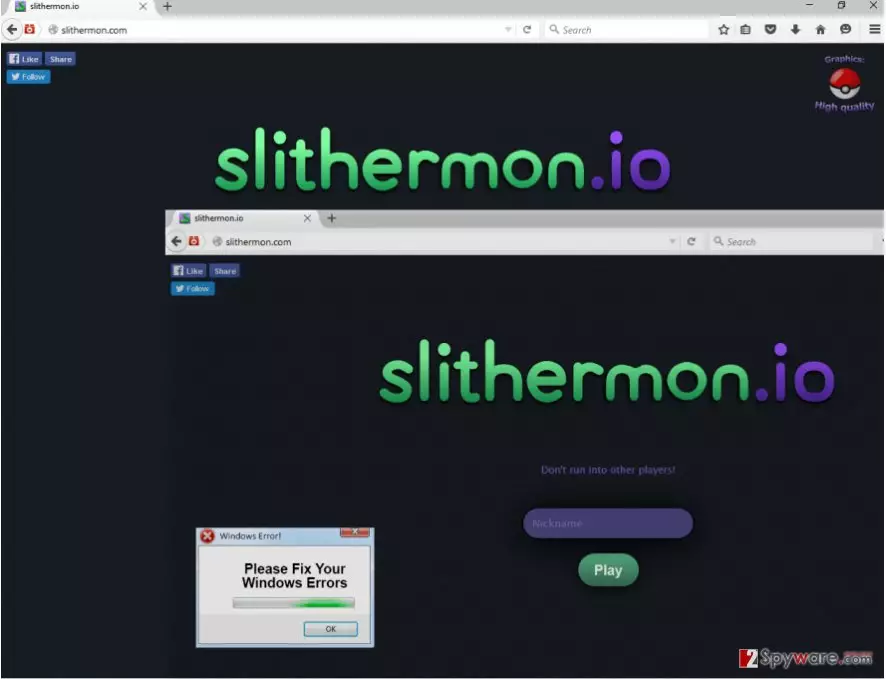
Why these ads appeared in my browser?
Adware which is responsible for Slithermon ads might have got inside the computer when you download and installed the latest program. The developers of potentially unwanted programs use deceptive software marketing technique – bundling. This method is widely used because computer users do not pay proper attention to software installation. Hackers take this bad habit as an advantage and spread their bogus applications. Adware might be added as an optional program to the regular software package and hidden under “Standard” or “Basic” installation mode. When installing programs, keep in mind that installation wizards do not openly disclose about additional downloads. You have to find them and reject their installation yourself. For doing this, you have to choose “Advanced” or “Custom” setup and when you see the checkbox with suggested programs, deselect them all and continue the installation.
How to get rid of Slithermon ads?
Intrusive online advertisements are bothering, annoying and decrease browsing experience a lot. Therefore, you should not reconcile with this unpleasant issues. Remove Slithermon ads with the help of a professional anti-malware program. However, some computer users are not willing to employ additional software and want to eliminate adware manually. Keep in mind that this method is more complicated, requires more time and effort because you have to detect and eliminate adware with all its components without additional help. In order to help you, we prepared manual Slithermon removal guide below.
Uninstall from Windows
Uninstall from Windows 10/8:
- Type Control Panel into the Windows search box and open the result.
- Under Programs, select Uninstall a program.


Uninstall from Windows 7/XP:
- Click on Windows Start > Control Panel (Windows XP users should click on Add/Remove Programs).
- In Control Panel, select Programs > Uninstall a program.


Remove the unwanted program:
- In the Programs and Features window, look for any recently installed suspicious entries, select them, and click Uninstall.
- If User Account Control appears, click Yes to confirm, then complete the removal.


Delete from macOS
Remove the unwanted application:
- From the menu bar, select Go > Applications.
- In the Applications folder, look for any suspicious entries, then drag them to Trash (or right-click and pick Move to Trash).


Delete leftover files and folders:
- Select Go > Go to Folder.
- Enter /Library/Application Support and remove any suspicious folders related to the unwanted program.
- Repeat the same check in the /Library/LaunchAgents and /Library/LaunchDaemons folders, deleting any suspicious entries.

- Finally, empty the Trash to permanently remove the leftovers.

Reset Internet Explorer
Remove dangerous add-ons:
- Open Internet Explorer, click on the Gear icon (IE menu) on the top-right corner of the browser
- Pick Manage Add-ons.
- You will see a Manage Add-ons window. Here, look for suspicious plugins. Click on these entries and select Disable.


Change your homepage if it was altered:
- Open IE and click on the Gear icon.
- Select Internet Options.
- In the General tab, delete the Home page address and replace it by your preferred one (for example, Google.com).
- Click Apply and then select OK.


Delete temporary files:
- Press on the Gear icon and select Internet Options.
- Under Browsing history, click Delete...
- Select relevant fields and press Delete.


Reset Internet Explorer:
- Click on Gear icon > Internet options and select Advanced tab.
- Select Reset.
- In the new window, check Delete personal settings and select Reset.


Remove from Microsoft Edge
Delete unwanted extensions from MS Edge:
- Select Menu (three horizontal dots at the top-right of the browser window) and pick Extensions.
- From the list, pick the extension and click on the Gear icon.
- Click Remove.


Clear cookies and other browser data:
- Click on the Menu (three horizontal dots at the top-right of the browser window) and select Settings > Privacy, search, and services..
- Under Clear browsing data, pick Choose what to clear.
- Select Cookies and other site data and Cached images and files. (apart from passwords, although you might want to include Media licenses as well, if applicable) and click on Clear.


Restore new tab and homepage settings:
- Click the menu icon and choose Settings.
- Then find On startup section.
- Click Remove next to any suspicious startup page.
Reset MS Edge if the above steps did not work:
- Press on Ctrl + Shift + Esc to open Task Manager.
- Click on More details arrow at the bottom of the window.
- Select Details tab.
- Now scroll down and locate every entry with Microsoft Edge name in it. Right-click on each of them and select End Task to stop MS Edge from running.


Instructions for Chromium-based Edge
Delete extensions from MS Edge (Chromium):
- Open Edge and click select Settings > Extensions.
- Delete unwanted extensions by clicking Remove.


Clear cache and site data:
- Click on Menu and go to Settings.
- Select Privacy, search and services.
- Under Clear browsing data, pick Choose what to clear.
- Under Time range, pick All time.
- Select Clear now.


Reset Chromium-based MS Edge:
- Click on Menu and select Settings.
- On the left side, pick Reset settings.
- Select Restore settings to their default values.
- Confirm with Reset.
- This will disable extensions and reset startup pages but will not delete bookmarks, saved passwords, or browsing history.


Remove from Mozilla Firefox (FF)
Remove dangerous extensions:
- Open Mozilla Firefox browser and click on the Menu (three horizontal lines at the top-right of the window).
- Select Add-ons.
- In here, select the unwanted extension and click Remove.


Reset the homepage:
- Click three horizontal lines at the top right corner to open the menu.
- Choose Settings.
- Under Home, set your preferred homepage and new tab settings.
Clear cookies and site data:
- Click Menu and pick Settings.
- Go to Privacy & Security section.
- Scroll down to locate Cookies and Site Data.
- Click on Clear Data...
- Select Cookies and Site Data and Temporary cached files and pages, then click Clear.


Reset Mozilla Firefox
If clearing the browser as explained above did not help, reset Mozilla Firefox:
- Open Mozilla Firefox browser and click the Menu.
- Go to Help and then choose Troubleshooting Information.

- Under Give Firefox a tune up section, click on Refresh Firefox...
- Once the pop-up shows up, confirm the action by pressing on Refresh Firefox.



Remove from Google Chrome
Delete malicious extensions from Google Chrome:
- Open Google Chrome, click on the Menu (three vertical dots at the top-right corner) and select More tools > Extensions.
- In the newly opened window, you will see all the installed extensions. Uninstall all suspicious extensions related to the unwanted program by clicking Remove.


Clear cache and web data from Chrome:
- Click on Menu and pick Settings.
- Under Privacy and security, select Clear browsing data.
- Select Browsing history, Cookies and other site data, as well as Cached images and files.
- Click Clear data.


Change your homepage:
- Click menu and choose Settings.
- Look for a suspicious site in the On startup section.
- Click on Open a specific or set of pages and click on three dots to find the Remove option.
Reset Google Chrome:
If the previous methods did not help you, reset Google Chrome to eliminate all the unwanted components:
- Click on Menu and select Settings.
- In the Settings, scroll down and click Advanced.
- Scroll down and locate Reset and clean up section.
- Now click Restore settings to their original defaults.
- Confirm with Reset settings.


Delete from Safari
Remove dangerous extensions:
- Open Safari, click Safari in the menu at the top-left of the screen, and select Preferences.
- Go to the Extensions tab, look for any suspicious entries, and click Uninstall to remove them.


Clear history and website data:
- Click Safari in the menu and pick Clear History.
- Set Clear to all history and confirm with Clear History.


Reset Safari:
- Click Safari in the menu and select Preferences > Advanced.
- Enable Show Develop menu in menu bar.
- From the menu bar, click Develop and select Empty Caches.


Did this guide help?
3 comments
Barbara
OMG!! I cant stand these ads and that silly game!
Janet
I hate online ads!
Gary
I thought developers of the game became crazy with flooding my browser with these ads... But it seems I am infected...