

What lies behind Search.ma-cmf.com?
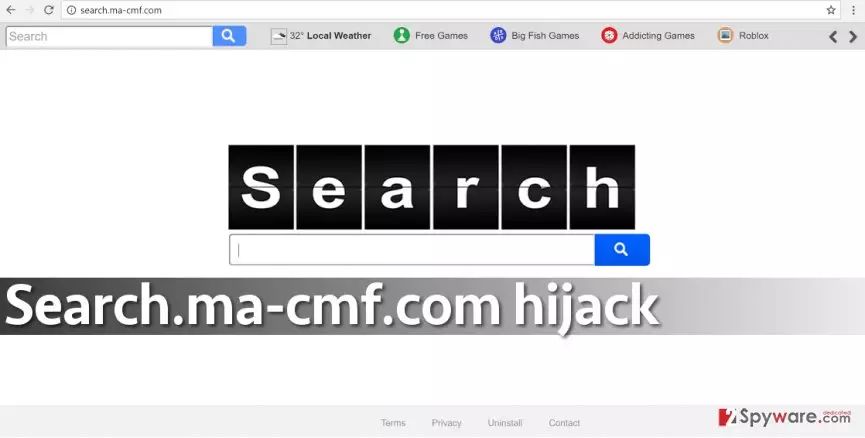
Search.ma-cmf.com virus may appeal to those users who seek to renew their browsing experience. It offers links to social networks, shopping domains, and news portals. However, such bait is a common characteristic for browser hijackers. Usually, the users continue browsing through this suspicious search engine because they simply could not be bothered to shift to some trustworthy browsing tool. Unfortunately, that is where they commit the fatal mistake. This PUP sets a different homepage and new tab page address instead of your Chrome, Firefox default ones so that third-parties could successfully promote their content users’ computers. These ads typically appear next to normal search results and look like they’re safe to click on, although in some cases they can lead to insecure web pages. Be careful – you might be redirected to websites that demand your personal information, or offer free programs or files that can harm your computer system. It is highly advisable to quit suspicious websites if the search engine unexpectedly redirects to them without your command to do it. In most cases, such occurrences indicate that the system has been infected with a browser hijacker. To remove Search.ma-cmf.com redirect virus, you have to use instructions provided under this post or just employ an automatic tool like FortectIntego.
What is more, due to Search.ma-cmf.com redirect, third-party companies may access data related to your browsing habits. This way, they can use it for market research. Typically, they need your recent search queries, a list of favorite websites, browsing history, IP address and similar data to find out what content interests you. Later on, they serve the user ads based on collected data. On top of it all, if Search.ma-cmf.com removal is not completed in time, the user even risks to be exposed to privacy violation or even identity theft.
The distribution peculiarities of the PUP
If you accidentally enabled Search.ma-cmf.com hijack, most likely you do not know when did that happen. Most of the time, hijackers spread around along with free software such as games, download managers, file format converters and similar programs. When installing a program that you have downloaded from the Internet, choose Custom or Advanced settings for the installation. These allow the user to drop off additional programs added to your download, whereas Default and Standard options do not. Remember this the next time you download some programs from the Internet and do not rush through the installation procedure by simply hitting the “Next” button repeatedly! Investigate software package components carefully and cancel installation of shady applications like this PUP.
Effectively terminate Search.ma-cmf.com
Have you already been attacked by Search.ma-cmf.com virus? If so, your browser must be functioning in a strange way. Good news is, you do not have to live with it – just remove Search.ma-cmf.com hijacker manually or automatically. Both removal options are described below, but we recommend choosing the automatic Search.ma-cmf.com removal option since anti-spyware or anti-malware programs can detect and clean your computer from unwanted programs very quickly. If you are sure that this hijacker is the only problem that you have to deal with, use manual removal instructions provided below.
Uninstall from Windows
Uninstall from Windows 10/8:
- Type Control Panel into the Windows search box and open the result.
- Under Programs, select Uninstall a program.


Uninstall from Windows 7/XP:
- Click on Windows Start > Control Panel (Windows XP users should click on Add/Remove Programs).
- In Control Panel, select Programs > Uninstall a program.


Remove the unwanted program:
- In the Programs and Features window, look for any recently installed suspicious entries, select them, and click Uninstall.
- If User Account Control appears, click Yes to confirm, then complete the removal.


Delete from macOS
Remove the unwanted application:
- From the menu bar, select Go > Applications.
- In the Applications folder, look for any suspicious entries, then drag them to Trash (or right-click and pick Move to Trash).


Delete leftover files and folders:
- Select Go > Go to Folder.
- Enter /Library/Application Support and remove any suspicious folders related to the unwanted program.
- Repeat the same check in the /Library/LaunchAgents and /Library/LaunchDaemons folders, deleting any suspicious entries.

- Finally, empty the Trash to permanently remove the leftovers.

Reset Internet Explorer
Remove dangerous add-ons:
- Open Internet Explorer, click on the Gear icon (IE menu) on the top-right corner of the browser
- Pick Manage Add-ons.
- You will see a Manage Add-ons window. Here, look for suspicious plugins. Click on these entries and select Disable.


Change your homepage if it was altered:
- Open IE and click on the Gear icon.
- Select Internet Options.
- In the General tab, delete the Home page address and replace it by your preferred one (for example, Google.com).
- Click Apply and then select OK.


Delete temporary files:
- Press on the Gear icon and select Internet Options.
- Under Browsing history, click Delete...
- Select relevant fields and press Delete.


Reset Internet Explorer:
- Click on Gear icon > Internet options and select Advanced tab.
- Select Reset.
- In the new window, check Delete personal settings and select Reset.


Remove from Microsoft Edge
Delete unwanted extensions from MS Edge:
- Select Menu (three horizontal dots at the top-right of the browser window) and pick Extensions.
- From the list, pick the extension and click on the Gear icon.
- Click Remove.


Clear cookies and other browser data:
- Click on the Menu (three horizontal dots at the top-right of the browser window) and select Settings > Privacy, search, and services..
- Under Clear browsing data, pick Choose what to clear.
- Select Cookies and other site data and Cached images and files. (apart from passwords, although you might want to include Media licenses as well, if applicable) and click on Clear.


Restore new tab and homepage settings:
- Click the menu icon and choose Settings.
- Then find On startup section.
- Click Remove next to any suspicious startup page.
Reset MS Edge if the above steps did not work:
- Press on Ctrl + Shift + Esc to open Task Manager.
- Click on More details arrow at the bottom of the window.
- Select Details tab.
- Now scroll down and locate every entry with Microsoft Edge name in it. Right-click on each of them and select End Task to stop MS Edge from running.


Instructions for Chromium-based Edge
Delete extensions from MS Edge (Chromium):
- Open Edge and click select Settings > Extensions.
- Delete unwanted extensions by clicking Remove.


Clear cache and site data:
- Click on Menu and go to Settings.
- Select Privacy, search and services.
- Under Clear browsing data, pick Choose what to clear.
- Under Time range, pick All time.
- Select Clear now.


Reset Chromium-based MS Edge:
- Click on Menu and select Settings.
- On the left side, pick Reset settings.
- Select Restore settings to their default values.
- Confirm with Reset.
- This will disable extensions and reset startup pages but will not delete bookmarks, saved passwords, or browsing history.


Remove from Mozilla Firefox (FF)
Remove dangerous extensions:
- Open Mozilla Firefox browser and click on the Menu (three horizontal lines at the top-right of the window).
- Select Add-ons.
- In here, select the unwanted extension and click Remove.


Reset the homepage:
- Click three horizontal lines at the top right corner to open the menu.
- Choose Settings.
- Under Home, set your preferred homepage and new tab settings.
Clear cookies and site data:
- Click Menu and pick Settings.
- Go to Privacy & Security section.
- Scroll down to locate Cookies and Site Data.
- Click on Clear Data...
- Select Cookies and Site Data and Temporary cached files and pages, then click Clear.


Reset Mozilla Firefox
If clearing the browser as explained above did not help, reset Mozilla Firefox:
- Open Mozilla Firefox browser and click the Menu.
- Go to Help and then choose Troubleshooting Information.

- Under Give Firefox a tune up section, click on Refresh Firefox...
- Once the pop-up shows up, confirm the action by pressing on Refresh Firefox.



Remove from Google Chrome
Delete malicious extensions from Google Chrome:
- Open Google Chrome, click on the Menu (three vertical dots at the top-right corner) and select More tools > Extensions.
- In the newly opened window, you will see all the installed extensions. Uninstall all suspicious extensions related to the unwanted program by clicking Remove.


Clear cache and web data from Chrome:
- Click on Menu and pick Settings.
- Under Privacy and security, select Clear browsing data.
- Select Browsing history, Cookies and other site data, as well as Cached images and files.
- Click Clear data.


Change your homepage:
- Click menu and choose Settings.
- Look for a suspicious site in the On startup section.
- Click on Open a specific or set of pages and click on three dots to find the Remove option.
Reset Google Chrome:
If the previous methods did not help you, reset Google Chrome to eliminate all the unwanted components:
- Click on Menu and select Settings.
- In the Settings, scroll down and click Advanced.
- Scroll down and locate Reset and clean up section.
- Now click Restore settings to their original defaults.
- Confirm with Reset settings.


Delete from Safari
Remove dangerous extensions:
- Open Safari, click Safari in the menu at the top-left of the screen, and select Preferences.
- Go to the Extensions tab, look for any suspicious entries, and click Uninstall to remove them.


Clear history and website data:
- Click Safari in the menu and pick Clear History.
- Set Clear to all history and confirm with Clear History.


Reset Safari:
- Click Safari in the menu and select Preferences > Advanced.
- Enable Show Develop menu in menu bar.
- From the menu bar, click Develop and select Empty Caches.


Did this guide help?
4 comments
Jerard
Search.ma-cmf.com virus is so annoying! Cant remove it no matter what!
lulu
these nasty browser hijackers are trying my patience, really. I have never agreed to install them!!!
Irina
Is this one malicious?
north91
not really - i removed it via my browser, doesnt seem to be too complex.