

Pros and cons of Rusificatory.ru
Rusificatory.ru virus happens to be a Russian search engine which causes unwanted and often dangerous redirects. It is not surprised since it is labeled as a browser hijacker [1]. What is more, it enables extensive advertising on the hijacked browsers. The primary Rusificatory site is mainly news-based, but the victims of this hijacker usually find another web page – http://rusificatory.ru/google.com/index.html – set as their homepage. Netizens often have no idea how did this suspicious search site ended up on their browsers, and some of them don’t even acknowledge any changes have occurred. In fact, it is completely understandable, since the hijacker attempts to remain “invisible” so that it can operate on the computer for as long as possible. By doing that, the virus ensures that the users are constantly exposed to the advertisements and sponsored links which increase the chances of them being clicked. User interaction with the advertised content brings the virus creators pay-per-click revenue, so the program is designed to generate as many of such opportunities as possible. Unfortunately, the victims of Rusificatory.ru hijack do not gain benefit from using this search provider. On the contrary, they report a diminished browsing effectiveness, continuous redirect interferences, and even system malfunctions. If you can relate to these unpleasant experiences as well, do not wait any longer and remove Rusificatory.ru from your PC. Use tools like FortectIntego anti-virus to prevent yourself from any errors that may occur during the virus elimination.
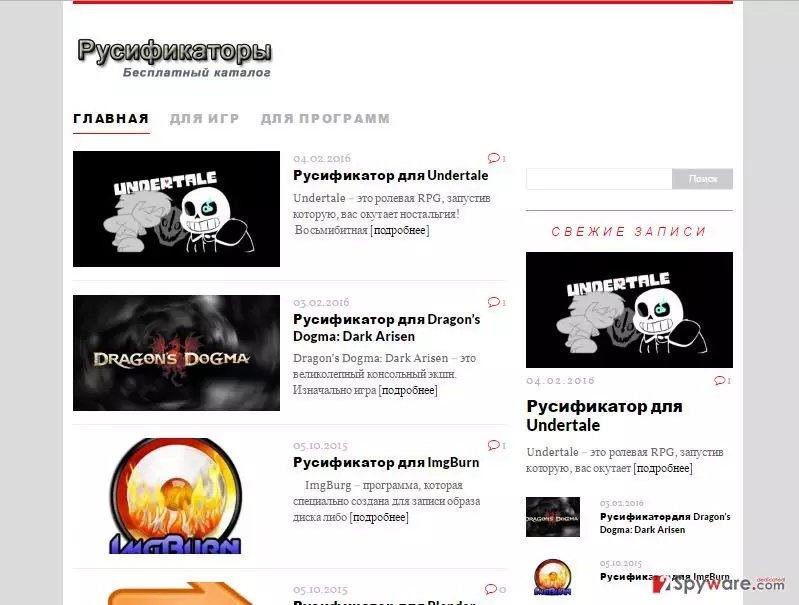
Needless to say, Rusificatory.ru redirect and advertising issues are annoying and obstructive, but the worst part is that it may also be highly dangerous. It’s all fine and dandy as long as the content that this site promotes is reliable and legitimate. Nevertheless, browser hijacker creators rarely choose what parties to collaborate with since all that matters to them is the profit received from the advertising [2]. Thus, pop-up ads, banners and other types of online marketing can be used to distribute malware, get the users involved in support scams or serve for the purposes of phishing [3]. Rusificatory.ru removal is the only option you have in order to stop this menace from falling upon your computer. Later in the article, we will discuss the strategies that can be used to eliminate this virus from the infected devices safely.
The distribution preferences of the hijacker
It is only natural that users constantly download freeware and shareware applications off of the Internet. And on the most part, it is a completely safe thing to do, as long as these programs are downloaded from official and trustworthy software pages. Nevertheless, we have to admit that this pattern is not consistent in our daily browsing and most of us wander off from the official websites and download content from software sharing sites or peer-to-peer networks [4]. Though it is not advisable, it is common practice, so if we cannot avoid it, we should at least know how to install such programs properly. Content downloaded from random web sources is usually bundled with various other software, potentially including Rusificatory.ru, so it is important to separate these legitimate programs from the potentially dangerous ones. This can be done manually, by opting for the “Advanced” installation mode in the installer’s settings. Then the undesirable components like Rusificatory.ru can be stopped from installing.
Quickly eradicate the adware
If Rusificatory.ru virus and its dubious search engine are already on your computer, do not waste time attempting to set your old browser settings back. It is highly unlikely that you will succeed, so we suggest focusing on Rusificatory.ru removal instead. You will be able to alter your browser setting however you please after the virus is banished from your PC. But first, you have to scan your system with a thorough antivirus scanning tool and allow it to eliminate all the components that belong to this hijacker. Then, after you remove Rusificatory.ru, reset your browser and choose the homepage you actually want to see when you open your browser. In addition, updating or installing a new firewall also contributes to the overall protection of the device [5].
Uninstall from Windows
Uninstall from Windows 10/8:
- Type Control Panel into the Windows search box and open the result.
- Under Programs, select Uninstall a program.


Uninstall from Windows 7/XP:
- Click on Windows Start > Control Panel (Windows XP users should click on Add/Remove Programs).
- In Control Panel, select Programs > Uninstall a program.


Remove the unwanted program:
- In the Programs and Features window, look for any recently installed suspicious entries, select them, and click Uninstall.
- If User Account Control appears, click Yes to confirm, then complete the removal.


Delete from macOS
Remove the unwanted application:
- From the menu bar, select Go > Applications.
- In the Applications folder, look for any suspicious entries, then drag them to Trash (or right-click and pick Move to Trash).


Delete leftover files and folders:
- Select Go > Go to Folder.
- Enter /Library/Application Support and remove any suspicious folders related to the unwanted program.
- Repeat the same check in the /Library/LaunchAgents and /Library/LaunchDaemons folders, deleting any suspicious entries.

- Finally, empty the Trash to permanently remove the leftovers.

Reset Internet Explorer
Remove dangerous add-ons:
- Open Internet Explorer, click on the Gear icon (IE menu) on the top-right corner of the browser
- Pick Manage Add-ons.
- You will see a Manage Add-ons window. Here, look for suspicious plugins. Click on these entries and select Disable.


Change your homepage if it was altered:
- Open IE and click on the Gear icon.
- Select Internet Options.
- In the General tab, delete the Home page address and replace it by your preferred one (for example, Google.com).
- Click Apply and then select OK.


Delete temporary files:
- Press on the Gear icon and select Internet Options.
- Under Browsing history, click Delete...
- Select relevant fields and press Delete.


Reset Internet Explorer:
- Click on Gear icon > Internet options and select Advanced tab.
- Select Reset.
- In the new window, check Delete personal settings and select Reset.


Remove from Microsoft Edge
Delete unwanted extensions from MS Edge:
- Select Menu (three horizontal dots at the top-right of the browser window) and pick Extensions.
- From the list, pick the extension and click on the Gear icon.
- Click Remove.


Clear cookies and other browser data:
- Click on the Menu (three horizontal dots at the top-right of the browser window) and select Settings > Privacy, search, and services..
- Under Clear browsing data, pick Choose what to clear.
- Select Cookies and other site data and Cached images and files. (apart from passwords, although you might want to include Media licenses as well, if applicable) and click on Clear.


Restore new tab and homepage settings:
- Click the menu icon and choose Settings.
- Then find On startup section.
- Click Remove next to any suspicious startup page.
Reset MS Edge if the above steps did not work:
- Press on Ctrl + Shift + Esc to open Task Manager.
- Click on More details arrow at the bottom of the window.
- Select Details tab.
- Now scroll down and locate every entry with Microsoft Edge name in it. Right-click on each of them and select End Task to stop MS Edge from running.


Instructions for Chromium-based Edge
Delete extensions from MS Edge (Chromium):
- Open Edge and click select Settings > Extensions.
- Delete unwanted extensions by clicking Remove.


Clear cache and site data:
- Click on Menu and go to Settings.
- Select Privacy, search and services.
- Under Clear browsing data, pick Choose what to clear.
- Under Time range, pick All time.
- Select Clear now.


Reset Chromium-based MS Edge:
- Click on Menu and select Settings.
- On the left side, pick Reset settings.
- Select Restore settings to their default values.
- Confirm with Reset.
- This will disable extensions and reset startup pages but will not delete bookmarks, saved passwords, or browsing history.


Remove from Mozilla Firefox (FF)
Remove dangerous extensions:
- Open Mozilla Firefox browser and click on the Menu (three horizontal lines at the top-right of the window).
- Select Add-ons.
- In here, select the unwanted extension and click Remove.


Reset the homepage:
- Click three horizontal lines at the top right corner to open the menu.
- Choose Settings.
- Under Home, set your preferred homepage and new tab settings.
Clear cookies and site data:
- Click Menu and pick Settings.
- Go to Privacy & Security section.
- Scroll down to locate Cookies and Site Data.
- Click on Clear Data...
- Select Cookies and Site Data and Temporary cached files and pages, then click Clear.


Reset Mozilla Firefox
If clearing the browser as explained above did not help, reset Mozilla Firefox:
- Open Mozilla Firefox browser and click the Menu.
- Go to Help and then choose Troubleshooting Information.

- Under Give Firefox a tune up section, click on Refresh Firefox...
- Once the pop-up shows up, confirm the action by pressing on Refresh Firefox.



Remove from Google Chrome
Delete malicious extensions from Google Chrome:
- Open Google Chrome, click on the Menu (three vertical dots at the top-right corner) and select More tools > Extensions.
- In the newly opened window, you will see all the installed extensions. Uninstall all suspicious extensions related to the unwanted program by clicking Remove.


Clear cache and web data from Chrome:
- Click on Menu and pick Settings.
- Under Privacy and security, select Clear browsing data.
- Select Browsing history, Cookies and other site data, as well as Cached images and files.
- Click Clear data.


Change your homepage:
- Click menu and choose Settings.
- Look for a suspicious site in the On startup section.
- Click on Open a specific or set of pages and click on three dots to find the Remove option.
Reset Google Chrome:
If the previous methods did not help you, reset Google Chrome to eliminate all the unwanted components:
- Click on Menu and select Settings.
- In the Settings, scroll down and click Advanced.
- Scroll down and locate Reset and clean up section.
- Now click Restore settings to their original defaults.
- Confirm with Reset settings.


Delete from Safari
Remove dangerous extensions:
- Open Safari, click Safari in the menu at the top-left of the screen, and select Preferences.
- Go to the Extensions tab, look for any suspicious entries, and click Uninstall to remove them.


Clear history and website data:
- Click Safari in the menu and pick Clear History.
- Set Clear to all history and confirm with Clear History.


Reset Safari:
- Click Safari in the menu and select Preferences > Advanced.
- Enable Show Develop menu in menu bar.
- From the menu bar, click Develop and select Empty Caches.


Did this guide help?
Be the first to comment