

The anatomy of SearchSafe.co: a privacy-oriented search engine with some dirty secrets
If you have never heard of browser hijackers before, this article about SearchSafe.co virus will be a great first introduction. Though SearchSafe creators and some users would argue that it is a completely legitimate search engine [1] which protects the privacy of their users more to a much greater extent than other search services do, we think that its aggressive distribution strategies [2] and unauthorized alteration of the browser settings qualify it as a potentially unwanted program. In this article, we will not attempt to undermine the capabilities of this program but objectively evaluate the features that might be the reason so many users are looking for SearchSafe.co removal advice. If, by the end of the article you decide to get rid of this program, our experts will kindly lend you a hand by providing comprehensive malware removal instructions. Remember though that you can always use automatic tools for any virus elimination. Software like FortectIntego should get rid of any undesirable programs without a problem.
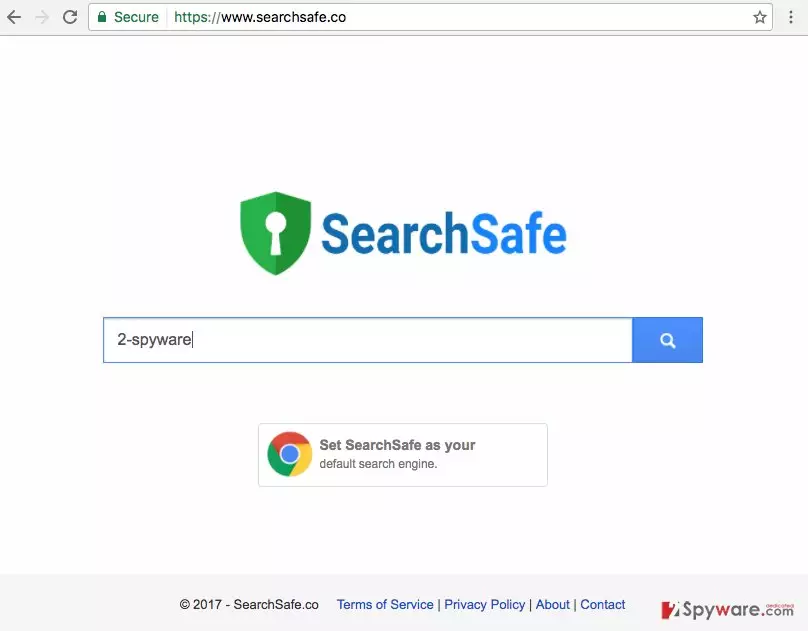
One of the main issues we have found after examining this program is that although SearchSafe.co has its official website, it is unusually common for the program to appear on the users’ computers unexpectedly. Of course, SearchSafe.co hijack does not involve any use of Trojans, exploit kits or other malicious infiltration tools [3]. Thus, there is probably one rational way to explain the program’s unauthorized appearance on the computers. And that is software bundling [4]. This essentially means that this program might be installed on the computers along with other software (usually popular programs) during a single procedure. The users might not even know about all the contents of such software package when agreeing to install it. We talk more about the strategies which can be used to prevent undesirable installs in the following sections, as for now, let us look at the SearchSafe.co redirect tendency [5] in more detail.
When some unfamiliar search engine shows up on the browser, the first instinct is to fight it and roll back the default browser settings. Unfortunately, it may not be as easy as it seems. Even in the official EULA of the Search Safe extension the site developers claim that this software will block any attempts to reach out to search engine that “are known to track you,” so you probably will not be able to access any sites other than SearchSafe.co. It might not be the most pleasant experience if you have not asked for your search engine to be replaced in the first place. To save you some time, we have prepared SearchSafe.co removal instructions at the end of the article.
What steps are important in hijacker prevention?
SearchSafe.co may not be a severe computer infection, but for the sake of your freedom to choose whatever website you want to use for the web search, you should do your best to prevent its infiltration. But you cannot do that successfully if you are not familiar with the way the way browser hijackers are distributed. As we have mentioned, the virus spreads via software bundles. An important thing to know about that, is that you should never install all of the software components at once, because you may unknowingly agree to some conditions that are not explicitly stated, such installing SearchSafe.co extension and setting unfamiliar website as your homepage. Thus, always opt for the advanced setting when setting up new software.
SearchSafe.co removal: how should you get rid of this virus?
First of all, we want to assure you that you are not the only one struggling with a program that has stealthily infected the computer and simply refuses to go away. There are users who have tried to remove SearchSafe.co virus manually and came back to us complaining that all of their elimination attempts have failed. For such users, we highly recommend trying out automatic SearchSafe.co removal and scan their computers with reputable antivirus tools. With an anti-malware software, the chances of a failed removal are slim, and you can be sure that there are no residual files left on your computer to continue messing up the system.
Uninstall from Windows
Uninstall from Windows 10/8:
- Type Control Panel into the Windows search box and open the result.
- Under Programs, select Uninstall a program.


Uninstall from Windows 7/XP:
- Click on Windows Start > Control Panel (Windows XP users should click on Add/Remove Programs).
- In Control Panel, select Programs > Uninstall a program.


Remove the unwanted program:
- In the Programs and Features window, look for any recently installed suspicious entries, select them, and click Uninstall.
- If User Account Control appears, click Yes to confirm, then complete the removal.


Delete from macOS
Remove the unwanted application:
- From the menu bar, select Go > Applications.
- In the Applications folder, look for any suspicious entries, then drag them to Trash (or right-click and pick Move to Trash).


Delete leftover files and folders:
- Select Go > Go to Folder.
- Enter /Library/Application Support and remove any suspicious folders related to the unwanted program.
- Repeat the same check in the /Library/LaunchAgents and /Library/LaunchDaemons folders, deleting any suspicious entries.

- Finally, empty the Trash to permanently remove the leftovers.

Reset Internet Explorer
Remove dangerous add-ons:
- Open Internet Explorer, click on the Gear icon (IE menu) on the top-right corner of the browser
- Pick Manage Add-ons.
- You will see a Manage Add-ons window. Here, look for suspicious plugins. Click on these entries and select Disable.


Change your homepage if it was altered:
- Open IE and click on the Gear icon.
- Select Internet Options.
- In the General tab, delete the Home page address and replace it by your preferred one (for example, Google.com).
- Click Apply and then select OK.


Delete temporary files:
- Press on the Gear icon and select Internet Options.
- Under Browsing history, click Delete...
- Select relevant fields and press Delete.


Reset Internet Explorer:
- Click on Gear icon > Internet options and select Advanced tab.
- Select Reset.
- In the new window, check Delete personal settings and select Reset.


Remove from Microsoft Edge
Delete unwanted extensions from MS Edge:
- Select Menu (three horizontal dots at the top-right of the browser window) and pick Extensions.
- From the list, pick the extension and click on the Gear icon.
- Click Remove.


Clear cookies and other browser data:
- Click on the Menu (three horizontal dots at the top-right of the browser window) and select Settings > Privacy, search, and services..
- Under Clear browsing data, pick Choose what to clear.
- Select Cookies and other site data and Cached images and files. (apart from passwords, although you might want to include Media licenses as well, if applicable) and click on Clear.


Restore new tab and homepage settings:
- Click the menu icon and choose Settings.
- Then find On startup section.
- Click Remove next to any suspicious startup page.
Reset MS Edge if the above steps did not work:
- Press on Ctrl + Shift + Esc to open Task Manager.
- Click on More details arrow at the bottom of the window.
- Select Details tab.
- Now scroll down and locate every entry with Microsoft Edge name in it. Right-click on each of them and select End Task to stop MS Edge from running.


Instructions for Chromium-based Edge
Delete extensions from MS Edge (Chromium):
- Open Edge and click select Settings > Extensions.
- Delete unwanted extensions by clicking Remove.


Clear cache and site data:
- Click on Menu and go to Settings.
- Select Privacy, search and services.
- Under Clear browsing data, pick Choose what to clear.
- Under Time range, pick All time.
- Select Clear now.


Reset Chromium-based MS Edge:
- Click on Menu and select Settings.
- On the left side, pick Reset settings.
- Select Restore settings to their default values.
- Confirm with Reset.
- This will disable extensions and reset startup pages but will not delete bookmarks, saved passwords, or browsing history.


Remove from Mozilla Firefox (FF)
Remove dangerous extensions:
- Open Mozilla Firefox browser and click on the Menu (three horizontal lines at the top-right of the window).
- Select Add-ons.
- In here, select the unwanted extension and click Remove.


Reset the homepage:
- Click three horizontal lines at the top right corner to open the menu.
- Choose Settings.
- Under Home, set your preferred homepage and new tab settings.
Clear cookies and site data:
- Click Menu and pick Settings.
- Go to Privacy & Security section.
- Scroll down to locate Cookies and Site Data.
- Click on Clear Data...
- Select Cookies and Site Data and Temporary cached files and pages, then click Clear.


Reset Mozilla Firefox
If clearing the browser as explained above did not help, reset Mozilla Firefox:
- Open Mozilla Firefox browser and click the Menu.
- Go to Help and then choose Troubleshooting Information.

- Under Give Firefox a tune up section, click on Refresh Firefox...
- Once the pop-up shows up, confirm the action by pressing on Refresh Firefox.



Remove from Google Chrome
Delete malicious extensions from Google Chrome:
- Open Google Chrome, click on the Menu (three vertical dots at the top-right corner) and select More tools > Extensions.
- In the newly opened window, you will see all the installed extensions. Uninstall all suspicious extensions related to the unwanted program by clicking Remove.


Clear cache and web data from Chrome:
- Click on Menu and pick Settings.
- Under Privacy and security, select Clear browsing data.
- Select Browsing history, Cookies and other site data, as well as Cached images and files.
- Click Clear data.


Change your homepage:
- Click menu and choose Settings.
- Look for a suspicious site in the On startup section.
- Click on Open a specific or set of pages and click on three dots to find the Remove option.
Reset Google Chrome:
If the previous methods did not help you, reset Google Chrome to eliminate all the unwanted components:
- Click on Menu and select Settings.
- In the Settings, scroll down and click Advanced.
- Scroll down and locate Reset and clean up section.
- Now click Restore settings to their original defaults.
- Confirm with Reset settings.


Delete from Safari
Remove dangerous extensions:
- Open Safari, click Safari in the menu at the top-left of the screen, and select Preferences.
- Go to the Extensions tab, look for any suspicious entries, and click Uninstall to remove them.


Clear history and website data:
- Click Safari in the menu and pick Clear History.
- Set Clear to all history and confirm with Clear History.


Reset Safari:
- Click Safari in the menu and select Preferences > Advanced.
- Enable Show Develop menu in menu bar.
- From the menu bar, click Develop and select Empty Caches.


Did this guide help?
Be the first to comment