

All the things wrong with G-search.pro search engine
G-search.pro virus belongs to browser hijacker[1] category, which means it automatically falls into potentially unwanted programs’ list. It was designed purely for monetization purpose, and it means that it is entirely useless for computer users. It turns out that G-search.pro redirect virus changes browser’s settings shortly after arrival to the target system, making the indicated URL browser’s new homepage address. This new homepage provides a search engine that delivers PlusNetwork search results. While some users tend to think that all search engines are more or less the same, we must point out that some of them, including the one we talk about today, are created with an intention to earn money in not entirely fair ways. It must be pointed out that G-search.pro hijacker aims to incorporate sponsored results[2] next to organic ones, and if the user accidentally or willingly clicks on them, they might cause a redirection to a pre-determined website. As soon as you visit it, both parties get a bonus – the website you get redirected to gets a visitor, and the developer of the described browser hijacker gets pay-per-click[3] type income. However, the victim in this situation is the user, because such redirects can unexpectedly throw him/her onto insecure[4] third-party websites. 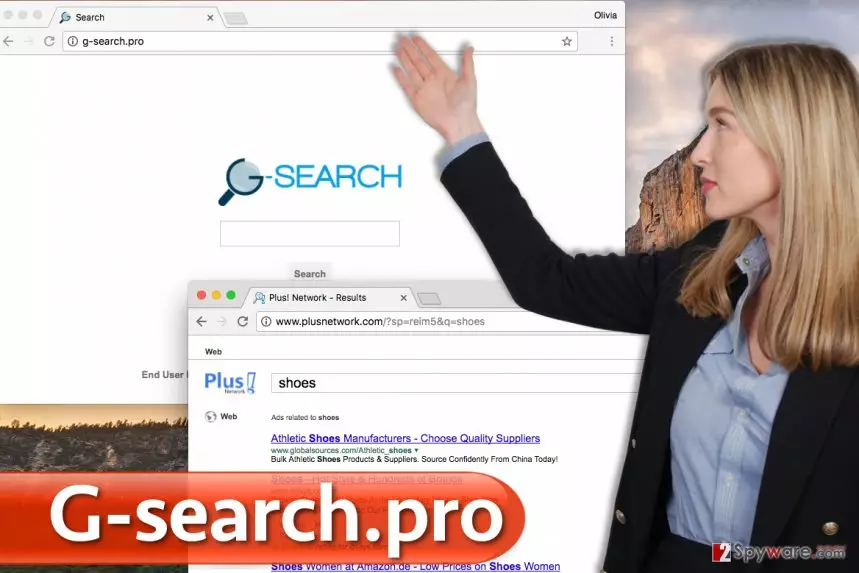
Each website is different, and you can never know what site you will be landed on. You might be rerouted to a dangerous site that suggests installing annoying ad-supported programs while stating that they are entirely safe and useful tools, and you might end up on sites that ask to provide personal information[5]. If you respect your privacy, better avoid using this search engine – while it cannot harm your computer, it can show you the path to websites that can. Therefore, we recommend you to remove G-search.pro hijacker manually or automatically. If you are willing to try to remove this potentially unwanted program on your own, please scroll down to see G-search.pro removal instructions that we prepared. If you are looking for automatic PUP removal solutions, use programs like FortectIntego or SpyHunterCombo Cleaner.
How could I install this program without knowing about it?
If you installed this program without realizing it, G-search.pro hijack happened. Usually, PUPs hijack computers without drawing users’ attention, and it happens only because users tend to act carelessly when installing freeware programs. You have to monitor the installation and make some adjustments during it to not allow PUPs enter your PC. Whenever you download a new program from the Internet and open its setup (or installation wizard), read all information it provides and, most importantly, do not rush! Your goal is to choose Advanced or Custom settings for the installation, opt out unwanted items, and finish the process successfully. If you used to choose Default or Standard option in the past, better scan your PC for spyware/malware because the chances are high that you installed more than G-search.pro throughout the time.
How can I remove G-search.pro from my browser?
If you are wondering whether you can remove G-search.pro virus on your own or you need a help from a technician, do not waste your time for these hesitations any longer. There are two methods how you can uninstall this browser hijacker – the manual, and the automatic removal option. For the manual option, you should read and follow instructions provided in G-search.pro removal guide below. For the automatic option, you will need to install an anti-spyware or anti-malware program. You can find more information about the removal process down below.
Uninstall from Windows
Uninstall from Windows 10/8:
- Type Control Panel into the Windows search box and open the result.
- Under Programs, select Uninstall a program.


Uninstall from Windows 7/XP:
- Click on Windows Start > Control Panel (Windows XP users should click on Add/Remove Programs).
- In Control Panel, select Programs > Uninstall a program.


Remove the unwanted program:
- In the Programs and Features window, look for any recently installed suspicious entries, select them, and click Uninstall.
- If User Account Control appears, click Yes to confirm, then complete the removal.


Delete from macOS
Remove the unwanted application:
- From the menu bar, select Go > Applications.
- In the Applications folder, look for any suspicious entries, then drag them to Trash (or right-click and pick Move to Trash).


Delete leftover files and folders:
- Select Go > Go to Folder.
- Enter /Library/Application Support and remove any suspicious folders related to the unwanted program.
- Repeat the same check in the /Library/LaunchAgents and /Library/LaunchDaemons folders, deleting any suspicious entries.

- Finally, empty the Trash to permanently remove the leftovers.

Remove from Microsoft Edge
Delete unwanted extensions from MS Edge:
- Select Menu (three horizontal dots at the top-right of the browser window) and pick Extensions.
- From the list, pick the extension and click on the Gear icon.
- Click Remove.


Clear cookies and other browser data:
- Click on the Menu (three horizontal dots at the top-right of the browser window) and select Settings > Privacy, search, and services..
- Under Clear browsing data, pick Choose what to clear.
- Select Cookies and other site data and Cached images and files. (apart from passwords, although you might want to include Media licenses as well, if applicable) and click on Clear.


Restore new tab and homepage settings:
- Click the menu icon and choose Settings.
- Then find On startup section.
- Click Remove next to any suspicious startup page.
Reset MS Edge if the above steps did not work:
- Press on Ctrl + Shift + Esc to open Task Manager.
- Click on More details arrow at the bottom of the window.
- Select Details tab.
- Now scroll down and locate every entry with Microsoft Edge name in it. Right-click on each of them and select End Task to stop MS Edge from running.


Instructions for Chromium-based Edge
Delete extensions from MS Edge (Chromium):
- Open Edge and click select Settings > Extensions.
- Delete unwanted extensions by clicking Remove.


Clear cache and site data:
- Click on Menu and go to Settings.
- Select Privacy, search and services.
- Under Clear browsing data, pick Choose what to clear.
- Under Time range, pick All time.
- Select Clear now.


Reset Chromium-based MS Edge:
- Click on Menu and select Settings.
- On the left side, pick Reset settings.
- Select Restore settings to their default values.
- Confirm with Reset.
- This will disable extensions and reset startup pages but will not delete bookmarks, saved passwords, or browsing history.


Remove from Mozilla Firefox (FF)
Remove dangerous extensions:
- Open Mozilla Firefox browser and click on the Menu (three horizontal lines at the top-right of the window).
- Select Add-ons.
- In here, select the unwanted extension and click Remove.


Reset the homepage:
- Click three horizontal lines at the top right corner to open the menu.
- Choose Settings.
- Under Home, set your preferred homepage and new tab settings.
Clear cookies and site data:
- Click Menu and pick Settings.
- Go to Privacy & Security section.
- Scroll down to locate Cookies and Site Data.
- Click on Clear Data...
- Select Cookies and Site Data and Temporary cached files and pages, then click Clear.


Reset Mozilla Firefox
If clearing the browser as explained above did not help, reset Mozilla Firefox:
- Open Mozilla Firefox browser and click the Menu.
- Go to Help and then choose Troubleshooting Information.

- Under Give Firefox a tune up section, click on Refresh Firefox...
- Once the pop-up shows up, confirm the action by pressing on Refresh Firefox.



Remove from Google Chrome
Delete malicious extensions from Google Chrome:
- Open Google Chrome, click on the Menu (three vertical dots at the top-right corner) and select More tools > Extensions.
- In the newly opened window, you will see all the installed extensions. Uninstall all suspicious extensions related to the unwanted program by clicking Remove.


Clear cache and web data from Chrome:
- Click on Menu and pick Settings.
- Under Privacy and security, select Clear browsing data.
- Select Browsing history, Cookies and other site data, as well as Cached images and files.
- Click Clear data.


Change your homepage:
- Click menu and choose Settings.
- Look for a suspicious site in the On startup section.
- Click on Open a specific or set of pages and click on three dots to find the Remove option.
Reset Google Chrome:
If the previous methods did not help you, reset Google Chrome to eliminate all the unwanted components:
- Click on Menu and select Settings.
- In the Settings, scroll down and click Advanced.
- Scroll down and locate Reset and clean up section.
- Now click Restore settings to their original defaults.
- Confirm with Reset settings.


Did this guide help?
4 comments
Logan
I was wondering, why am i getting plusnetwork and not google search results... thanks for the information.
Paul
great tutorial - i wish i didnt have to spend so much time searching for the right one. This is the only website that actually provided useful information!
maro91
Thanks, just deleted it
leon
Cant wait to delete this virus, finally.