

Search.searchdcnow.com – a fake security engine that shows results riddled with ads
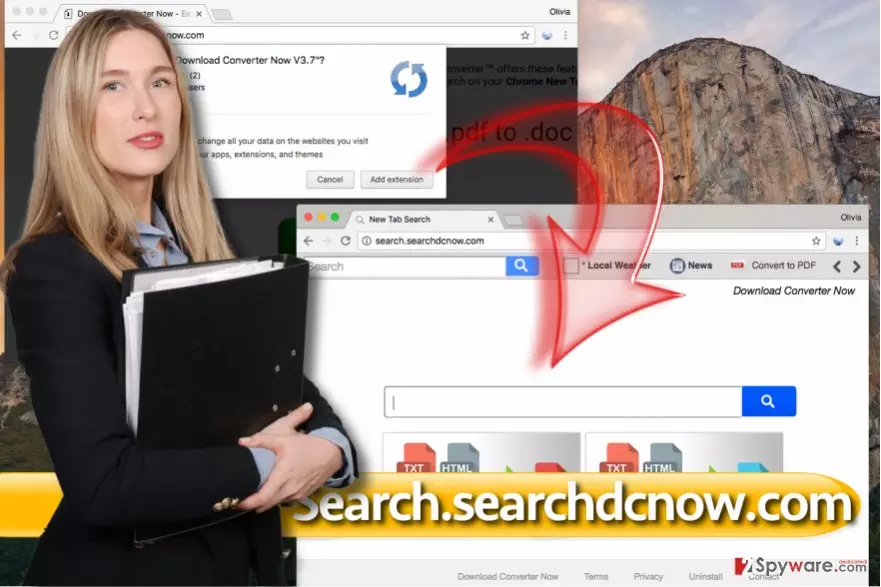
Search.searchdcnow.com virus hijacks web browsers when the user inattentively installs several pieces of software on the computer. It can happen to anyone, and, thankfully, the hijacker (developed by Polarity Technologies Ltd) is not a malicious program, though it can make enough problems for you.
This intruder is a browser extension called either Download Converter Now or Download Converter V3.7, although it can arrive in the system along with associated software. This suspicious extension suggests “free web search on your browser new tab,” and claims to be a useful addition that allows the user to convert files between multiple different formats.
While these features can seem interesting and useful, we are afraid that it is just a nice description of the program that makes it seem useful. In reality, this program changes homepage settings, as well as the new tab and default search settings to prioritize Search.searchdcnow.com search engine, so we have decided to add it to the “browser hijacker”[1] category and suggest users remove it.
| name | Search.searchdcnow.com virus |
|---|---|
| Type | Browser hijacker, PUP |
| Symptoms | Changed browser settings keep redirecting search inquiries through unknown domains until results from Yahoo are shown but with injected ads |
| Risks | Privacy issues, financial losses |
| Distribution | Freeware, software bundles |
| Elimination | Scan your device with security tools to remove this and any other cyber infection |
| system health | Repair outdated or corrupted system files by using the FortectIntego system diagnostics tool |
Now, what is so wrong with this search engine is that it makes us write a whole article about it? The problem is, it doesn’t act fairly – instead of providing relevant and organic[2] search results, it tracks user’s activity online and provides customized, ad-filled search results[3] that are full of links pointing to third-party sites.
Sadly, we cannot confirm that all of these sites are secure to visit. Be careful not to come across dangerous sites that provide dangerous download links or ask for sensitive data. If you value your privacy, better remove Search.searchdcnow.com browser hijacker as soon as you can.
We advise you to complete the removal professionally, with a help of an anti-spyware program, for instance, MalwarebytesMalwarebytes or SpyHunterCombo Cleaner. Such security tools will not only locate and eliminate all threats from your device, but they will also protect you from various malware in the future.
If after the removal your device exhibits any strange behavior, such as crashing, severe lag, freezing, or similar, you have to take care of its overall health. Our IT experts recommend using the FortectIntego system diagnostics tool to take care of all system irregularities.
How did the browser hijacker end up on my PC?
Search.searchdcnow.com hijack is an unpleasant incident that can take place right after the installation of another free program. For this reason, you have to download and install freeware responsibly. If you ever come across a questionable website that suggests installing browser add-ons or computer programs urgently, better quit it[4].
If you ever feel that someone is pushing you to install something on your computer, understand that the program is likely to be dangerous. It is important not to install pieces of software accidentally – surprisingly, it happens quite frequently, and only because PC users tend to rush when installing computer programs.
When you open an installer, read all information it provides carefully[5]. You have to deselect additional programs bundled with your download manually, so choose Custom/Advanced setup settings instead of Default/Standard ones. Here, drop off all unwanted items by hand.
Detailed instructions to remove Search.searchdcnow.com browser hijacker
It is easy to remove Search.searchdcnow.com virus if you have anti-spyware software. If you don’t, download our recommended software. Without it, automatic removal becomes a tougher task. Despite that, we don’t want to stop you from trying your hand at it, so we prepared detailed removal instructions that you can use.
Even if you manage to remove this browser hijacker manually, scan the PC with anti-malware software to see if there are any other dangerous spyware or malware-related components left. Afterward, run system diagnostics with compatible software to ensure a stable working environment.
Uninstall from Windows
Uninstall from Windows 10/8:
- Type Control Panel into the Windows search box and open the result.
- Under Programs, select Uninstall a program.


Uninstall from Windows 7/XP:
- Click on Windows Start > Control Panel (Windows XP users should click on Add/Remove Programs).
- In Control Panel, select Programs > Uninstall a program.


Remove the unwanted program:
- In the Programs and Features window, look for any recently installed suspicious entries, select them, and click Uninstall.
- If User Account Control appears, click Yes to confirm, then complete the removal.


Delete from macOS
Remove the unwanted application:
- From the menu bar, select Go > Applications.
- In the Applications folder, look for any suspicious entries, then drag them to Trash (or right-click and pick Move to Trash).


Delete leftover files and folders:
- Select Go > Go to Folder.
- Enter /Library/Application Support and remove any suspicious folders related to the unwanted program.
- Repeat the same check in the /Library/LaunchAgents and /Library/LaunchDaemons folders, deleting any suspicious entries.

- Finally, empty the Trash to permanently remove the leftovers.

Remove from Microsoft Edge
Delete unwanted extensions from MS Edge:
- Select Menu (three horizontal dots at the top-right of the browser window) and pick Extensions.
- From the list, pick the extension and click on the Gear icon.
- Click Remove.


Clear cookies and other browser data:
- Click on the Menu (three horizontal dots at the top-right of the browser window) and select Settings > Privacy, search, and services..
- Under Clear browsing data, pick Choose what to clear.
- Select Cookies and other site data and Cached images and files. (apart from passwords, although you might want to include Media licenses as well, if applicable) and click on Clear.


Restore new tab and homepage settings:
- Click the menu icon and choose Settings.
- Then find On startup section.
- Click Remove next to any suspicious startup page.
Reset MS Edge if the above steps did not work:
- Press on Ctrl + Shift + Esc to open Task Manager.
- Click on More details arrow at the bottom of the window.
- Select Details tab.
- Now scroll down and locate every entry with Microsoft Edge name in it. Right-click on each of them and select End Task to stop MS Edge from running.


Instructions for Chromium-based Edge
Delete extensions from MS Edge (Chromium):
- Open Edge and click select Settings > Extensions.
- Delete unwanted extensions by clicking Remove.


Clear cache and site data:
- Click on Menu and go to Settings.
- Select Privacy, search and services.
- Under Clear browsing data, pick Choose what to clear.
- Under Time range, pick All time.
- Select Clear now.


Reset Chromium-based MS Edge:
- Click on Menu and select Settings.
- On the left side, pick Reset settings.
- Select Restore settings to their default values.
- Confirm with Reset.
- This will disable extensions and reset startup pages but will not delete bookmarks, saved passwords, or browsing history.


Remove from Mozilla Firefox (FF)
Remove dangerous extensions:
- Open Mozilla Firefox browser and click on the Menu (three horizontal lines at the top-right of the window).
- Select Add-ons.
- In here, select the unwanted extension and click Remove.


Reset the homepage:
- Click three horizontal lines at the top right corner to open the menu.
- Choose Settings.
- Under Home, set your preferred homepage and new tab settings.
Clear cookies and site data:
- Click Menu and pick Settings.
- Go to Privacy & Security section.
- Scroll down to locate Cookies and Site Data.
- Click on Clear Data...
- Select Cookies and Site Data and Temporary cached files and pages, then click Clear.


Reset Mozilla Firefox
If clearing the browser as explained above did not help, reset Mozilla Firefox:
- Open Mozilla Firefox browser and click the Menu.
- Go to Help and then choose Troubleshooting Information.

- Under Give Firefox a tune up section, click on Refresh Firefox...
- Once the pop-up shows up, confirm the action by pressing on Refresh Firefox.



Remove from Google Chrome
Delete malicious extensions from Google Chrome:
- Open Google Chrome, click on the Menu (three vertical dots at the top-right corner) and select More tools > Extensions.
- In the newly opened window, you will see all the installed extensions. Uninstall all suspicious extensions related to the unwanted program by clicking Remove.


Clear cache and web data from Chrome:
- Click on Menu and pick Settings.
- Under Privacy and security, select Clear browsing data.
- Select Browsing history, Cookies and other site data, as well as Cached images and files.
- Click Clear data.


Change your homepage:
- Click menu and choose Settings.
- Look for a suspicious site in the On startup section.
- Click on Open a specific or set of pages and click on three dots to find the Remove option.
Reset Google Chrome:
If the previous methods did not help you, reset Google Chrome to eliminate all the unwanted components:
- Click on Menu and select Settings.
- In the Settings, scroll down and click Advanced.
- Scroll down and locate Reset and clean up section.
- Now click Restore settings to their original defaults.
- Confirm with Reset settings.


Delete from Safari
Remove dangerous extensions:
- Open Safari, click Safari in the menu at the top-left of the screen, and select Preferences.
- Go to the Extensions tab, look for any suspicious entries, and click Uninstall to remove them.


Clear history and website data:
- Click Safari in the menu and pick Clear History.
- Set Clear to all history and confirm with Clear History.


Reset Safari:
- Click Safari in the menu and select Preferences > Advanced.
- Enable Show Develop menu in menu bar.
- From the menu bar, click Develop and select Empty Caches.


Did this guide help?
Be the first to comment