

How destructive is UserFilesLocker ransomware?
UserFilesLocker virus, alternatively known as FileLocker, presents itself as a file-encrypting ransomware[1] targeting Czech and Slovak users. Interestingly, that supposedly Czech cyber villains are on the move since it is already a third virus introduced in this language. Do not underestimate this malware, but instead focus on UserFilesLocker removal. It is known that the malware encrypts the files with AES-256 and RSA-2048 key and then appends .ENCR file extension. This technique results in the complex encrypting key[2]. The most viable ways to decrypt it is to obtain the official decryptor or use backup copies. If you do not own either of them, take a look at the data recovery recommendations displayed below the article. Keep in mind that data recovery is effective only when you remove UserFilesLocker fully. In this regard, let FortectIntego deal with the infection.
Looking from a technical perspective, UserFilesLocker ransomware does not differ much from other crypto-malware. In the beginning of the ransom message, it scares users with the fact that their data has been encoded with a complex, military-level encryption algorithm. It ensures that there is no other way to recover the files other than complying with their demands and paying the ransom. In exchange for the key, they ask 0,8 bitcoin (955,18 USD)[3].
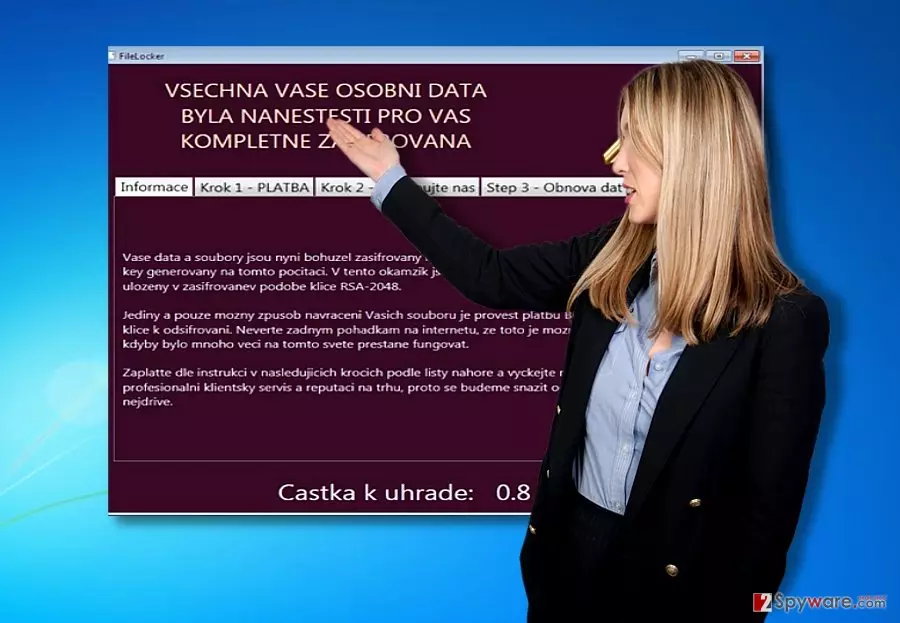
Interestingly, that it offers another variation of the payment – 2,1 BTC. However, no specific information is provided about the conditions of paying their amount of money. Moving on, the cyber villains of User Files Locker seem to sympathize with the creators of Spora ransomware which delivers sophisticated customer service[4]. Likewise, the creators of FileLocker also present a step-by-step payment program for receiving the payment. They ensure fast data decryption to please their “customers”, i.e, victims. It also provides the email address – vlastnou.hlavou@mailfence.com – in case the victims encounter any payment trouble. Needless to say, that such mocking manner of speech should not encourage you paying the money. The key reason of booming ransomware business is victims’ hope to retrieve the files. Nonetheless, there are few data retrieval cases. Instead, remove UserFilesLocker right away.
The transmission tendencies of the malware
Unlike other prominent file-encrypting threats, UserFilesLocker hijack occurs upon visiting the corrupted Czech and Slovak sites. Specifically, exploit kits serve as temporal carriers for this threat. EITest malicious code may as well contribute to the attack. Upon visiting them, the malware connects to the following web pages: uradvlady.eu, financnasprava.digital, and www.simplecoin.cz. The felons may as well target the victims via spam messages. They try to scare with fake notifications from the Supreme Court or the FBI. The binaries of UserFilesLocker malware may hide in the invoice attachments or .zip folder which contains the following elements: prehled_hotely.exe, installer.exe, elektronicka-komunikacia-instalacia.exe, and encrypt.pinfo. The latter file contains encryption information[5]. It is of crucial importance to keep your system applications updated to reduce the general number of vulnerabilities on your system.
Is there a way to eradicate UserFilesLocker?
The most efficient UserFilesLocker removal is considered to be automatic elimination. Manual termination is a hardly effective solution when dealing with crypto-malware. Finding and removing all related files are crucial factors to ensure the complete eradication. If the virus blocked your screen and due to this occurrence you cannot remove UserFilesLocker virus, use the below suggested guide. It will explain to you how to unlock your device with the help of Safe mode and System Restore functions.
Did this guide help?
Be the first to comment