

Searchjungle.com is a fake search engine that will show you ads instead of legitimate results
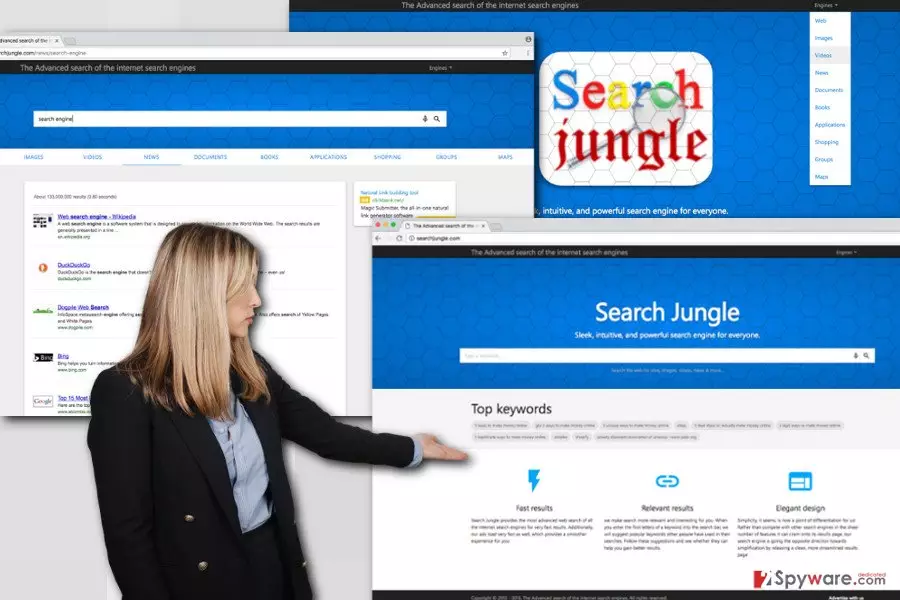
Searchjungle.com wants to trick people by claiming that it is a “sleek, intuitive, and powerful search engine.” However, its power only lies in the ability to get inside computers unnoticed and hijacking[1] web browsers. The developers of this program claim that this tool provides fast and relevant search results, although security experts have long figured out that it is a browser hijacker.[2]
Browser redirects and suspicious distribution techniques are not the only two negative traits of this app, as it may also start collecting your web browsing data in the background. This information might later be shared with third parties for increased profits. If you have found the app seemingly out of nowhere, use this article to help you eliminate it quickly.
| Name | Searchjungle.com |
| Type | Browser hijacker |
| Distribution | Software bundling, third-party websites |
| Operation | Changes the homepage and new tab address of the browser; redirects all searches to alternative provider and inserts sponsored links and ads into search results; tracks user data |
| Removal | Quickly get rid of the hijacker by performing a full system scan with SpyHunterCombo Cleaner anti-malware |
| Browser fix | If you want to make sure that your browser is clean and no tracking technologies remain, use FortectIntego to clean it quickly |
Unfortunately, instead of the advanced search results, you might be offered to browse through commercial content. The browser hijacker might modify search results and include sponsored links. It means that some organic results that might be shown on the first Google search page might be removed. Instead of them, you might see links to the sponsored third-party websites.
The problem is not that these sites might be irrelevant, and you might need to spend more time looking for specific information. Be aware of the fact that some of these links might redirect to questionable websites, where you might be involved in an online scam – you might be tricked into spending money on useless services, provide your personal information or install dangerous programs.
If it managed to hijack your web browser, please install an anti-malware program and run a full system scan. Automatic Searchjungle.com removal assures that all hijacker-related components are eliminated from the system, and you will get back control over your web browser.
The biggest threat that might be caused by this browser hijacker is related to its redirect tendencies. As we already mentioned, it might include some links in the search results that may lead to shady online places. The same problem is with provided ads as well. The main page of the website has brief information that hijacker provides ads that load very fast.
Though, the hijacker might bring so many ads or pop-ups that your browser might freeze and crash. However, it might deliver infected ads[3]. After one click, you might install Trojan or malware executable or be redirected to the infected or phishing website[4].
Cybercriminals use many ways to harm computer users, and using hijacker’s services might help them achieve their goal. Even though this search engine looks reliable, we highly recommend staying away from it. However, if it already sneaked inside the computer, please remove Searchjungle.com immediately.
Unexpected PUP appearance explained
The infiltration of the app might have happened when you have installed a new program using the wrong installation method. We call Basic or Quick installation settings “wrong” because they don’t disclose about additional downloads and install them silently. The developers spread this program attached to the software package. The only way to “unpack” the program and see what other apps are offered to install is to use Custom or Advanced installation mode.
This mode reveals the list of additional applications and allows stop them from entering the system. You may find the pre-selected statement to make Search Jungle as your default search engine. Of course, you must disagree with it! Though, if already failed with freeware or shareware[5] installation, now it’s a perfect time to make unwanted apps to leave your PC for better security and privacy.
Remove Searchjungle.com virus
At the end of the article, you will find illustrated instructions on how to remove the PUP manually. Have a look at them. If they look clear and plain, follow them and get rid of this cyber parasite. Don’t forget to check and clean all your web browsers that are installed on your computer too.
You might be surprised how many third-party extensions, add-ons, or toolbars might have been installed without your knowledge! However, if you do not want to play detective and want a simpler solution, you should opt for automatic Searchjungle.com removal. Install one of the suggested programs below, update it and scan the system.
Uninstall from Windows
Uninstall from Windows 10/8:
- Type Control Panel into the Windows search box and open the result.
- Under Programs, select Uninstall a program.


Uninstall from Windows 7/XP:
- Click on Windows Start > Control Panel (Windows XP users should click on Add/Remove Programs).
- In Control Panel, select Programs > Uninstall a program.


Remove the unwanted program:
- In the Programs and Features window, look for any recently installed suspicious entries, select them, and click Uninstall.
- If User Account Control appears, click Yes to confirm, then complete the removal.


Delete from macOS
Remove the unwanted application:
- From the menu bar, select Go > Applications.
- In the Applications folder, look for any suspicious entries, then drag them to Trash (or right-click and pick Move to Trash).


Delete leftover files and folders:
- Select Go > Go to Folder.
- Enter /Library/Application Support and remove any suspicious folders related to the unwanted program.
- Repeat the same check in the /Library/LaunchAgents and /Library/LaunchDaemons folders, deleting any suspicious entries.

- Finally, empty the Trash to permanently remove the leftovers.

Remove from Microsoft Edge
Delete unwanted extensions from MS Edge:
- Select Menu (three horizontal dots at the top-right of the browser window) and pick Extensions.
- From the list, pick the extension and click on the Gear icon.
- Click Remove.


Clear cookies and other browser data:
- Click on the Menu (three horizontal dots at the top-right of the browser window) and select Settings > Privacy, search, and services..
- Under Clear browsing data, pick Choose what to clear.
- Select Cookies and other site data and Cached images and files. (apart from passwords, although you might want to include Media licenses as well, if applicable) and click on Clear.


Restore new tab and homepage settings:
- Click the menu icon and choose Settings.
- Then find On startup section.
- Click Remove next to any suspicious startup page.
Reset MS Edge if the above steps did not work:
- Press on Ctrl + Shift + Esc to open Task Manager.
- Click on More details arrow at the bottom of the window.
- Select Details tab.
- Now scroll down and locate every entry with Microsoft Edge name in it. Right-click on each of them and select End Task to stop MS Edge from running.


Instructions for Chromium-based Edge
Delete extensions from MS Edge (Chromium):
- Open Edge and click select Settings > Extensions.
- Delete unwanted extensions by clicking Remove.


Clear cache and site data:
- Click on Menu and go to Settings.
- Select Privacy, search and services.
- Under Clear browsing data, pick Choose what to clear.
- Under Time range, pick All time.
- Select Clear now.


Reset Chromium-based MS Edge:
- Click on Menu and select Settings.
- On the left side, pick Reset settings.
- Select Restore settings to their default values.
- Confirm with Reset.
- This will disable extensions and reset startup pages but will not delete bookmarks, saved passwords, or browsing history.


Remove from Mozilla Firefox (FF)
Remove dangerous extensions:
- Open Mozilla Firefox browser and click on the Menu (three horizontal lines at the top-right of the window).
- Select Add-ons.
- In here, select the unwanted extension and click Remove.


Reset the homepage:
- Click three horizontal lines at the top right corner to open the menu.
- Choose Settings.
- Under Home, set your preferred homepage and new tab settings.
Clear cookies and site data:
- Click Menu and pick Settings.
- Go to Privacy & Security section.
- Scroll down to locate Cookies and Site Data.
- Click on Clear Data...
- Select Cookies and Site Data and Temporary cached files and pages, then click Clear.


Reset Mozilla Firefox
If clearing the browser as explained above did not help, reset Mozilla Firefox:
- Open Mozilla Firefox browser and click the Menu.
- Go to Help and then choose Troubleshooting Information.

- Under Give Firefox a tune up section, click on Refresh Firefox...
- Once the pop-up shows up, confirm the action by pressing on Refresh Firefox.



Remove from Google Chrome
Delete malicious extensions from Google Chrome:
- Open Google Chrome, click on the Menu (three vertical dots at the top-right corner) and select More tools > Extensions.
- In the newly opened window, you will see all the installed extensions. Uninstall all suspicious extensions related to the unwanted program by clicking Remove.


Clear cache and web data from Chrome:
- Click on Menu and pick Settings.
- Under Privacy and security, select Clear browsing data.
- Select Browsing history, Cookies and other site data, as well as Cached images and files.
- Click Clear data.


Change your homepage:
- Click menu and choose Settings.
- Look for a suspicious site in the On startup section.
- Click on Open a specific or set of pages and click on three dots to find the Remove option.
Reset Google Chrome:
If the previous methods did not help you, reset Google Chrome to eliminate all the unwanted components:
- Click on Menu and select Settings.
- In the Settings, scroll down and click Advanced.
- Scroll down and locate Reset and clean up section.
- Now click Restore settings to their original defaults.
- Confirm with Reset settings.


Delete from Safari
Remove dangerous extensions:
- Open Safari, click Safari in the menu at the top-left of the screen, and select Preferences.
- Go to the Extensions tab, look for any suspicious entries, and click Uninstall to remove them.


Clear history and website data:
- Click Safari in the menu and pick Clear History.
- Set Clear to all history and confirm with Clear History.


Reset Safari:
- Click Safari in the menu and select Preferences > Advanced.
- Enable Show Develop menu in menu bar.
- From the menu bar, click Develop and select Empty Caches.


Did this guide help?
3 comments
Mason
Thanks for the instructions! happy to browse the internet normally again!
Maja
I though I would never get rid of searchjungle.com. I cannot tell how many times I tried to replace this address with google.... finally, i looked for the information online, and realized that my pc is infected!! But... now its not :)
Sara
Really, your instructions are easy to follow even the people like me.. Im not very good in this kind of stuff.