

Search.showmoreabout.com – a deceptive search engine set by a browser hijacker
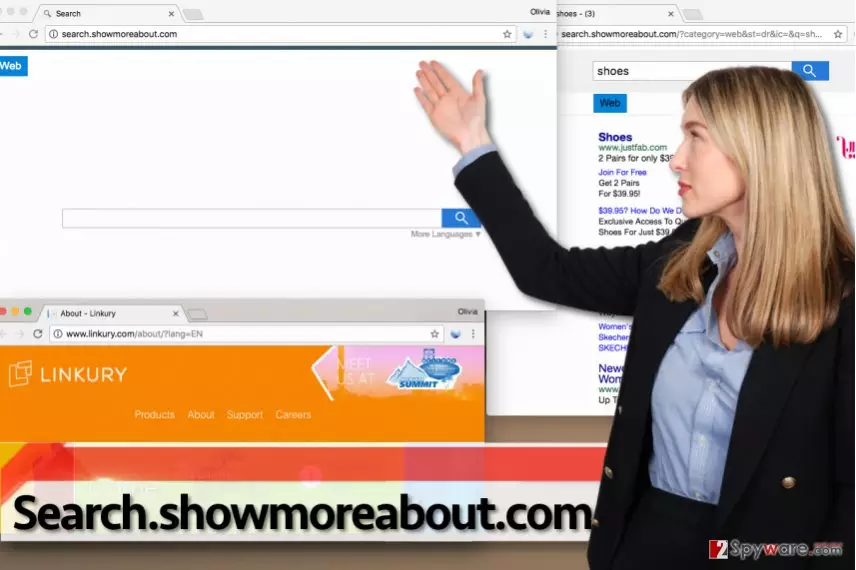
Search.showmoreabout.com virus won’t affect your computer system. It is a program created by Linkury[1], a company whose name is often mentioned when speaking about browser hijackers. It seems that this company has created a lot of pesky applications that change the browser’s homepage and new tab settings without telling the computer user in a direct way.
It happens because these programs are usually distributed via the software bundling technique[2]. This method helps to add a couple of additional programs to one popular software and present these additions during the installation procedure.
We highly advise you to avoid Search.showmoreabout.com hijack because if this bothersome parasite manages to enter a computer system, it starts tracking your activity online and collecting pieces of information. For example, your IP address[3], screen resolution of your monitor, date and time you access the described URL, and might also try to track your search queries.
It uses gathered data for statistical analysis and provides particular third-party advertisements based on user’s interests. In this article, we'll show you how to remove the browser hijacker from your device and how to reset your the altered settings so you could use a search engine of your choice.
| name | Search.showmoreabout.com virus |
|---|---|
| Type | Potentially unwanted program, browser hijacker |
| Symptoms | The threat changes default browser settings to redirect all search traffic through a website of its choice; it also diminishes the device's performance and causes redirects to untrustworthy domains |
| Risks | Privacy issues, malware infections, financial losses |
| Distribution | Deceptive ads, file-sharing platforms, software bundling, freeware |
| Elimination | Dependable security applications can remove this cyber threat with ease |
| System health | Delete tracking cookies stored by dangerous websites and repair corrupted system files by running system diagnostics with the FortectIntego |
However, we are afraid that some links that this suspicious browser hijacker might throw you onto hazardous places on the Internet. We haven’t mentioned that the website that this browser hijacker promotes presents a web search engine, which is likely to serve paid results instead of organic[4] ones.
Some of these paid links can be dangerous, so we do not recommend clicking them. In general, you can be lured into deceptive websites or sites that promote spyware/malware programs or even visit a phishing website, so we highly suggest you stay away from this search engine.
We do not say that aims of Linkury are malevolent, but we are sure that it claims no responsibility for any “damages, including for any lost profits or lost data arising from user’s use of software, the Linkury service, any platform apps or any of web-based interface content or materials on, accessed through or downloaded using the Linkury services, even if Linkury is aware or has been advised of the possibility of such damages.”
This is what Linkury says in its Terms of Use document. We do not believe that Search.showmoreabout.com redirect virus can provide you beneficial features or a better experience than popular search engines such as Google; therefore, we highly recommend you uninstall it.
To remove it, we recommend using MalwarebytesMalwarebytes, SpyHunterCombo Cleaner, or similar anti-malware software. For your convenience, we have provided illustrated removal instructions below the article so that you could try to uninstall this browser hijacker manually. Once it's gone, run a system tune-up with the FortectIntego app to ensure that your device runs smoothly.
Popular ways that browser hijackers are spread
The first thing that comes to computer users’ minds when they notice unexpected changes in their web browsers is that they were hacked or infected. That is not true – browser hijackers are not malicious programs, and most of the time they are distributed in a legitimate way.
We have already mentioned that the software bundling technique is used in the distribution[5] of potentially unwanted programs (PUPs), and such programs usually cannot be installed without the user’s interaction. Therefore, we suggest you be more careful when installing new applications on your PC.
The most important thing is to use Custom/Advanced settings for the setup because then you will get access to the list of additional third-party software bundled with your download. Your task is to deselect all additional items added to your preferred program and only then proceed to the next setup stage.
Remove Search.showmoreabout.com hijacker with detailed instructions
Our experts have already prepared a comprehensive tutorial on how to remove Search.showmoreabout.com virus manually – make sure to follow the instructions carefully. Keep in mind that you have to eliminate all associated files so the infection doesn't renew.
If you wish to regain the normal functionality of your web browser within the shortest span of time possible, install and run anti-malware software and let it complete the removal automatically. There is no better way to remove spyware and malware from the system quickly.
Uninstall from Windows
Uninstall from Windows 10/8:
- Type Control Panel into the Windows search box and open the result.
- Under Programs, select Uninstall a program.


Uninstall from Windows 7/XP:
- Click on Windows Start > Control Panel (Windows XP users should click on Add/Remove Programs).
- In Control Panel, select Programs > Uninstall a program.


Remove the unwanted program:
- In the Programs and Features window, look for any recently installed suspicious entries, select them, and click Uninstall.
- If User Account Control appears, click Yes to confirm, then complete the removal.


Delete from macOS
Remove the unwanted application:
- From the menu bar, select Go > Applications.
- In the Applications folder, look for any suspicious entries, then drag them to Trash (or right-click and pick Move to Trash).


Delete leftover files and folders:
- Select Go > Go to Folder.
- Enter /Library/Application Support and remove any suspicious folders related to the unwanted program.
- Repeat the same check in the /Library/LaunchAgents and /Library/LaunchDaemons folders, deleting any suspicious entries.

- Finally, empty the Trash to permanently remove the leftovers.

Remove from Microsoft Edge
Delete unwanted extensions from MS Edge:
- Select Menu (three horizontal dots at the top-right of the browser window) and pick Extensions.
- From the list, pick the extension and click on the Gear icon.
- Click Remove.


Clear cookies and other browser data:
- Click on the Menu (three horizontal dots at the top-right of the browser window) and select Settings > Privacy, search, and services..
- Under Clear browsing data, pick Choose what to clear.
- Select Cookies and other site data and Cached images and files. (apart from passwords, although you might want to include Media licenses as well, if applicable) and click on Clear.


Restore new tab and homepage settings:
- Click the menu icon and choose Settings.
- Then find On startup section.
- Click Remove next to any suspicious startup page.
Reset MS Edge if the above steps did not work:
- Press on Ctrl + Shift + Esc to open Task Manager.
- Click on More details arrow at the bottom of the window.
- Select Details tab.
- Now scroll down and locate every entry with Microsoft Edge name in it. Right-click on each of them and select End Task to stop MS Edge from running.


Instructions for Chromium-based Edge
Delete extensions from MS Edge (Chromium):
- Open Edge and click select Settings > Extensions.
- Delete unwanted extensions by clicking Remove.


Clear cache and site data:
- Click on Menu and go to Settings.
- Select Privacy, search and services.
- Under Clear browsing data, pick Choose what to clear.
- Under Time range, pick All time.
- Select Clear now.


Reset Chromium-based MS Edge:
- Click on Menu and select Settings.
- On the left side, pick Reset settings.
- Select Restore settings to their default values.
- Confirm with Reset.
- This will disable extensions and reset startup pages but will not delete bookmarks, saved passwords, or browsing history.


Remove from Mozilla Firefox (FF)
Remove dangerous extensions:
- Open Mozilla Firefox browser and click on the Menu (three horizontal lines at the top-right of the window).
- Select Add-ons.
- In here, select the unwanted extension and click Remove.


Reset the homepage:
- Click three horizontal lines at the top right corner to open the menu.
- Choose Settings.
- Under Home, set your preferred homepage and new tab settings.
Clear cookies and site data:
- Click Menu and pick Settings.
- Go to Privacy & Security section.
- Scroll down to locate Cookies and Site Data.
- Click on Clear Data...
- Select Cookies and Site Data and Temporary cached files and pages, then click Clear.


Reset Mozilla Firefox
If clearing the browser as explained above did not help, reset Mozilla Firefox:
- Open Mozilla Firefox browser and click the Menu.
- Go to Help and then choose Troubleshooting Information.

- Under Give Firefox a tune up section, click on Refresh Firefox...
- Once the pop-up shows up, confirm the action by pressing on Refresh Firefox.



Remove from Google Chrome
Delete malicious extensions from Google Chrome:
- Open Google Chrome, click on the Menu (three vertical dots at the top-right corner) and select More tools > Extensions.
- In the newly opened window, you will see all the installed extensions. Uninstall all suspicious extensions related to the unwanted program by clicking Remove.


Clear cache and web data from Chrome:
- Click on Menu and pick Settings.
- Under Privacy and security, select Clear browsing data.
- Select Browsing history, Cookies and other site data, as well as Cached images and files.
- Click Clear data.


Change your homepage:
- Click menu and choose Settings.
- Look for a suspicious site in the On startup section.
- Click on Open a specific or set of pages and click on three dots to find the Remove option.
Reset Google Chrome:
If the previous methods did not help you, reset Google Chrome to eliminate all the unwanted components:
- Click on Menu and select Settings.
- In the Settings, scroll down and click Advanced.
- Scroll down and locate Reset and clean up section.
- Now click Restore settings to their original defaults.
- Confirm with Reset settings.


Delete from Safari
Remove dangerous extensions:
- Open Safari, click Safari in the menu at the top-left of the screen, and select Preferences.
- Go to the Extensions tab, look for any suspicious entries, and click Uninstall to remove them.


Clear history and website data:
- Click Safari in the menu and pick Clear History.
- Set Clear to all history and confirm with Clear History.


Reset Safari:
- Click Safari in the menu and select Preferences > Advanced.
- Enable Show Develop menu in menu bar.
- From the menu bar, click Develop and select Empty Caches.


Did this guide help?
4 comments
alejandro
Thanks! I just uninstalled this browser hijacker.
Maxia
Who knew browser hijackers can be so annoying...
James
This browser hijacker was driving me nuts! Ive been looking for the cause of showmoreabout search engine redirects everywhere, but only your article gave me the answer. Thanks!
Namira
Thank you for providing this explanation. Very useful! I will never install a potentially unwanted program again. (hopefully)