

PowerfulSearch.net does’t allow to search with ad-blocker on
PowerfulSearch.net virus is a shady search engine designed by a London-based technology company by the same title. The software creators are supposedly offering customer support via support@powerfulsearch.net email address, but they are unlikely to respond. The software is a potentially unwanted program, and the last thing they want is dealing with angry customers. Looking at its characteristics, this malware is a typical browser hijacker [1]: it infiltrates web browsers without authorization, replaces their default search engines and homepages, and, finally, floods the search results with sponsored links and advertisements. Such course of action is necessary to implement the following step of the hijack — generating advertising revenue. The advertisers put the pay-per-click [2] strategy to use in order to fulfill this purpose. Powerful Search displays all sorts of different pop-ups, banners, video ads and the users are expected to click them. When they do, they get immediately redirected to the advertised websites and automatically boost their traffic. In the meanwhile, advertisers receive commissions for every click they manage to swindle away from the users. It is important to point out that this search engine does not display search results with ad-blocker on which is a clear indicator that the service developers are in there only for the money. Thus, if you don’t feel like you are on the same page as they are and would like your search engine to provide relevant information instead of ads, you should not hesitate to remove PowerfulSearch.net from your computer and opt for some legitimate search service instead. To clean up your PC from the potentially unwanted programs, we recommend using FortectIntego or similar malware-removal software.
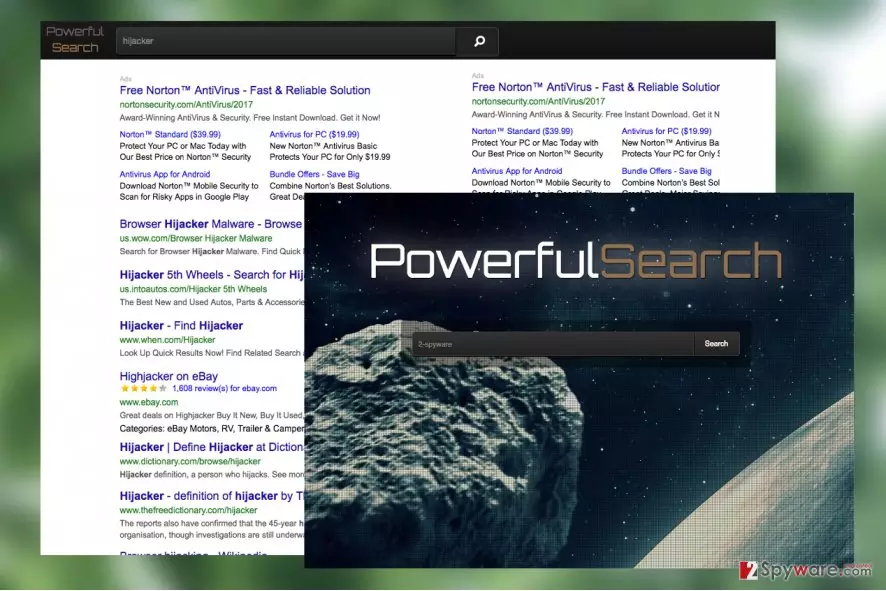
Another interesting and rather worrying thing about this search service is that it won’t display any search results if some ad-blocking software is installed and running on the browser. This once again proves that the program is oriented towards the revenue collected from ads and its usefulness for the user is non-existent. No self-respecting search providers apply such techniques in their businesses. Besides, with the ad-blocker off, you will also risk encountering potentially malicious ads, which may redirect you to dangerous websites and lead your computer to become infected with some more serious malware than a browser hijacker. Thus, we highly recommend to proceed with the PowerfulSearch.net removal as soon as possible and prevent very unpleasant consequences from taking place.

Preventing hijacker infiltration
A good way to prevent PowerfulSearch.net hijack is by obtaining a reliable security utility and enabling real-time protection. This way, the potentially unwanted programs will run into a strong barrier when trying to invade your PC and you are likely to have a much healthier system. Nevertheless, relying on automatic system protection alone will not prevent PowerfulSearch.net and other malware from infiltrating your system in other ways, say through software bundling. If you want to stay safe, you should always inspect the downloaded software packages for undesirable or suspicious-looking components and opt out their installation manually.
Techniques that will help remove PowerfulSearch.net
While you can’t fully rely on security software to prevent malware infiltration, you can surely trust the automatic utilities to remove PowerfulSearch.net virus from your computer. Such tools are superior to human-driven malware elimination because they can scan through extensive amounts of data quickly and consistently. For PowerfulSearch.net removal to be successful, you simply need to obtain a security utility or update the one you already own to the latest version and launch the scan. An alternative to the automatic hijacker removal is the manual elimination which steps are indicated below the article.
Uninstall from Windows
Uninstall from Windows 10/8:
- Type Control Panel into the Windows search box and open the result.
- Under Programs, select Uninstall a program.


Uninstall from Windows 7/XP:
- Click on Windows Start > Control Panel (Windows XP users should click on Add/Remove Programs).
- In Control Panel, select Programs > Uninstall a program.


Remove the unwanted program:
- In the Programs and Features window, look for any recently installed suspicious entries, select them, and click Uninstall.
- If User Account Control appears, click Yes to confirm, then complete the removal.


Delete from macOS
Remove the unwanted application:
- From the menu bar, select Go > Applications.
- In the Applications folder, look for any suspicious entries, then drag them to Trash (or right-click and pick Move to Trash).


Delete leftover files and folders:
- Select Go > Go to Folder.
- Enter /Library/Application Support and remove any suspicious folders related to the unwanted program.
- Repeat the same check in the /Library/LaunchAgents and /Library/LaunchDaemons folders, deleting any suspicious entries.

- Finally, empty the Trash to permanently remove the leftovers.

Reset Internet Explorer
Remove dangerous add-ons:
- Open Internet Explorer, click on the Gear icon (IE menu) on the top-right corner of the browser
- Pick Manage Add-ons.
- You will see a Manage Add-ons window. Here, look for suspicious plugins. Click on these entries and select Disable.


Change your homepage if it was altered:
- Open IE and click on the Gear icon.
- Select Internet Options.
- In the General tab, delete the Home page address and replace it by your preferred one (for example, Google.com).
- Click Apply and then select OK.


Delete temporary files:
- Press on the Gear icon and select Internet Options.
- Under Browsing history, click Delete...
- Select relevant fields and press Delete.


Reset Internet Explorer:
- Click on Gear icon > Internet options and select Advanced tab.
- Select Reset.
- In the new window, check Delete personal settings and select Reset.


Remove from Microsoft Edge
Delete unwanted extensions from MS Edge:
- Select Menu (three horizontal dots at the top-right of the browser window) and pick Extensions.
- From the list, pick the extension and click on the Gear icon.
- Click Remove.


Clear cookies and other browser data:
- Click on the Menu (three horizontal dots at the top-right of the browser window) and select Settings > Privacy, search, and services..
- Under Clear browsing data, pick Choose what to clear.
- Select Cookies and other site data and Cached images and files. (apart from passwords, although you might want to include Media licenses as well, if applicable) and click on Clear.


Restore new tab and homepage settings:
- Click the menu icon and choose Settings.
- Then find On startup section.
- Click Remove next to any suspicious startup page.
Reset MS Edge if the above steps did not work:
- Press on Ctrl + Shift + Esc to open Task Manager.
- Click on More details arrow at the bottom of the window.
- Select Details tab.
- Now scroll down and locate every entry with Microsoft Edge name in it. Right-click on each of them and select End Task to stop MS Edge from running.


Instructions for Chromium-based Edge
Delete extensions from MS Edge (Chromium):
- Open Edge and click select Settings > Extensions.
- Delete unwanted extensions by clicking Remove.


Clear cache and site data:
- Click on Menu and go to Settings.
- Select Privacy, search and services.
- Under Clear browsing data, pick Choose what to clear.
- Under Time range, pick All time.
- Select Clear now.


Reset Chromium-based MS Edge:
- Click on Menu and select Settings.
- On the left side, pick Reset settings.
- Select Restore settings to their default values.
- Confirm with Reset.
- This will disable extensions and reset startup pages but will not delete bookmarks, saved passwords, or browsing history.


Remove from Mozilla Firefox (FF)
Remove dangerous extensions:
- Open Mozilla Firefox browser and click on the Menu (three horizontal lines at the top-right of the window).
- Select Add-ons.
- In here, select the unwanted extension and click Remove.


Reset the homepage:
- Click three horizontal lines at the top right corner to open the menu.
- Choose Settings.
- Under Home, set your preferred homepage and new tab settings.
Clear cookies and site data:
- Click Menu and pick Settings.
- Go to Privacy & Security section.
- Scroll down to locate Cookies and Site Data.
- Click on Clear Data...
- Select Cookies and Site Data and Temporary cached files and pages, then click Clear.


Reset Mozilla Firefox
If clearing the browser as explained above did not help, reset Mozilla Firefox:
- Open Mozilla Firefox browser and click the Menu.
- Go to Help and then choose Troubleshooting Information.

- Under Give Firefox a tune up section, click on Refresh Firefox...
- Once the pop-up shows up, confirm the action by pressing on Refresh Firefox.



Remove from Google Chrome
Delete malicious extensions from Google Chrome:
- Open Google Chrome, click on the Menu (three vertical dots at the top-right corner) and select More tools > Extensions.
- In the newly opened window, you will see all the installed extensions. Uninstall all suspicious extensions related to the unwanted program by clicking Remove.


Clear cache and web data from Chrome:
- Click on Menu and pick Settings.
- Under Privacy and security, select Clear browsing data.
- Select Browsing history, Cookies and other site data, as well as Cached images and files.
- Click Clear data.


Change your homepage:
- Click menu and choose Settings.
- Look for a suspicious site in the On startup section.
- Click on Open a specific or set of pages and click on three dots to find the Remove option.
Reset Google Chrome:
If the previous methods did not help you, reset Google Chrome to eliminate all the unwanted components:
- Click on Menu and select Settings.
- In the Settings, scroll down and click Advanced.
- Scroll down and locate Reset and clean up section.
- Now click Restore settings to their original defaults.
- Confirm with Reset settings.


Delete from Safari
Remove dangerous extensions:
- Open Safari, click Safari in the menu at the top-left of the screen, and select Preferences.
- Go to the Extensions tab, look for any suspicious entries, and click Uninstall to remove them.


Clear history and website data:
- Click Safari in the menu and pick Clear History.
- Set Clear to all history and confirm with Clear History.


Reset Safari:
- Click Safari in the menu and select Preferences > Advanced.
- Enable Show Develop menu in menu bar.
- From the menu bar, click Develop and select Empty Caches.


Did this guide help?
Be the first to comment