

Reasons not to keep MyMapsWizard Toolbar on your PC
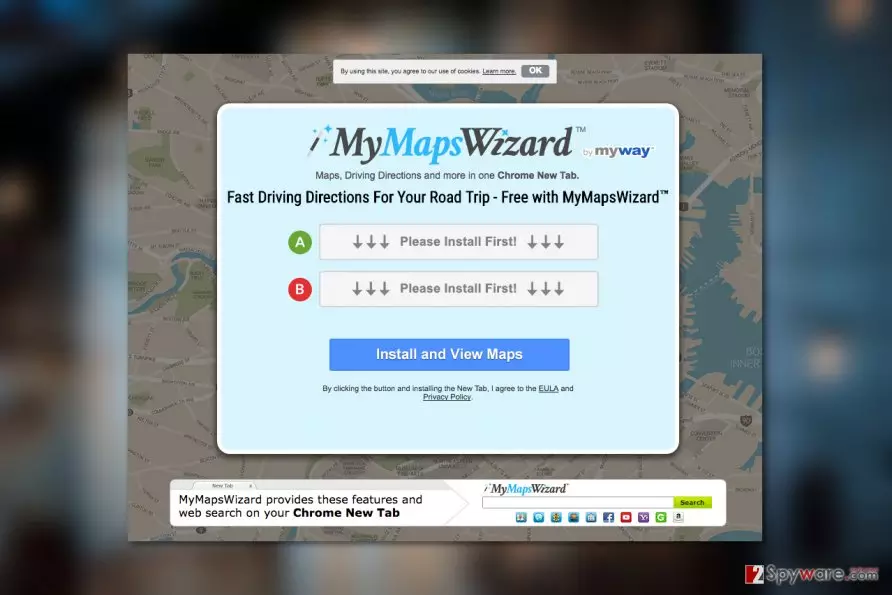
MyMapsWizard Toolbar virus is a new questionable computer software from Mindspark which has been categorized as a potentially unwanted program [1]. When the tool is installed, it triggers the hp.myway.com domain to take over the position of a default search engine and homepage. That’s why this application has also acquired a title of a browser hijacker [2].
Nevertheless, the program is legal, and some users may find it useful. This toolbar is said to combine web search and driving direction straight on the Chrome New Tab. But there are a few problems that make this app potentially unwanted. But before we discuss them, we should remind you that you have a right to remove MyMapsWizard Toolbar from your PC if you are not happy with its services.
Some sophisticated antivirus software, say FortectIntego, MalwarebytesMalwarebytes or similar may detect the program as PUP, but if the system scan does deal with this toolbar and you still see it on your browser, you may as well carry out its elimination manually. Instructions how to do it are presented below this article.

Returning back to the My Maps Wizard Toolbar drawbacks, the first thing that does not seem to together with any trusted computer software are the insidious ways its developers choose to spread the program around. The app is attached to freeware and shareware applications, so it installs on the PC without necessarily asking for overt user’s permission.
Secondly, when this browser helper object is installed, it will automatically reassign your regular homepage to My Way search, and every search query that you type into the toolbar’s search bar will be redirected to the same site as well.
Finally, you may notice that your online search does not provide you anticipated results anymore and you are being constantly followed by tons of pop-ups, banners, and ads everywhere you go on the web.
These actions may not be sinister or harmful to your PC, but you should not ignore them or let them pass. You should perform MyMapsWizard Toolbar removal without delay and bring back order to your computer.
Preventing unwanted programs from installing on your PC
“Don’t want to see MyMapsWizard Toolbar on your computer? Then don’t install it!.” It’s a rather useless advice since, in reality, things are not that simple. Small-scale applications such as toolbars, extensions or add-ons can easily be hidden in software packages together with other programs or install as the user clicks on some random download button online. To stay safe, you should:
- Always keep the real-time security shield of your antivirus software enabled and make sure that the program itself is legal and running the latest version
- Stay away from suspicious web pages or insecure peer-to-peer software sharing platforms. Obtain new software only from the reputable sources as it diminishes the possibility of additionally added programs entering your PC.
- Install new software via Advanced or Custom installation modes. Don’t hurry when going through the installation stages — you may accidentally miss the step allowing you to opt out MyMapsWizard Toolbar installation!
Tips for MyMapsWizard Toolbar removal
Typically, it should be enough to remove MyMapsWizard Toolbar from the list of your browser extensions. But there is a catch — this add-on installs on all web browsers, including MS Edge, Mozilla Firefox, Google Chrome, and Safari, so all these applications should be checked for the unwanted content and reset.
Sometimes, even performing the regular elimination actions may not be enough to complete MyMapsWizard Toolbar removal. Some of the program’s components may still be left on the computer, preventing its full elimination. Thus, we recommend scanning the system automatically as well.
Uninstall from Windows
Uninstall from Windows 10/8:
- Type Control Panel into the Windows search box and open the result.
- Under Programs, select Uninstall a program.


Uninstall from Windows 7/XP:
- Click on Windows Start > Control Panel (Windows XP users should click on Add/Remove Programs).
- In Control Panel, select Programs > Uninstall a program.


Remove the unwanted program:
- In the Programs and Features window, look for any recently installed suspicious entries, select them, and click Uninstall.
- If User Account Control appears, click Yes to confirm, then complete the removal.


Delete from macOS
Remove the unwanted application:
- From the menu bar, select Go > Applications.
- In the Applications folder, look for any suspicious entries, then drag them to Trash (or right-click and pick Move to Trash).


Delete leftover files and folders:
- Select Go > Go to Folder.
- Enter /Library/Application Support and remove any suspicious folders related to the unwanted program.
- Repeat the same check in the /Library/LaunchAgents and /Library/LaunchDaemons folders, deleting any suspicious entries.

- Finally, empty the Trash to permanently remove the leftovers.

Reset Internet Explorer
Remove dangerous add-ons:
- Open Internet Explorer, click on the Gear icon (IE menu) on the top-right corner of the browser
- Pick Manage Add-ons.
- You will see a Manage Add-ons window. Here, look for suspicious plugins. Click on these entries and select Disable.


Change your homepage if it was altered:
- Open IE and click on the Gear icon.
- Select Internet Options.
- In the General tab, delete the Home page address and replace it by your preferred one (for example, Google.com).
- Click Apply and then select OK.


Delete temporary files:
- Press on the Gear icon and select Internet Options.
- Under Browsing history, click Delete...
- Select relevant fields and press Delete.


Reset Internet Explorer:
- Click on Gear icon > Internet options and select Advanced tab.
- Select Reset.
- In the new window, check Delete personal settings and select Reset.


Remove from Microsoft Edge
Delete unwanted extensions from MS Edge:
- Select Menu (three horizontal dots at the top-right of the browser window) and pick Extensions.
- From the list, pick the extension and click on the Gear icon.
- Click Remove.


Clear cookies and other browser data:
- Click on the Menu (three horizontal dots at the top-right of the browser window) and select Settings > Privacy, search, and services..
- Under Clear browsing data, pick Choose what to clear.
- Select Cookies and other site data and Cached images and files. (apart from passwords, although you might want to include Media licenses as well, if applicable) and click on Clear.


Restore new tab and homepage settings:
- Click the menu icon and choose Settings.
- Then find On startup section.
- Click Remove next to any suspicious startup page.
Reset MS Edge if the above steps did not work:
- Press on Ctrl + Shift + Esc to open Task Manager.
- Click on More details arrow at the bottom of the window.
- Select Details tab.
- Now scroll down and locate every entry with Microsoft Edge name in it. Right-click on each of them and select End Task to stop MS Edge from running.


Instructions for Chromium-based Edge
Delete extensions from MS Edge (Chromium):
- Open Edge and click select Settings > Extensions.
- Delete unwanted extensions by clicking Remove.


Clear cache and site data:
- Click on Menu and go to Settings.
- Select Privacy, search and services.
- Under Clear browsing data, pick Choose what to clear.
- Under Time range, pick All time.
- Select Clear now.


Reset Chromium-based MS Edge:
- Click on Menu and select Settings.
- On the left side, pick Reset settings.
- Select Restore settings to their default values.
- Confirm with Reset.
- This will disable extensions and reset startup pages but will not delete bookmarks, saved passwords, or browsing history.


Remove from Mozilla Firefox (FF)
Remove dangerous extensions:
- Open Mozilla Firefox browser and click on the Menu (three horizontal lines at the top-right of the window).
- Select Add-ons.
- In here, select the unwanted extension and click Remove.


Reset the homepage:
- Click three horizontal lines at the top right corner to open the menu.
- Choose Settings.
- Under Home, set your preferred homepage and new tab settings.
Clear cookies and site data:
- Click Menu and pick Settings.
- Go to Privacy & Security section.
- Scroll down to locate Cookies and Site Data.
- Click on Clear Data...
- Select Cookies and Site Data and Temporary cached files and pages, then click Clear.


Reset Mozilla Firefox
If clearing the browser as explained above did not help, reset Mozilla Firefox:
- Open Mozilla Firefox browser and click the Menu.
- Go to Help and then choose Troubleshooting Information.

- Under Give Firefox a tune up section, click on Refresh Firefox...
- Once the pop-up shows up, confirm the action by pressing on Refresh Firefox.



Remove from Google Chrome
Delete malicious extensions from Google Chrome:
- Open Google Chrome, click on the Menu (three vertical dots at the top-right corner) and select More tools > Extensions.
- In the newly opened window, you will see all the installed extensions. Uninstall all suspicious extensions related to the unwanted program by clicking Remove.


Clear cache and web data from Chrome:
- Click on Menu and pick Settings.
- Under Privacy and security, select Clear browsing data.
- Select Browsing history, Cookies and other site data, as well as Cached images and files.
- Click Clear data.


Change your homepage:
- Click menu and choose Settings.
- Look for a suspicious site in the On startup section.
- Click on Open a specific or set of pages and click on three dots to find the Remove option.
Reset Google Chrome:
If the previous methods did not help you, reset Google Chrome to eliminate all the unwanted components:
- Click on Menu and select Settings.
- In the Settings, scroll down and click Advanced.
- Scroll down and locate Reset and clean up section.
- Now click Restore settings to their original defaults.
- Confirm with Reset settings.


Delete from Safari
Remove dangerous extensions:
- Open Safari, click Safari in the menu at the top-left of the screen, and select Preferences.
- Go to the Extensions tab, look for any suspicious entries, and click Uninstall to remove them.


Clear history and website data:
- Click Safari in the menu and pick Clear History.
- Set Clear to all history and confirm with Clear History.


Reset Safari:
- Click Safari in the menu and select Preferences > Advanced.
- Enable Show Develop menu in menu bar.
- From the menu bar, click Develop and select Empty Caches.


Did this guide help?
Be the first to comment