

Zipfilesearch.com recommends file zipping services
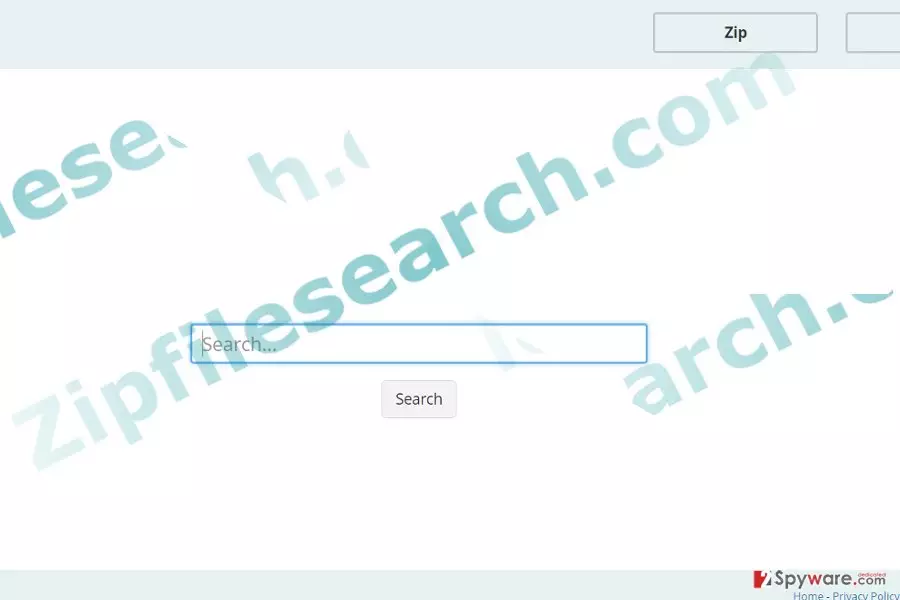
Zipfilesearch.com virus happens to be another browser hijacker created by Hopebest Ltd. This company located in Hong Kong has already launched a couple of search engines, Screenrecordsearch.com, being one of them. Thus, Chinese users[1] may notice this web being advertised more often.
All of them use Yahoo or Google as search databases and promote additional service – either an audio recording or file archiving. However, it does not change the fact that they belong to potentially unwanted programs.
The key problem is the amount of data this search tool collects about netizens and the purposes it may use for. Like other search engines of this kind, it tends to track users activities.[2] If privacy is a value to you, you may consider Zipfilesearch.com removal. FortectIntego or MalwarebytesMalwarebytes does it for you.
Offering multiple services
In order to attract visitors and users, the developers of similar tools often add numerous additional services. Thus, you may find browsing tools which attempt to catch your eye with weather forecast news, links to shopping domains or games. Some of them might be quite persistent, e.g. MyWay search tools.
Speaking of Zip File Search hijacker, it employs Yahoo database for delivering search results. It is commendable that the tool also supports security browser extensions. If you take a glimpse at its privacy policy, you will find out that the browser engine collects personal information. If you tend to disclose your personal information too recklessly, you should consider the risk of using this tool. Here is how the developers may misuse your data:
- Provide the products and services that you requested;
- Deliver Services and customer support;
- Perform target marketing and advertising
- Manage and protect our business, which includes the quality of the HOPEBEST Services and system;
- Contact you by postal mail, e-mail, or telephone in order to explain our recent products and services;
The document also mentions that Hopebest cooperates with multiple advertisers.[3] Consequently, commercial pop-ups may interrupt your browsing sessions.
In addition, due to the above fact, you should not also ignore Zipfilesearch.com redirect phenomenon. Due to it, you might find yourself in a fishy sponsored domain. There is no need such tools when you can use more trusted alternatives.
Transmission peculiarities
Since this website can be located on its official website, Zipfilesearch.com hijack is unlikely to happen. Though the website does not require you to install it, you may notice other commercial offers promoting specific products. In any case, if you got redirected to this domain accidentally, it is still recommended to remove Zipfilesearch.com web scripts. More detailed instructions can be found below.
Usually, such search tools are either promoted in sponsored websites, gaming or movie streaming sites. When you click to exit the ad to launch the video, you may be redirected to this domain. In addition, keep in mind that the majority PUPs prefer another distribution method –“bundling.”
In that case, it is important to pay attention to the installation guide regardless of the software and source you are downloading from.
Eliminate Zipfilesearch.com and its related elements
Regarding its privacy policy, the search tool uses a variety of tracking elements, including pixels and cookies. In order to remove Zipfilesearch.com virus scripts, scan the disk with an anti-spyware program. Update it before the scanning process launches.
Alternatively, you may benefit from manual Zipfilesearch.com removal guidelines. They will instruct how to delete the browser infection entirely.
Uninstall from Windows
Uninstall from Windows 10/8:
- Type Control Panel into the Windows search box and open the result.
- Under Programs, select Uninstall a program.


Uninstall from Windows 7/XP:
- Click on Windows Start > Control Panel (Windows XP users should click on Add/Remove Programs).
- In Control Panel, select Programs > Uninstall a program.


Remove the unwanted program:
- In the Programs and Features window, look for any recently installed suspicious entries, select them, and click Uninstall.
- If User Account Control appears, click Yes to confirm, then complete the removal.


Delete from macOS
Remove the unwanted application:
- From the menu bar, select Go > Applications.
- In the Applications folder, look for any suspicious entries, then drag them to Trash (or right-click and pick Move to Trash).


Delete leftover files and folders:
- Select Go > Go to Folder.
- Enter /Library/Application Support and remove any suspicious folders related to the unwanted program.
- Repeat the same check in the /Library/LaunchAgents and /Library/LaunchDaemons folders, deleting any suspicious entries.

- Finally, empty the Trash to permanently remove the leftovers.

Reset Internet Explorer
Remove dangerous add-ons:
- Open Internet Explorer, click on the Gear icon (IE menu) on the top-right corner of the browser
- Pick Manage Add-ons.
- You will see a Manage Add-ons window. Here, look for suspicious plugins. Click on these entries and select Disable.


Change your homepage if it was altered:
- Open IE and click on the Gear icon.
- Select Internet Options.
- In the General tab, delete the Home page address and replace it by your preferred one (for example, Google.com).
- Click Apply and then select OK.


Delete temporary files:
- Press on the Gear icon and select Internet Options.
- Under Browsing history, click Delete...
- Select relevant fields and press Delete.


Reset Internet Explorer:
- Click on Gear icon > Internet options and select Advanced tab.
- Select Reset.
- In the new window, check Delete personal settings and select Reset.


Remove from Microsoft Edge
Delete unwanted extensions from MS Edge:
- Select Menu (three horizontal dots at the top-right of the browser window) and pick Extensions.
- From the list, pick the extension and click on the Gear icon.
- Click Remove.


Clear cookies and other browser data:
- Click on the Menu (three horizontal dots at the top-right of the browser window) and select Settings > Privacy, search, and services..
- Under Clear browsing data, pick Choose what to clear.
- Select Cookies and other site data and Cached images and files. (apart from passwords, although you might want to include Media licenses as well, if applicable) and click on Clear.


Restore new tab and homepage settings:
- Click the menu icon and choose Settings.
- Then find On startup section.
- Click Remove next to any suspicious startup page.
Reset MS Edge if the above steps did not work:
- Press on Ctrl + Shift + Esc to open Task Manager.
- Click on More details arrow at the bottom of the window.
- Select Details tab.
- Now scroll down and locate every entry with Microsoft Edge name in it. Right-click on each of them and select End Task to stop MS Edge from running.


Instructions for Chromium-based Edge
Delete extensions from MS Edge (Chromium):
- Open Edge and click select Settings > Extensions.
- Delete unwanted extensions by clicking Remove.


Clear cache and site data:
- Click on Menu and go to Settings.
- Select Privacy, search and services.
- Under Clear browsing data, pick Choose what to clear.
- Under Time range, pick All time.
- Select Clear now.


Reset Chromium-based MS Edge:
- Click on Menu and select Settings.
- On the left side, pick Reset settings.
- Select Restore settings to their default values.
- Confirm with Reset.
- This will disable extensions and reset startup pages but will not delete bookmarks, saved passwords, or browsing history.


Remove from Mozilla Firefox (FF)
Remove dangerous extensions:
- Open Mozilla Firefox browser and click on the Menu (three horizontal lines at the top-right of the window).
- Select Add-ons.
- In here, select the unwanted extension and click Remove.


Reset the homepage:
- Click three horizontal lines at the top right corner to open the menu.
- Choose Settings.
- Under Home, set your preferred homepage and new tab settings.
Clear cookies and site data:
- Click Menu and pick Settings.
- Go to Privacy & Security section.
- Scroll down to locate Cookies and Site Data.
- Click on Clear Data...
- Select Cookies and Site Data and Temporary cached files and pages, then click Clear.


Reset Mozilla Firefox
If clearing the browser as explained above did not help, reset Mozilla Firefox:
- Open Mozilla Firefox browser and click the Menu.
- Go to Help and then choose Troubleshooting Information.

- Under Give Firefox a tune up section, click on Refresh Firefox...
- Once the pop-up shows up, confirm the action by pressing on Refresh Firefox.



Remove from Google Chrome
Delete malicious extensions from Google Chrome:
- Open Google Chrome, click on the Menu (three vertical dots at the top-right corner) and select More tools > Extensions.
- In the newly opened window, you will see all the installed extensions. Uninstall all suspicious extensions related to the unwanted program by clicking Remove.


Clear cache and web data from Chrome:
- Click on Menu and pick Settings.
- Under Privacy and security, select Clear browsing data.
- Select Browsing history, Cookies and other site data, as well as Cached images and files.
- Click Clear data.


Change your homepage:
- Click menu and choose Settings.
- Look for a suspicious site in the On startup section.
- Click on Open a specific or set of pages and click on three dots to find the Remove option.
Reset Google Chrome:
If the previous methods did not help you, reset Google Chrome to eliminate all the unwanted components:
- Click on Menu and select Settings.
- In the Settings, scroll down and click Advanced.
- Scroll down and locate Reset and clean up section.
- Now click Restore settings to their original defaults.
- Confirm with Reset settings.


Delete from Safari
Remove dangerous extensions:
- Open Safari, click Safari in the menu at the top-left of the screen, and select Preferences.
- Go to the Extensions tab, look for any suspicious entries, and click Uninstall to remove them.


Clear history and website data:
- Click Safari in the menu and pick Clear History.
- Set Clear to all history and confirm with Clear History.


Reset Safari:
- Click Safari in the menu and select Preferences > Advanced.
- Enable Show Develop menu in menu bar.
- From the menu bar, click Develop and select Empty Caches.


Did this guide help?
Be the first to comment