

Nextlnk.com leads traces to Search Algo hijackers
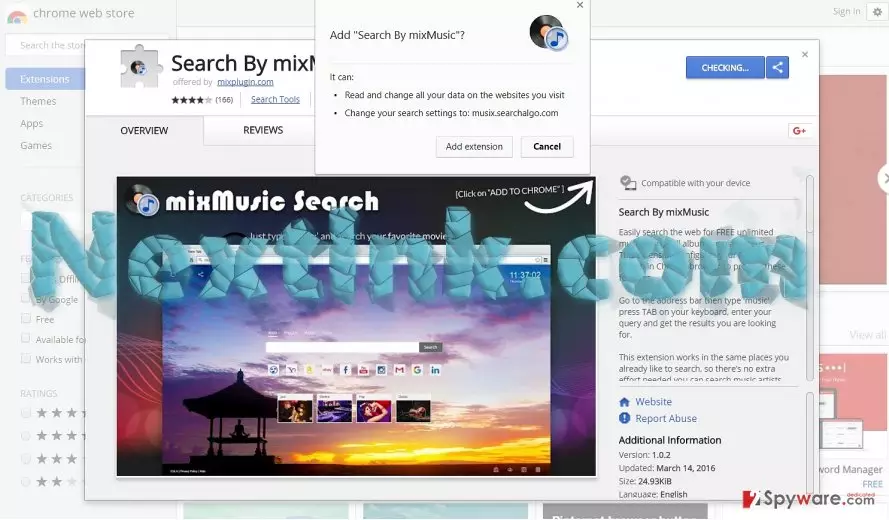
Nextlnk.com virus redirects users to the website which promotes MixMusic application. You can find the latter in Chrome Web Store as the search tool called “MixMusic Search”.
Upon enabling the extension, you are notified that:
• the extension will be able to read and change all your data on the websites you visit
• change your search settings to music.searchalgo.com
Let us note that the latter belongs to a well-known group of SearchAlgo PUPs. The design of the search tool might look flashy and appealing, but note that eye-catchy tools or services often have annoying side-effects.
It is commendable that this group of hijackers does not specifically collect personal details, but the way it promotes its services is not common for reliable search engines. Contrary to SearchAlgo, mixPlugin, the official representative of MixMusic app[1], tends to:
mixPlugin may use information (whether personal identifying information or not) that we collect about you to:
- Manage your relationship with us and provide you with customer support
- Perform research and analysis about your use of, or interest in, our products, services or content, or products, services or content offered by others
- Manage our business
- Indemnification
Finally, the fact that this application is promoted via nextlnk.com does not leave any reliable impression. Thus, now let us proceed to Nextlnk.com removal. FortectIntego or MalwarebytesMalwarebytes does that faster.
Entertainment apps tempt users to install questionable applications
At first glance, mixMusic seems a highly practical application. It lets you find favorite songs faster as well search for movie soundtracks. However, even if you are not interested in preserving cyber security, soon you may get annoyed by MixMusic ads and notifications.
Furthermore, taking into account the fact that the company compiled personal information to “manage your business,” you are likely to spot commercial offers in your Inbox as well. Note that spam emails may contain a far bigger menace.[2] Additionally, there is no guarantee that due to Nextlnk.com redirect, you may not find yourself on a shady website.
Ways to pinpoint adware before its gets into your computer
If you have a bad luck installing questionable applications and can’t understand how you did that, let us shed some light on the major adware distribution network. PUP applications or websites can be promoted by adware scripts injected in movie streaming or gaming sites.
Alternatively, the majority of dubious applications tend to click onto freeware in the form of attachments. When a user is about to install a new tool, they often tend to opt for “Recommended” settings.
Thus, it deprives them of spotting irrelevant applications on time. In order to avoid unexpected “Nextlnk.com hijack” or prevent the installation of questionable add-ons time opt for “Advanced” settings. Now let us move on the section which explains how to remove Nextlnk.com web scripts and uninstall its extensions.
Nextlnk.com elimination options
This tool is evenly promoted to every user, so if you are a British or Greek[3] Chrome user, you are likely to spot promotional MixMusic popups. Since the application comes as a browser add-on and a search tool, you may combine manual and automatic Nextlnk removal methods.
As for the manual instructions, feel free to use the ones provided by our IT experts. Note that this method might require more time. If you intend to remove Nextlnk.com virus faster, you may perform full browser reset.
Uninstall from Windows
Uninstall from Windows 10/8:
- Type Control Panel into the Windows search box and open the result.
- Under Programs, select Uninstall a program.


Uninstall from Windows 7/XP:
- Click on Windows Start > Control Panel (Windows XP users should click on Add/Remove Programs).
- In Control Panel, select Programs > Uninstall a program.


Remove the unwanted program:
- In the Programs and Features window, look for any recently installed suspicious entries, select them, and click Uninstall.
- If User Account Control appears, click Yes to confirm, then complete the removal.


Delete from macOS
Remove the unwanted application:
- From the menu bar, select Go > Applications.
- In the Applications folder, look for any suspicious entries, then drag them to Trash (or right-click and pick Move to Trash).


Delete leftover files and folders:
- Select Go > Go to Folder.
- Enter /Library/Application Support and remove any suspicious folders related to the unwanted program.
- Repeat the same check in the /Library/LaunchAgents and /Library/LaunchDaemons folders, deleting any suspicious entries.

- Finally, empty the Trash to permanently remove the leftovers.

Reset Internet Explorer
Remove dangerous add-ons:
- Open Internet Explorer, click on the Gear icon (IE menu) on the top-right corner of the browser
- Pick Manage Add-ons.
- You will see a Manage Add-ons window. Here, look for suspicious plugins. Click on these entries and select Disable.


Change your homepage if it was altered:
- Open IE and click on the Gear icon.
- Select Internet Options.
- In the General tab, delete the Home page address and replace it by your preferred one (for example, Google.com).
- Click Apply and then select OK.


Delete temporary files:
- Press on the Gear icon and select Internet Options.
- Under Browsing history, click Delete...
- Select relevant fields and press Delete.


Reset Internet Explorer:
- Click on Gear icon > Internet options and select Advanced tab.
- Select Reset.
- In the new window, check Delete personal settings and select Reset.


Remove from Microsoft Edge
Delete unwanted extensions from MS Edge:
- Select Menu (three horizontal dots at the top-right of the browser window) and pick Extensions.
- From the list, pick the extension and click on the Gear icon.
- Click Remove.


Clear cookies and other browser data:
- Click on the Menu (three horizontal dots at the top-right of the browser window) and select Settings > Privacy, search, and services..
- Under Clear browsing data, pick Choose what to clear.
- Select Cookies and other site data and Cached images and files. (apart from passwords, although you might want to include Media licenses as well, if applicable) and click on Clear.


Restore new tab and homepage settings:
- Click the menu icon and choose Settings.
- Then find On startup section.
- Click Remove next to any suspicious startup page.
Reset MS Edge if the above steps did not work:
- Press on Ctrl + Shift + Esc to open Task Manager.
- Click on More details arrow at the bottom of the window.
- Select Details tab.
- Now scroll down and locate every entry with Microsoft Edge name in it. Right-click on each of them and select End Task to stop MS Edge from running.


Instructions for Chromium-based Edge
Delete extensions from MS Edge (Chromium):
- Open Edge and click select Settings > Extensions.
- Delete unwanted extensions by clicking Remove.


Clear cache and site data:
- Click on Menu and go to Settings.
- Select Privacy, search and services.
- Under Clear browsing data, pick Choose what to clear.
- Under Time range, pick All time.
- Select Clear now.


Reset Chromium-based MS Edge:
- Click on Menu and select Settings.
- On the left side, pick Reset settings.
- Select Restore settings to their default values.
- Confirm with Reset.
- This will disable extensions and reset startup pages but will not delete bookmarks, saved passwords, or browsing history.


Remove from Mozilla Firefox (FF)
Remove dangerous extensions:
- Open Mozilla Firefox browser and click on the Menu (three horizontal lines at the top-right of the window).
- Select Add-ons.
- In here, select the unwanted extension and click Remove.


Reset the homepage:
- Click three horizontal lines at the top right corner to open the menu.
- Choose Settings.
- Under Home, set your preferred homepage and new tab settings.
Clear cookies and site data:
- Click Menu and pick Settings.
- Go to Privacy & Security section.
- Scroll down to locate Cookies and Site Data.
- Click on Clear Data...
- Select Cookies and Site Data and Temporary cached files and pages, then click Clear.


Reset Mozilla Firefox
If clearing the browser as explained above did not help, reset Mozilla Firefox:
- Open Mozilla Firefox browser and click the Menu.
- Go to Help and then choose Troubleshooting Information.

- Under Give Firefox a tune up section, click on Refresh Firefox...
- Once the pop-up shows up, confirm the action by pressing on Refresh Firefox.



Remove from Google Chrome
Delete malicious extensions from Google Chrome:
- Open Google Chrome, click on the Menu (three vertical dots at the top-right corner) and select More tools > Extensions.
- In the newly opened window, you will see all the installed extensions. Uninstall all suspicious extensions related to the unwanted program by clicking Remove.


Clear cache and web data from Chrome:
- Click on Menu and pick Settings.
- Under Privacy and security, select Clear browsing data.
- Select Browsing history, Cookies and other site data, as well as Cached images and files.
- Click Clear data.


Change your homepage:
- Click menu and choose Settings.
- Look for a suspicious site in the On startup section.
- Click on Open a specific or set of pages and click on three dots to find the Remove option.
Reset Google Chrome:
If the previous methods did not help you, reset Google Chrome to eliminate all the unwanted components:
- Click on Menu and select Settings.
- In the Settings, scroll down and click Advanced.
- Scroll down and locate Reset and clean up section.
- Now click Restore settings to their original defaults.
- Confirm with Reset settings.


Delete from Safari
Remove dangerous extensions:
- Open Safari, click Safari in the menu at the top-left of the screen, and select Preferences.
- Go to the Extensions tab, look for any suspicious entries, and click Uninstall to remove them.


Clear history and website data:
- Click Safari in the menu and pick Clear History.
- Set Clear to all history and confirm with Clear History.


Reset Safari:
- Click Safari in the menu and select Preferences > Advanced.
- Enable Show Develop menu in menu bar.
- From the menu bar, click Develop and select Empty Caches.


Did this guide help?
Be the first to comment