

Search.loginemailaccounts.com might hijack Chrome, Firefox, Safari, and Explorer web browsers
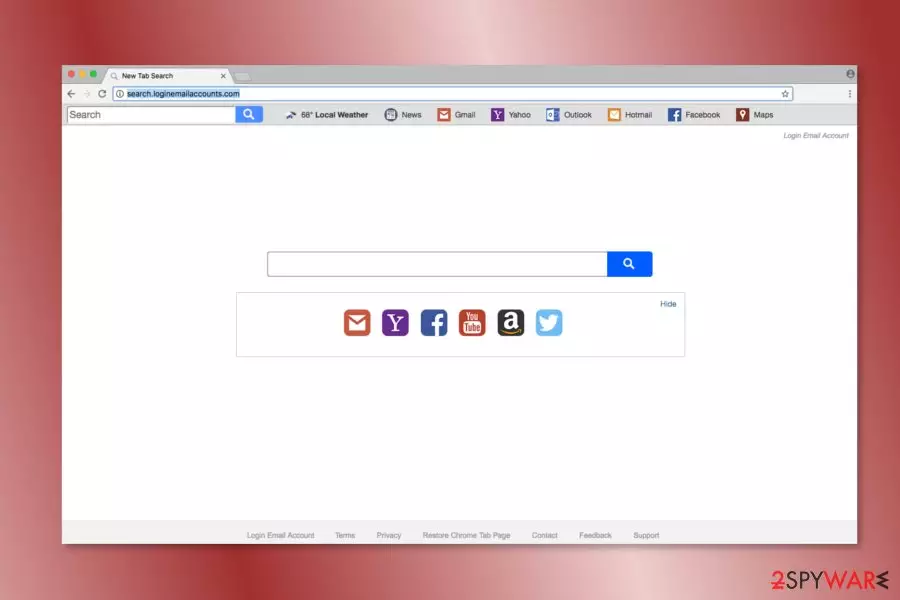
Search.loginemailaccounts.com is a search tool by Polarity Technologies. It spreads with a “Login Email Account” browser extension that is usually attached in software bundles. After the hijack, it might alter browser settings and track users' information to display targeted ads and gain revenue.[1]
It offers a search service and quick access to the most popular email services, such as Gmail, Yahoo, Outlook, and Hotmail. Therefore, this tool might seem helpful for those who use multiple email accounts. However, you should not be tricked by this feature.
Although it seems legitimate, this potentially unwanted program (PUP) might enter the system silently and take over the browser without asking the user’s permission. The Search.loginemailaccounts.com virus might also alter the Registry, browsers’ settings, and shortcuts or install additional components that prevent users from setting their preferred homepage and search engine. This article contains the threats summary and removal options.
| name | Search.loginemailaccounts.com virus |
|---|---|
| Type | Browser hijacker, potentially unwanted program |
| Associated Plug-in | Login Email Account browser extension |
| Symptoms | Search inquiries redirected through dubious websites until results filled with ads are shown from a different search provider; new tabs with suspicious websites open out of the blue |
| Risks | Privacy loss, installation of additional PUPs, or even malware |
| Elimination | Remove the intruder either manually with our detailed instructions below or automatically by using a trustworthy anti-malware software |
| System health check | Fix Registry and other system-related issues by running a scan with the FortectIntego system diagnostics tool |
The manifestation of the browser hijacker diminishes the browsing experience and causes slowdowns or freezing of the browser. Besides, it might display third-party commercial advertisements that cover necessary content, do not have a close button, and redirect to potentially dangerous websites.
The trick is that the program collects a bunch of information about the user that allows creating personalized content. However, once you click on them, you might end up on a site with nothing in common with the advertised range. Hence, these misleading Search.loginemailaccounts.com redirect tendencies should motivate you to get rid of the hijacker.
All in all, you should remove it from the PC for these reasons:
- suspicious distribution method;
- changed search provider and in-built search box to query.loginemailaccounts.com or search.loginemailaccounts.com;
- inability to revert these alterations;
- an increased amount of suspicious online ads;
- questionable data tracking and sharing activities.
We recommend performing Search.loginemailaccounts.com removal using security software. It’s the easiest and quickest method to get rid of the hijacker and all its components. Thus, install MalwarebytesMalwarebytes, SpyHunterCombo Cleaner, or another anti-malware tool and run the system scan.
If you wish to remove it manually, at least let us help you by providing guidance. You'll find comprehensive instructions at the bottom of the article. When the device is crispy clean, we recommend performing system diagnostics with the FortectIntego app to ensure a stable working environment.

Developers of the suspicious search tool use bundling as the primary distribution method
The “Login Email Account” application is responsible for setting search.loginemailaccounts.com as your default homepage, and search engine spreads bundled with freeware and shareware. Thus, in order to avoid the hijack, you should be careful with freeware installation.
Lots of PUPs spread using this bundling technique, so you should always make sure that you are not installing a package:
- Always opt for the Advanced/Custom settings instead of Quick/Recommended;
- Read EULA,[2] Privacy Policy, Terms of Use, and other provided documents;
- Monitor installation process and do not rush to hit the “Next” button;
- Unmark all third-party applications that are offered to download with the primary program.
The hijacker has been noticed mostly spreading among American computer users. However, this popular distribution method can help hijack web browsers in Asian and European countries, such as Norway,[3] Italy, or Germany. Thus, it doesn’t matter where you live; you should always be careful with your downloads.
Remove Search.loginemailaccounts.com virus without leaving it a chance to come back
You can complete the article's culprit removal either manually or automatically. The first method requires looking for hijacker-related entries on the computer and eliminating them individually. The second one allows removing the virus together with its components automatically.
If you are interested in manual removal, you should have a close look at the instructions provided at the end of the article. If you follow them carefully, you should not encounter any problems. If you prefer the automatic elimination option, you have to employ professional security software and run a full system scan with an updated tool.
Uninstall from Windows
Uninstall from Windows 10/8:
- Type Control Panel into the Windows search box and open the result.
- Under Programs, select Uninstall a program.


Uninstall from Windows 7/XP:
- Click on Windows Start > Control Panel (Windows XP users should click on Add/Remove Programs).
- In Control Panel, select Programs > Uninstall a program.


Remove the unwanted program:
- In the Programs and Features window, look for any recently installed suspicious entries, select them, and click Uninstall.
- If User Account Control appears, click Yes to confirm, then complete the removal.


Delete from macOS
Remove the unwanted application:
- From the menu bar, select Go > Applications.
- In the Applications folder, look for any suspicious entries, then drag them to Trash (or right-click and pick Move to Trash).


Delete leftover files and folders:
- Select Go > Go to Folder.
- Enter /Library/Application Support and remove any suspicious folders related to the unwanted program.
- Repeat the same check in the /Library/LaunchAgents and /Library/LaunchDaemons folders, deleting any suspicious entries.

- Finally, empty the Trash to permanently remove the leftovers.

Remove from Microsoft Edge
Delete unwanted extensions from MS Edge:
- Select Menu (three horizontal dots at the top-right of the browser window) and pick Extensions.
- From the list, pick the extension and click on the Gear icon.
- Click Remove.


Clear cookies and other browser data:
- Click on the Menu (three horizontal dots at the top-right of the browser window) and select Settings > Privacy, search, and services..
- Under Clear browsing data, pick Choose what to clear.
- Select Cookies and other site data and Cached images and files. (apart from passwords, although you might want to include Media licenses as well, if applicable) and click on Clear.


Restore new tab and homepage settings:
- Click the menu icon and choose Settings.
- Then find On startup section.
- Click Remove next to any suspicious startup page.
Reset MS Edge if the above steps did not work:
- Press on Ctrl + Shift + Esc to open Task Manager.
- Click on More details arrow at the bottom of the window.
- Select Details tab.
- Now scroll down and locate every entry with Microsoft Edge name in it. Right-click on each of them and select End Task to stop MS Edge from running.


Instructions for Chromium-based Edge
Delete extensions from MS Edge (Chromium):
- Open Edge and click select Settings > Extensions.
- Delete unwanted extensions by clicking Remove.


Clear cache and site data:
- Click on Menu and go to Settings.
- Select Privacy, search and services.
- Under Clear browsing data, pick Choose what to clear.
- Under Time range, pick All time.
- Select Clear now.


Reset Chromium-based MS Edge:
- Click on Menu and select Settings.
- On the left side, pick Reset settings.
- Select Restore settings to their default values.
- Confirm with Reset.
- This will disable extensions and reset startup pages but will not delete bookmarks, saved passwords, or browsing history.


Remove from Mozilla Firefox (FF)
Remove dangerous extensions:
- Open Mozilla Firefox browser and click on the Menu (three horizontal lines at the top-right of the window).
- Select Add-ons.
- In here, select the unwanted extension and click Remove.


Reset the homepage:
- Click three horizontal lines at the top right corner to open the menu.
- Choose Settings.
- Under Home, set your preferred homepage and new tab settings.
Clear cookies and site data:
- Click Menu and pick Settings.
- Go to Privacy & Security section.
- Scroll down to locate Cookies and Site Data.
- Click on Clear Data...
- Select Cookies and Site Data and Temporary cached files and pages, then click Clear.


Reset Mozilla Firefox
If clearing the browser as explained above did not help, reset Mozilla Firefox:
- Open Mozilla Firefox browser and click the Menu.
- Go to Help and then choose Troubleshooting Information.

- Under Give Firefox a tune up section, click on Refresh Firefox...
- Once the pop-up shows up, confirm the action by pressing on Refresh Firefox.



Remove from Google Chrome
Delete malicious extensions from Google Chrome:
- Open Google Chrome, click on the Menu (three vertical dots at the top-right corner) and select More tools > Extensions.
- In the newly opened window, you will see all the installed extensions. Uninstall all suspicious extensions related to the unwanted program by clicking Remove.


Clear cache and web data from Chrome:
- Click on Menu and pick Settings.
- Under Privacy and security, select Clear browsing data.
- Select Browsing history, Cookies and other site data, as well as Cached images and files.
- Click Clear data.


Change your homepage:
- Click menu and choose Settings.
- Look for a suspicious site in the On startup section.
- Click on Open a specific or set of pages and click on three dots to find the Remove option.
Reset Google Chrome:
If the previous methods did not help you, reset Google Chrome to eliminate all the unwanted components:
- Click on Menu and select Settings.
- In the Settings, scroll down and click Advanced.
- Scroll down and locate Reset and clean up section.
- Now click Restore settings to their original defaults.
- Confirm with Reset settings.


Delete from Safari
Remove dangerous extensions:
- Open Safari, click Safari in the menu at the top-left of the screen, and select Preferences.
- Go to the Extensions tab, look for any suspicious entries, and click Uninstall to remove them.


Clear history and website data:
- Click Safari in the menu and pick Clear History.
- Set Clear to all history and confirm with Clear History.


Reset Safari:
- Click Safari in the menu and select Preferences > Advanced.
- Enable Show Develop menu in menu bar.
- From the menu bar, click Develop and select Empty Caches.


Did this guide help?
Be the first to comment