

Explanation of Search.kyushuplow.com search hijacker's activities
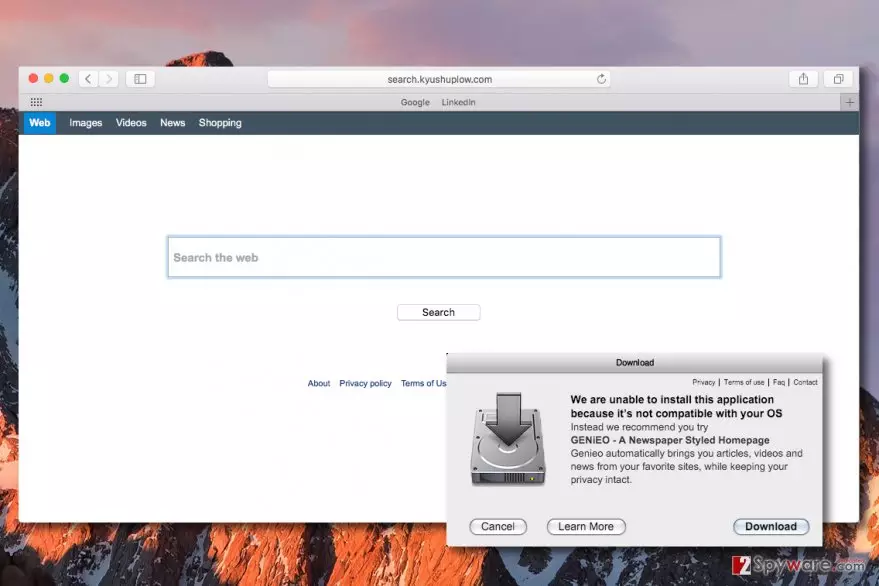
Search.kyushuplow.com is a hazy search engine that is promoted with the help of Kyushuplow browser hijacker[1]. It is ranked as a potentially unwanted program (PUP) that mainly hits Mac computers. Although it seems to provide a traditional search engine, it actually wants to push ads in the form of search findings, causing unexpected URL redirections to external websites.
The aim of the vague Kyushuplow search engine is to provide as many shady search results as possible. To masquerade them, the hijacker collects browsing-related data from victim’s computer and presents interest-based ads (or at least ones that look catchy to the victim).
However, it is important to understand that clicking on those ads can immediately reroute you to highly insecure Internet websites, so we suggest you to stay cautious.
Instead of using a suspicious search engine that replaced your previous homepage and search engine all of a sudden, consider removing the program that settled it in your web browsers.
To remove Search.kyushuplow.com, you should use a trustworthy anti-spyware software that is compatible with Macs (for instance, MalwarebytesMalwarebytes). If you decide to leave the hijacker in your system, the following problems might occur:
- System slowdowns;
- Unexpected redirections to vague-looking Internet sites;
- Tracking of your browsing activities.
Speaking of tracking, the described search tool might attempt to collect your search queries, clicks, impressions, the list of visited sites, downloads or even IP address in order to provide you tailored ads. Keep in mind that such data collection is implemented not with an intention to bring you useful content. Instead, it is done on a particular purpose.
The hijacker collects browsing-related data in order to provide you interesting-looking, but not actually useful ads. Visiting sites hidden behind them can pose a threat to your security and privacy. For this reason, we highly recommend using anti-malware software like MalwarebytesMalwarebytes for a professional Search.kyushuplow.com removal.

Distribution of browser-hijacking Mac apps
Some Mac users believe that Mac OS X is resistant to spyware or malware. Unfortunately, that is no longer a fact[2] – in reality, Macs are vulnerable to potentially unwanted or dangerous programs[3], especially to spyware-type ones. In this tutorial, we will explain to you how to avoid installing these apps to your Mac operating system.
- First of all, try to download programs only from the App Store. If you absolutely must install a program from a different source, better check reviews of it online and be careful during the installation of it.
- If possible, always select Custom or Advanced installation settings instead of Standard, Default or Recommended ones. The pre-selected options typically do not even allow the victim to drop bundled additions and force him/her to install them.
Remove Search.kyushuplow.com from your Mac
It is easy to remove Search.kyushuplow.com virus if you know how to do it correctly. If this is your first time dealing with a Mac browser hijacker, better read the instructions provided below the article. We strongly suggest that you delete the browser redirect virus with extreme caution because if you miss at least a few of its components, the browser redirect problem will persist.
For a professional Search.kyushuplow.com removal, you should select automatic spyware removal tool and use it to detect and eliminate the hijacker from the system. You can find the list of recommended programs below.
Uninstall from Windows
Uninstall from Windows 10/8:
- Type Control Panel into the Windows search box and open the result.
- Under Programs, select Uninstall a program.


Uninstall from Windows 7/XP:
- Click on Windows Start > Control Panel (Windows XP users should click on Add/Remove Programs).
- In Control Panel, select Programs > Uninstall a program.


Remove the unwanted program:
- In the Programs and Features window, look for any recently installed suspicious entries, select them, and click Uninstall.
- If User Account Control appears, click Yes to confirm, then complete the removal.


Delete from macOS
Remove the unwanted application:
- From the menu bar, select Go > Applications.
- In the Applications folder, look for any suspicious entries, then drag them to Trash (or right-click and pick Move to Trash).


Delete leftover files and folders:
- Select Go > Go to Folder.
- Enter /Library/Application Support and remove any suspicious folders related to the unwanted program.
- Repeat the same check in the /Library/LaunchAgents and /Library/LaunchDaemons folders, deleting any suspicious entries.

- Finally, empty the Trash to permanently remove the leftovers.

Reset Internet Explorer
Remove dangerous add-ons:
- Open Internet Explorer, click on the Gear icon (IE menu) on the top-right corner of the browser
- Pick Manage Add-ons.
- You will see a Manage Add-ons window. Here, look for suspicious plugins. Click on these entries and select Disable.


Change your homepage if it was altered:
- Open IE and click on the Gear icon.
- Select Internet Options.
- In the General tab, delete the Home page address and replace it by your preferred one (for example, Google.com).
- Click Apply and then select OK.


Delete temporary files:
- Press on the Gear icon and select Internet Options.
- Under Browsing history, click Delete...
- Select relevant fields and press Delete.


Reset Internet Explorer:
- Click on Gear icon > Internet options and select Advanced tab.
- Select Reset.
- In the new window, check Delete personal settings and select Reset.


Remove from Microsoft Edge
Delete unwanted extensions from MS Edge:
- Select Menu (three horizontal dots at the top-right of the browser window) and pick Extensions.
- From the list, pick the extension and click on the Gear icon.
- Click Remove.


Clear cookies and other browser data:
- Click on the Menu (three horizontal dots at the top-right of the browser window) and select Settings > Privacy, search, and services..
- Under Clear browsing data, pick Choose what to clear.
- Select Cookies and other site data and Cached images and files. (apart from passwords, although you might want to include Media licenses as well, if applicable) and click on Clear.


Restore new tab and homepage settings:
- Click the menu icon and choose Settings.
- Then find On startup section.
- Click Remove next to any suspicious startup page.
Reset MS Edge if the above steps did not work:
- Press on Ctrl + Shift + Esc to open Task Manager.
- Click on More details arrow at the bottom of the window.
- Select Details tab.
- Now scroll down and locate every entry with Microsoft Edge name in it. Right-click on each of them and select End Task to stop MS Edge from running.


Instructions for Chromium-based Edge
Delete extensions from MS Edge (Chromium):
- Open Edge and click select Settings > Extensions.
- Delete unwanted extensions by clicking Remove.


Clear cache and site data:
- Click on Menu and go to Settings.
- Select Privacy, search and services.
- Under Clear browsing data, pick Choose what to clear.
- Under Time range, pick All time.
- Select Clear now.


Reset Chromium-based MS Edge:
- Click on Menu and select Settings.
- On the left side, pick Reset settings.
- Select Restore settings to their default values.
- Confirm with Reset.
- This will disable extensions and reset startup pages but will not delete bookmarks, saved passwords, or browsing history.


Remove from Mozilla Firefox (FF)
Remove dangerous extensions:
- Open Mozilla Firefox browser and click on the Menu (three horizontal lines at the top-right of the window).
- Select Add-ons.
- In here, select the unwanted extension and click Remove.


Reset the homepage:
- Click three horizontal lines at the top right corner to open the menu.
- Choose Settings.
- Under Home, set your preferred homepage and new tab settings.
Clear cookies and site data:
- Click Menu and pick Settings.
- Go to Privacy & Security section.
- Scroll down to locate Cookies and Site Data.
- Click on Clear Data...
- Select Cookies and Site Data and Temporary cached files and pages, then click Clear.


Reset Mozilla Firefox
If clearing the browser as explained above did not help, reset Mozilla Firefox:
- Open Mozilla Firefox browser and click the Menu.
- Go to Help and then choose Troubleshooting Information.

- Under Give Firefox a tune up section, click on Refresh Firefox...
- Once the pop-up shows up, confirm the action by pressing on Refresh Firefox.



Remove from Google Chrome
Delete malicious extensions from Google Chrome:
- Open Google Chrome, click on the Menu (three vertical dots at the top-right corner) and select More tools > Extensions.
- In the newly opened window, you will see all the installed extensions. Uninstall all suspicious extensions related to the unwanted program by clicking Remove.


Clear cache and web data from Chrome:
- Click on Menu and pick Settings.
- Under Privacy and security, select Clear browsing data.
- Select Browsing history, Cookies and other site data, as well as Cached images and files.
- Click Clear data.


Change your homepage:
- Click menu and choose Settings.
- Look for a suspicious site in the On startup section.
- Click on Open a specific or set of pages and click on three dots to find the Remove option.
Reset Google Chrome:
If the previous methods did not help you, reset Google Chrome to eliminate all the unwanted components:
- Click on Menu and select Settings.
- In the Settings, scroll down and click Advanced.
- Scroll down and locate Reset and clean up section.
- Now click Restore settings to their original defaults.
- Confirm with Reset settings.


Delete from Safari
Remove dangerous extensions:
- Open Safari, click Safari in the menu at the top-left of the screen, and select Preferences.
- Go to the Extensions tab, look for any suspicious entries, and click Uninstall to remove them.


Clear history and website data:
- Click Safari in the menu and pick Clear History.
- Set Clear to all history and confirm with Clear History.


Reset Safari:
- Click Safari in the menu and select Preferences > Advanced.
- Enable Show Develop menu in menu bar.
- From the menu bar, click Develop and select Empty Caches.


Did this guide help?
Be the first to comment