

Search.searchonin.com is the search engine that triggers various issues to occur
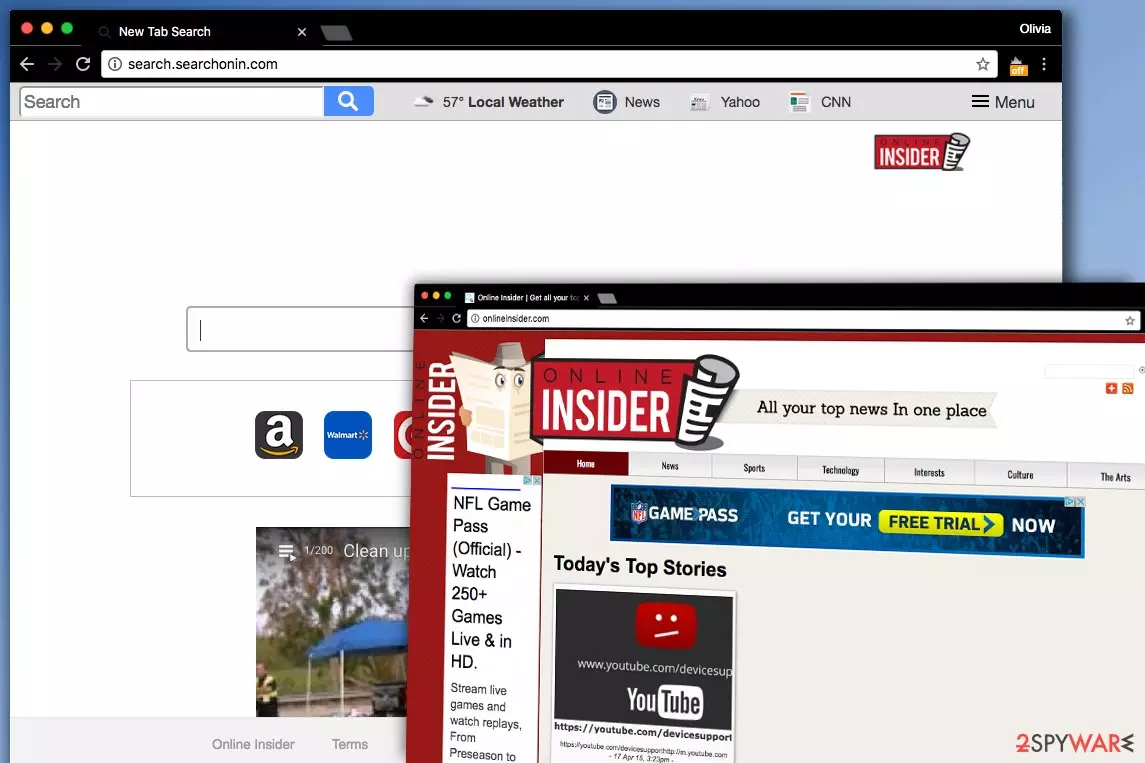
Search.searchonin.com (by Polarity Technologies, Ltd.) is a search site that appears in web browsers after installing the Online Insider extension[1] for Chrome. Once installed, it changes the default start page and search engine settings, making the victim experience redirects through query.searchonin.com on a daily basis. If you are looking for relevant search results, you should never count on a virus like this or any suspicious program.
The redirect virus has earned such title for its ability to reroute the victim to sites that one did not intend to visit. This potentially unwanted program (PUP) serves ads in the form of search results and convinces the victim to believe that these are regular search results. In fact, it provides modified Yahoo search results that are altered by Safer Browser virus.
| Name | Search.searchonin.com |
|---|---|
| Type | Browser hijacker |
| Symptoms | Redirects, affected browsing sessions, speed issues, changed the default homepage and search engine preferences |
| Issues | PUPs like this can access various information about users' habits online and even expose them to malicious online material |
| Distribution | Freeware installations, other PUPs, ransom sites, and torrent pages |
| Elimination | Removing the program can get difficult, so rely on the guide below or run the anti-malware tool to do that automatically |
| Repair | Recover system files and functions with system tools like FortectIntego |
Firstly, you should never use search tools that appear in your browser all of a sudden, and the same can be said about the unexpected and excessive amount of ads that appear on your screen. Clicking questionable search results or ads can trigger redirects to external sites of unknown reputation and make you encounter potentially dangerous content. In the worst scenario, you can even unknowingly install malware[2] on your computer.
Besides, this questionable search tool can collect data regarding your browsing habits, including, but not limited to:
- Phrases and keywords you use when searching the Internet;
- Browsing history;
- Ads and links that you click;
- Your IP address;
- Geolocation and related data.
Having such information allows the developers of this questionable tool to analyze your interests and then select ads based on the content you like. However, remember that these ads can be used as bait to lure you into vague web pages. In addition, if you enter some personal details when searching the web, such details are going to be transmitted to developers of Search.searchonin as well.

To protect your privacy while browsing the world wide web, LesVirus.fr experts recommend[3] you remove the browser hijacker. To clean your browser from its remains, consider using anti-malware software like MalwarebytesMalwarebytes or SpyHunterCombo Cleaner. However, it is not necessary to use automatic spyware or malware removal tools if you do not want to. You can also rely on the Search.searchonin.com removal instructions we prepared – we provided them below the article.
Distribution of browser hijacking extensions and programs
You can encounter potentially unwanted programs while browsing through various file-sharing sites, but most frequently these programs hide in installers of well-known and popular free programs. In the majority of cases, you can find them in games or media streaming software.
When installing free programs, pay attention to the installation options provided to you. Do not rush and pick the right option to install your download. Usually, software installers suggest choosing Default/Standard installation settings, offering them as the “safe and easy option” to set up your preferred program. Sadly, these installation options often hide additional components that will be installed alongside your download.
For this reason, you should always pick Custom or Advanced settings and drop unwanted elements by deselecting them.
Efficient Search.searchonin.com removal technique
If you want to find a quick and easy way to remove the virus, read the tutorial provided below the article. It explains how to uninstall potentially unwanted programs and delete the components they dropped on your computer system.
A clever way to complete Search.searchonin.com removal is to perform a system scan using anti-malware software. It helps to locate and eliminate software that uses sophisticated obfuscation methods and attempts to avoid detection.
Uninstall from Windows
Uninstall from Windows 10/8:
- Type Control Panel into the Windows search box and open the result.
- Under Programs, select Uninstall a program.


Uninstall from Windows 7/XP:
- Click on Windows Start > Control Panel (Windows XP users should click on Add/Remove Programs).
- In Control Panel, select Programs > Uninstall a program.


Remove the unwanted program:
- In the Programs and Features window, look for any recently installed suspicious entries, select them, and click Uninstall.
- If User Account Control appears, click Yes to confirm, then complete the removal.


Delete from macOS
Remove the unwanted application:
- From the menu bar, select Go > Applications.
- In the Applications folder, look for any suspicious entries, then drag them to Trash (or right-click and pick Move to Trash).


Delete leftover files and folders:
- Select Go > Go to Folder.
- Enter /Library/Application Support and remove any suspicious folders related to the unwanted program.
- Repeat the same check in the /Library/LaunchAgents and /Library/LaunchDaemons folders, deleting any suspicious entries.

- Finally, empty the Trash to permanently remove the leftovers.

Remove from Microsoft Edge
Delete unwanted extensions from MS Edge:
- Select Menu (three horizontal dots at the top-right of the browser window) and pick Extensions.
- From the list, pick the extension and click on the Gear icon.
- Click Remove.


Clear cookies and other browser data:
- Click on the Menu (three horizontal dots at the top-right of the browser window) and select Settings > Privacy, search, and services..
- Under Clear browsing data, pick Choose what to clear.
- Select Cookies and other site data and Cached images and files. (apart from passwords, although you might want to include Media licenses as well, if applicable) and click on Clear.


Restore new tab and homepage settings:
- Click the menu icon and choose Settings.
- Then find On startup section.
- Click Remove next to any suspicious startup page.
Reset MS Edge if the above steps did not work:
- Press on Ctrl + Shift + Esc to open Task Manager.
- Click on More details arrow at the bottom of the window.
- Select Details tab.
- Now scroll down and locate every entry with Microsoft Edge name in it. Right-click on each of them and select End Task to stop MS Edge from running.


Instructions for Chromium-based Edge
Delete extensions from MS Edge (Chromium):
- Open Edge and click select Settings > Extensions.
- Delete unwanted extensions by clicking Remove.


Clear cache and site data:
- Click on Menu and go to Settings.
- Select Privacy, search and services.
- Under Clear browsing data, pick Choose what to clear.
- Under Time range, pick All time.
- Select Clear now.


Reset Chromium-based MS Edge:
- Click on Menu and select Settings.
- On the left side, pick Reset settings.
- Select Restore settings to their default values.
- Confirm with Reset.
- This will disable extensions and reset startup pages but will not delete bookmarks, saved passwords, or browsing history.


Remove from Mozilla Firefox (FF)
Remove dangerous extensions:
- Open Mozilla Firefox browser and click on the Menu (three horizontal lines at the top-right of the window).
- Select Add-ons.
- In here, select the unwanted extension and click Remove.


Reset the homepage:
- Click three horizontal lines at the top right corner to open the menu.
- Choose Settings.
- Under Home, set your preferred homepage and new tab settings.
Clear cookies and site data:
- Click Menu and pick Settings.
- Go to Privacy & Security section.
- Scroll down to locate Cookies and Site Data.
- Click on Clear Data...
- Select Cookies and Site Data and Temporary cached files and pages, then click Clear.


Reset Mozilla Firefox
If clearing the browser as explained above did not help, reset Mozilla Firefox:
- Open Mozilla Firefox browser and click the Menu.
- Go to Help and then choose Troubleshooting Information.

- Under Give Firefox a tune up section, click on Refresh Firefox...
- Once the pop-up shows up, confirm the action by pressing on Refresh Firefox.



Remove from Google Chrome
Delete malicious extensions from Google Chrome:
- Open Google Chrome, click on the Menu (three vertical dots at the top-right corner) and select More tools > Extensions.
- In the newly opened window, you will see all the installed extensions. Uninstall all suspicious extensions related to the unwanted program by clicking Remove.


Clear cache and web data from Chrome:
- Click on Menu and pick Settings.
- Under Privacy and security, select Clear browsing data.
- Select Browsing history, Cookies and other site data, as well as Cached images and files.
- Click Clear data.


Change your homepage:
- Click menu and choose Settings.
- Look for a suspicious site in the On startup section.
- Click on Open a specific or set of pages and click on three dots to find the Remove option.
Reset Google Chrome:
If the previous methods did not help you, reset Google Chrome to eliminate all the unwanted components:
- Click on Menu and select Settings.
- In the Settings, scroll down and click Advanced.
- Scroll down and locate Reset and clean up section.
- Now click Restore settings to their original defaults.
- Confirm with Reset settings.


Delete from Safari
Remove dangerous extensions:
- Open Safari, click Safari in the menu at the top-left of the screen, and select Preferences.
- Go to the Extensions tab, look for any suspicious entries, and click Uninstall to remove them.


Clear history and website data:
- Click Safari in the menu and pick Clear History.
- Set Clear to all history and confirm with Clear History.


Reset Safari:
- Click Safari in the menu and select Preferences > Advanced.
- Enable Show Develop menu in menu bar.
- From the menu bar, click Develop and select Empty Caches.


Did this guide help?
Be the first to comment