

Tyrant is a new cyber threat for computer users in Arabic countries
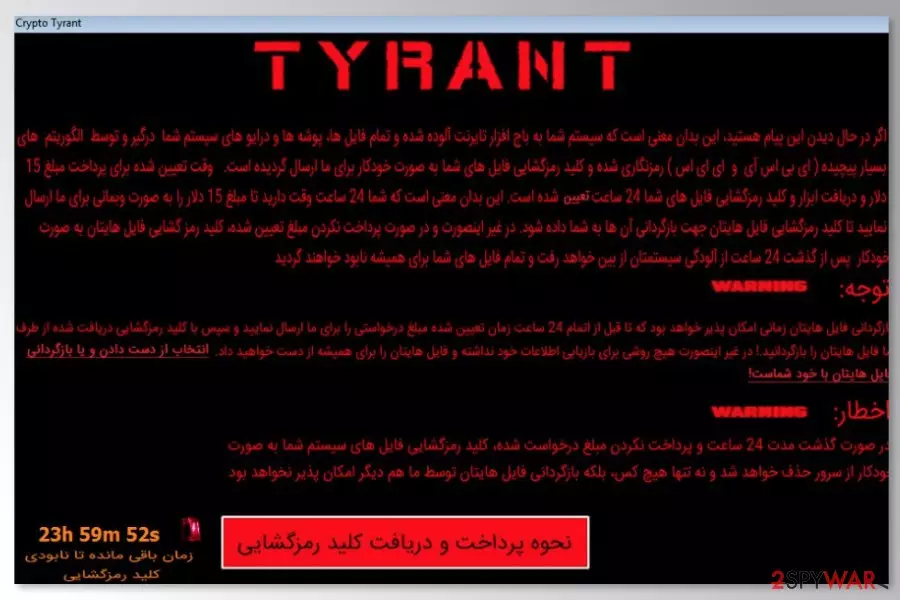
Tyrant is a file-encrypting virus that seems to target Arabic computer users. It encrypts files using AES[1] encryption and runs a ransom note where victims are asked to pay $15 for data recovery. These demands have to be completed within 24 hours time.
According to the research analysis, two executable files – DUMB.exe and locker.exe – are associated with Tyrant virus. As soon as malicious program infiltrates the system, it makes some changes to Windows system and encrypts various targeted files. Then it informs victims about data encryption and asks to pay the ransom.
Malware runs a “Crypto Tyrant” program that presents data recovery instructions which are written in the Persian language. You can read the translated text below:
Your files are encrypted. You have 24 hours to pay a ransom of $15 dollars. Further redemption amount will depend on the period that has elapsed since 24 hours …
The decipherer of the files will be sent after payment is received. If you have any questions, please contact us by email, we will answer you …
Praise be to Allah, and in the Hereafter!
It seems that Crypto Tyrant ransomware aims at the small amount of computer users who live in Iran or other Arabic countries. However, it doesn’t mean that users in Europe or the United States cannot get infected with this crypto-malware.
Even though cyber-criminals demand a small ransom, victims are still not advised to pay it. Even 15 dollars is a motivation for the hackers to continue they illegal work and create more sophisticated infections. Thus, you should focus on Tyrant removal instead of hoping that criminals will keep their promise and provide the decryption software.
In order to remove Tyrant virus, you have to obtain a professional security program and run a full system scan. Our team recommends choosing FortectIntego for this task. However, you can choose any other software, but don’t forget to update it first to wipe out all malicious content from the device.

The ways how file-encrypting virus spreads
Tyrant, as well as other ransomware-type cyber threats, are most likely to be distributed via malicious spam emails. Typically they include a malicious attachment that is presented as a useful document, invoice or statement. Therefore, users are easily tricked by the safe look of the attachment.
Security experts from the Netherlands[2] warn that people have to be not only vigilant with received emails but also avoid downloading illegal content,[3] software from unreliable sources and stay away from suspicious ads. Malicious programs spread using various techniques, thus it;s important to watch your clicks to avoid ransomware attack.
Additionally, users are advised to install a reputable antivirus program and create backups that will be crucial in case of ransomware infiltration.
The correct way to eliminate Tyrant virus
Ransomware is one of the most dangerous and complicated cyber threats. Thus, Tyrant removal should be completed properly. The virus may have affected various system processes and installed other damaging files or programs. Sometimes malware might open a backdoor. Hence, your computer is in danger.
The safe and correct way to remove Tyrant is to obtain a reputable malware removal tool, such as FortectIntego or MalwarebytesMalwarebytes, and get rid of the virus automatically. In order to install and run a security program, users have to reboot their computers to Safe Mode with Networking as shown in the instructions below.
Did this guide help?
Be the first to comment