

Search60.com is a browser-hijacking app you should not ignore
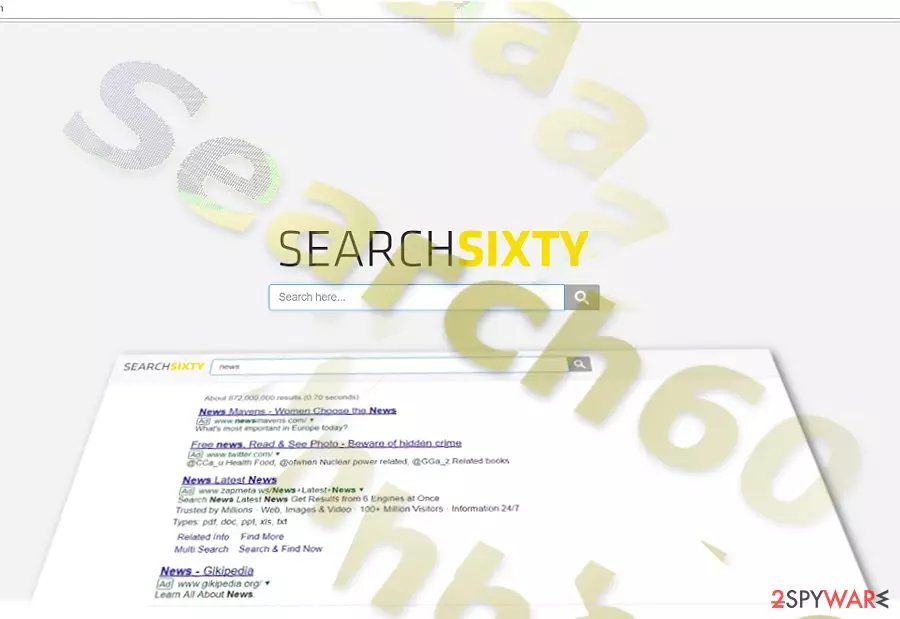
Search60.com is a deceptive search tool that has a plain homepage design. Despite this, it does not change the fact that it is a potentially unwanted application that most commonly does not arrive on users' systems intentionally. Once installed, it changes the preferences of Google Chrome or another browser and sets its URL as a preferred search provider. Later, the top results provided are usually littered with ads and promotional links.
Let us assure you that it does not hijack your browser nor plagues you with ads. On the other hand, such a scenario is possible due to the scarce privacy policy and the absence of HTTP protocol[1]. Therefore, you might want to remove the PUP from the browser if you get redirected there often.
| Name | Search60.com |
| Type | Browser hijacker |
| Distribution | Third-party websites |
| Symptoms | Changes to homepage and new tab URL; search results filled with sponsored links |
| Uninstall | You can get rid of the browser hijacker by either scanning the device with antivirus software or following manual instructions |
| System fix | After the elimination of adware or malware, we highly recommend running a scan with FortectIntego repair software |
Other negative aspects
The search engine delivers the search results from its own database. In comparison with other search engines Google, Yahoo, or Bing, Sixty60 provides fewer results. Furthermore, this search tool does not support security plug-ins[2]. This is one of the major flaws, especially if you value cybersecurity. Without it, the risk of visiting infected site increases.
The “About us” section does not leave a positive impression either:
Search 60 are firmly positioned as global leaders in search engine marketing and web traffic generation. Founded on the vision that no goal is too ambitious, Search 60 has evolved into a leading global provider of search-based advertising to publishers globally.
It mentions that no personal information is collected, only non-personal which includes IP address and browsing history. This data is said to be used for service improvement. They also mention that the tool contains multiple links to third parties. They are not obviously visible, so redirects are possible. Due to it, you might get directed to quite insecure websites.
Lastly, the search tool emphasizes that the privacy policy only applies to hotsearchresults.com site, though it does seem to work properly. Due to these aspects, the search tool has been labeled as a browser hijacker. Likewise, there are more than enough reasons to start its removal. FortectIntego or MalwarebytesMalwarebytes comes in handy in this situation.

PUP promotion techniques
Because this search tool includes links to external sites, it is possible that the hijacker might be promoted in sponsored domains. In that, clicking on an ad or video link directs you to Search60.
Alternatively, the search tool might be promoted as an additional plug-in to free file editors and media players. However, due to an underdeveloped network of this search tool, it is unlikely. In any case, to stop the installation of an unwanted program, opt for “Custom” mode.
It will disclose optional tools, and you will be able to deselect them before the installation. Likewise, if you pick “Recommended” or “Quick,” you are more likely not to notice which optional apps are recommended for you (this is a very well-known trick used by software distributors).
Eliminate the hijacker
It is not aggressive as typical browser hijackers. On the other hand, if you get redirected here once in a while, you might want to remove Search60.com and its associated files. You can do so with the assistance of a malware elimination tool, although you should not forget to bring it to the latest version before performing a full system scan.
Alternatively, you can delete the hijacker scripts manually as well. In that case, follow below manual removal instructions below. You should not only look at the installed programs list but also check your web browsers carefully. Note that the search engine may appear not only in English but in Russian[3] or Spanish sites.
Uninstall from Windows
Uninstall from Windows 10/8:
- Type Control Panel into the Windows search box and open the result.
- Under Programs, select Uninstall a program.


Uninstall from Windows 7/XP:
- Click on Windows Start > Control Panel (Windows XP users should click on Add/Remove Programs).
- In Control Panel, select Programs > Uninstall a program.


Remove the unwanted program:
- In the Programs and Features window, look for any recently installed suspicious entries, select them, and click Uninstall.
- If User Account Control appears, click Yes to confirm, then complete the removal.


Delete from macOS
Remove the unwanted application:
- From the menu bar, select Go > Applications.
- In the Applications folder, look for any suspicious entries, then drag them to Trash (or right-click and pick Move to Trash).


Delete leftover files and folders:
- Select Go > Go to Folder.
- Enter /Library/Application Support and remove any suspicious folders related to the unwanted program.
- Repeat the same check in the /Library/LaunchAgents and /Library/LaunchDaemons folders, deleting any suspicious entries.

- Finally, empty the Trash to permanently remove the leftovers.

Remove from Microsoft Edge
Delete unwanted extensions from MS Edge:
- Select Menu (three horizontal dots at the top-right of the browser window) and pick Extensions.
- From the list, pick the extension and click on the Gear icon.
- Click Remove.


Clear cookies and other browser data:
- Click on the Menu (three horizontal dots at the top-right of the browser window) and select Settings > Privacy, search, and services..
- Under Clear browsing data, pick Choose what to clear.
- Select Cookies and other site data and Cached images and files. (apart from passwords, although you might want to include Media licenses as well, if applicable) and click on Clear.


Restore new tab and homepage settings:
- Click the menu icon and choose Settings.
- Then find On startup section.
- Click Remove next to any suspicious startup page.
Reset MS Edge if the above steps did not work:
- Press on Ctrl + Shift + Esc to open Task Manager.
- Click on More details arrow at the bottom of the window.
- Select Details tab.
- Now scroll down and locate every entry with Microsoft Edge name in it. Right-click on each of them and select End Task to stop MS Edge from running.


Instructions for Chromium-based Edge
Delete extensions from MS Edge (Chromium):
- Open Edge and click select Settings > Extensions.
- Delete unwanted extensions by clicking Remove.


Clear cache and site data:
- Click on Menu and go to Settings.
- Select Privacy, search and services.
- Under Clear browsing data, pick Choose what to clear.
- Under Time range, pick All time.
- Select Clear now.


Reset Chromium-based MS Edge:
- Click on Menu and select Settings.
- On the left side, pick Reset settings.
- Select Restore settings to their default values.
- Confirm with Reset.
- This will disable extensions and reset startup pages but will not delete bookmarks, saved passwords, or browsing history.


Remove from Mozilla Firefox (FF)
Remove dangerous extensions:
- Open Mozilla Firefox browser and click on the Menu (three horizontal lines at the top-right of the window).
- Select Add-ons.
- In here, select the unwanted extension and click Remove.


Reset the homepage:
- Click three horizontal lines at the top right corner to open the menu.
- Choose Settings.
- Under Home, set your preferred homepage and new tab settings.
Clear cookies and site data:
- Click Menu and pick Settings.
- Go to Privacy & Security section.
- Scroll down to locate Cookies and Site Data.
- Click on Clear Data...
- Select Cookies and Site Data and Temporary cached files and pages, then click Clear.


Reset Mozilla Firefox
If clearing the browser as explained above did not help, reset Mozilla Firefox:
- Open Mozilla Firefox browser and click the Menu.
- Go to Help and then choose Troubleshooting Information.

- Under Give Firefox a tune up section, click on Refresh Firefox...
- Once the pop-up shows up, confirm the action by pressing on Refresh Firefox.



Remove from Google Chrome
Delete malicious extensions from Google Chrome:
- Open Google Chrome, click on the Menu (three vertical dots at the top-right corner) and select More tools > Extensions.
- In the newly opened window, you will see all the installed extensions. Uninstall all suspicious extensions related to the unwanted program by clicking Remove.


Clear cache and web data from Chrome:
- Click on Menu and pick Settings.
- Under Privacy and security, select Clear browsing data.
- Select Browsing history, Cookies and other site data, as well as Cached images and files.
- Click Clear data.


Change your homepage:
- Click menu and choose Settings.
- Look for a suspicious site in the On startup section.
- Click on Open a specific or set of pages and click on three dots to find the Remove option.
Reset Google Chrome:
If the previous methods did not help you, reset Google Chrome to eliminate all the unwanted components:
- Click on Menu and select Settings.
- In the Settings, scroll down and click Advanced.
- Scroll down and locate Reset and clean up section.
- Now click Restore settings to their original defaults.
- Confirm with Reset settings.


Delete from Safari
Remove dangerous extensions:
- Open Safari, click Safari in the menu at the top-left of the screen, and select Preferences.
- Go to the Extensions tab, look for any suspicious entries, and click Uninstall to remove them.


Clear history and website data:
- Click Safari in the menu and pick Clear History.
- Set Clear to all history and confirm with Clear History.


Reset Safari:
- Click Safari in the menu and select Preferences > Advanced.
- Enable Show Develop menu in menu bar.
- From the menu bar, click Develop and select Empty Caches.


Did this guide help?
Be the first to comment