

Reasons to scan your computer after noticing Feed.incognitosearches.com in your browser's URL bar
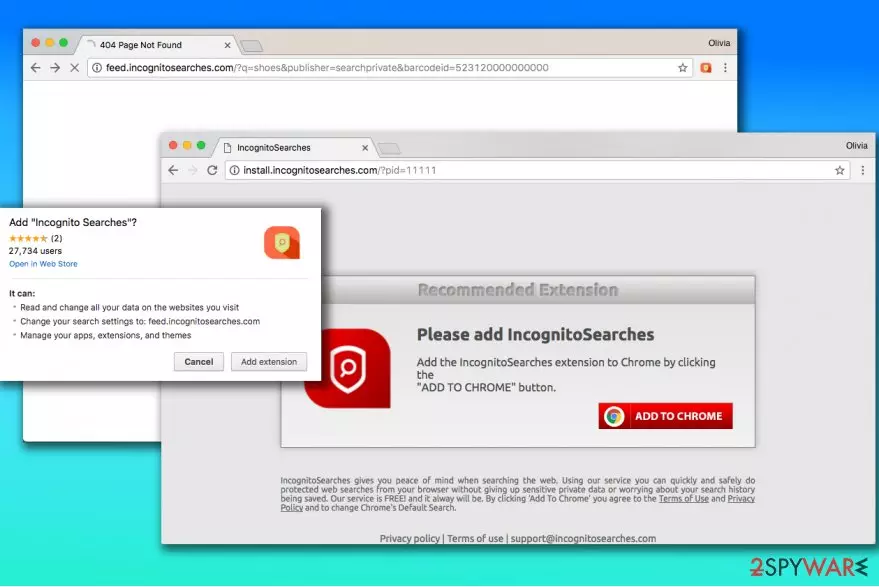
Feed.incognitosearches.com is an untrustworthy domain associated with a potentially unwanted program (PUP) called Incognito Searches. Once installed, it replaces current browser’s search settings and allows launching private browsing mode during each browsing session. Unfortunately, it also fills search results with deceptive ads[1] and poses a threat to user’s security.
IncognitoSearches.com aims to convince the user that searching in private mode ensures user’s privacy. However, the extension it promotes cannot be called trustworthy. First of all, it collects each search phrase entered into browser’s URL bar.
Besides, it redirects the user to incognito mode[2] only when searching via search box that appears after clicking the Incognito Searches extension icon. Since users tend to rely on browser’s bar more frequently, it means that the described potentially unwanted program is basically useless.
At first, it seems that this browser hijacker simply serves Yahoo search results. Unfortunately, if you compared the URL address after performing a search via yahoo.com and via Feed.incognitosearches.com, you would notice that the latter tracks your IP address. You can see the difference between regular URL and the one serving altered search results in the picture below.
Keep in mind that the unwanted search tool can track your search queries, IP address, clicks, downloads, and even more information without letting you know. We believe that the user should not be attacked with advertisements based on daily online activities, especially when such tracking happens without user’s knowledge. That is just one of the reasons why we recommend you to remove Feed.incognitosearches.com from your browser.
If you want to reset your browser’s settings, you should know that it won’t be possible as long as the described hijacker stays on the system. You must find and eliminate all of its components and complete full Feed.incognitosearches.com removal in order to perform any changes regarding browser’s settings. We highly suggest using anti-spyware software like FortectIntego as it can quickly identify and delete hijackers keeping control of your browser’s settings.
Of course, you can always opt for manual uninstall option and delete the Incognito Searches virus using typical browser hijacker removal instructions customized by our experts.

Ways of installing unwanted search tools
Many computer users install unwanted or unknown browser tools, extensions, and other spyware-type applications during installation of well-known free programs. The problem is that developers of free programs still need to monetize their services somehow, so they often opt for a pay-per-install revenue model. All they have to do is to suggest installing vague third-party applications in a bundle with their products. As a consequence, users may install programs like Incognito Searches.
First of all, this is not useful for them in terms of their reputation. Inexperienced computer users hardly spot the difference between several apps, especially because they do not even know about installation of additional programs at all. All they notice is that “pop-ups and ads, browser redirects and other problems” started bothering them after installation of a particular program.
The main issue is that users tend to install new downloads hastily, and that is why they end up with a couple of programs on their computers instead of one, say experts from Utanvirus.se[3]. To drop off unwanted components, we highly recommend selecting Custom or Advanced installation settings.
While these installation options allow rejecting unwanted extras, bear in mind that Default or Standard options won’t. That is why we do not recommend relying on them.
In addition, the described hijacker is promoted via install.incognitosearches.com/?pid=11111 page. If you were redirected to this site, we strongly advise closing it immediately.
Remove Incognitosearches.com hijacker in a few easy steps
If your computer is compromised by Incognitosearches.com virus already, do not delay its removal any longer. The first thing you want to do is to choose how you want to uninstall it – manually or automatically.
To remove Feed.Incognitosearches.com, we strongly suggest using instructions provided below this article. We have added screenshots that will help you to navigate through computer’s panels and configure the right settings safely.
To finish Feed.incognitosearches.com removal, consider using one of the provided anti-spyware or anti-malware solutions. While we do not insist on using automated tools for spyware removal, we have to say that can significantly ease the process and help you save some time.
Uninstall from Windows
Uninstall from Windows 10/8:
- Type Control Panel into the Windows search box and open the result.
- Under Programs, select Uninstall a program.


Uninstall from Windows 7/XP:
- Click on Windows Start > Control Panel (Windows XP users should click on Add/Remove Programs).
- In Control Panel, select Programs > Uninstall a program.


Remove the unwanted program:
- In the Programs and Features window, look for any recently installed suspicious entries, select them, and click Uninstall.
- If User Account Control appears, click Yes to confirm, then complete the removal.


Delete from macOS
Remove the unwanted application:
- From the menu bar, select Go > Applications.
- In the Applications folder, look for any suspicious entries, then drag them to Trash (or right-click and pick Move to Trash).


Delete leftover files and folders:
- Select Go > Go to Folder.
- Enter /Library/Application Support and remove any suspicious folders related to the unwanted program.
- Repeat the same check in the /Library/LaunchAgents and /Library/LaunchDaemons folders, deleting any suspicious entries.

- Finally, empty the Trash to permanently remove the leftovers.

Reset Internet Explorer
Remove dangerous add-ons:
- Open Internet Explorer, click on the Gear icon (IE menu) on the top-right corner of the browser
- Pick Manage Add-ons.
- You will see a Manage Add-ons window. Here, look for suspicious plugins. Click on these entries and select Disable.


Change your homepage if it was altered:
- Open IE and click on the Gear icon.
- Select Internet Options.
- In the General tab, delete the Home page address and replace it by your preferred one (for example, Google.com).
- Click Apply and then select OK.


Delete temporary files:
- Press on the Gear icon and select Internet Options.
- Under Browsing history, click Delete...
- Select relevant fields and press Delete.


Reset Internet Explorer:
- Click on Gear icon > Internet options and select Advanced tab.
- Select Reset.
- In the new window, check Delete personal settings and select Reset.


Remove from Microsoft Edge
Delete unwanted extensions from MS Edge:
- Select Menu (three horizontal dots at the top-right of the browser window) and pick Extensions.
- From the list, pick the extension and click on the Gear icon.
- Click Remove.


Clear cookies and other browser data:
- Click on the Menu (three horizontal dots at the top-right of the browser window) and select Settings > Privacy, search, and services..
- Under Clear browsing data, pick Choose what to clear.
- Select Cookies and other site data and Cached images and files. (apart from passwords, although you might want to include Media licenses as well, if applicable) and click on Clear.


Restore new tab and homepage settings:
- Click the menu icon and choose Settings.
- Then find On startup section.
- Click Remove next to any suspicious startup page.
Reset MS Edge if the above steps did not work:
- Press on Ctrl + Shift + Esc to open Task Manager.
- Click on More details arrow at the bottom of the window.
- Select Details tab.
- Now scroll down and locate every entry with Microsoft Edge name in it. Right-click on each of them and select End Task to stop MS Edge from running.


Instructions for Chromium-based Edge
Delete extensions from MS Edge (Chromium):
- Open Edge and click select Settings > Extensions.
- Delete unwanted extensions by clicking Remove.


Clear cache and site data:
- Click on Menu and go to Settings.
- Select Privacy, search and services.
- Under Clear browsing data, pick Choose what to clear.
- Under Time range, pick All time.
- Select Clear now.


Reset Chromium-based MS Edge:
- Click on Menu and select Settings.
- On the left side, pick Reset settings.
- Select Restore settings to their default values.
- Confirm with Reset.
- This will disable extensions and reset startup pages but will not delete bookmarks, saved passwords, or browsing history.


Remove from Mozilla Firefox (FF)
Remove dangerous extensions:
- Open Mozilla Firefox browser and click on the Menu (three horizontal lines at the top-right of the window).
- Select Add-ons.
- In here, select the unwanted extension and click Remove.


Reset the homepage:
- Click three horizontal lines at the top right corner to open the menu.
- Choose Settings.
- Under Home, set your preferred homepage and new tab settings.
Clear cookies and site data:
- Click Menu and pick Settings.
- Go to Privacy & Security section.
- Scroll down to locate Cookies and Site Data.
- Click on Clear Data...
- Select Cookies and Site Data and Temporary cached files and pages, then click Clear.


Reset Mozilla Firefox
If clearing the browser as explained above did not help, reset Mozilla Firefox:
- Open Mozilla Firefox browser and click the Menu.
- Go to Help and then choose Troubleshooting Information.

- Under Give Firefox a tune up section, click on Refresh Firefox...
- Once the pop-up shows up, confirm the action by pressing on Refresh Firefox.



Remove from Google Chrome
Delete malicious extensions from Google Chrome:
- Open Google Chrome, click on the Menu (three vertical dots at the top-right corner) and select More tools > Extensions.
- In the newly opened window, you will see all the installed extensions. Uninstall all suspicious extensions related to the unwanted program by clicking Remove.


Clear cache and web data from Chrome:
- Click on Menu and pick Settings.
- Under Privacy and security, select Clear browsing data.
- Select Browsing history, Cookies and other site data, as well as Cached images and files.
- Click Clear data.


Change your homepage:
- Click menu and choose Settings.
- Look for a suspicious site in the On startup section.
- Click on Open a specific or set of pages and click on three dots to find the Remove option.
Reset Google Chrome:
If the previous methods did not help you, reset Google Chrome to eliminate all the unwanted components:
- Click on Menu and select Settings.
- In the Settings, scroll down and click Advanced.
- Scroll down and locate Reset and clean up section.
- Now click Restore settings to their original defaults.
- Confirm with Reset settings.


Delete from Safari
Remove dangerous extensions:
- Open Safari, click Safari in the menu at the top-left of the screen, and select Preferences.
- Go to the Extensions tab, look for any suspicious entries, and click Uninstall to remove them.


Clear history and website data:
- Click Safari in the menu and pick Clear History.
- Set Clear to all history and confirm with Clear History.


Reset Safari:
- Click Safari in the menu and select Preferences > Advanced.
- Enable Show Develop menu in menu bar.
- From the menu bar, click Develop and select Empty Caches.


Did this guide help?
Be the first to comment