A step-by-step removal guide for affected devices. Follow the verified procedure below — most readers complete it in under 10 minutes.
Alice Woods· Likes to teach users about virus prevention
Home.musicktab.com is a browser hijacker which promises useful features
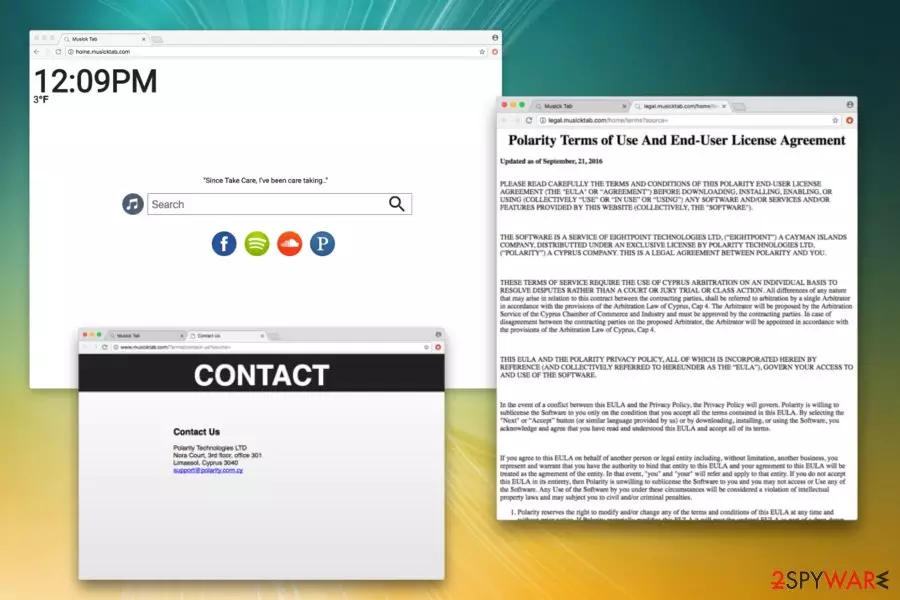
Home.musicktab.com is classified as a browser hijacker by security experts[1]. It is known to interrupt browsing sessions with invasive ads, redirects and altered browser settings on Google Chrome, Internet Explorer, Mozilla Firefox, Safari or similar browsers. It is closely related to Search.musicktab.com and visually looks almost identical. This dubious app was created by Polarity Technologies Ltd – a notorious company which produces multiple browser hijackers on a regular basis.
As the name suggests, Musick Tab offers multiple shortcuts to various music platforms and sites. You will find quick access buttons for Spotify, Soundcloud and not-so-known and questionable music platform called Pandora (it is only operated in the US). Links to social media giant Facebook are present as well, just like time and weather forecasts. As evident, developers at trying their best to make users believe that their application is a convenient way to browse the internet.
However, right after system hijack,[2] virus alters web browser settings and sets new tab URL, search engine and homepage to home.musicktab.com. At this point, if a user tries to reset his browser settings, he will not be successful as questionable app merely reapplies its settings after every attempt made. Thus, a user is forced to browse through a hijacked search engine, which does not bring any benefit for the victim. What lies ahead is only trouble and frustration from user's point of view.
The presence of a Musick tab virus is noticeable right after users open internet browser. It might seem normal at the start – some people might not pay attention to an unusual homepage. However, after they start their browsing session, they might notice that some of the websites that they regularly visit are covered in a layer of ads, popups, and banners which used never to appear before.
Developers use these ads to generate revenue from third-parties. Thus, do not let them monetize on the expense of your flawless browsing sessions – remove Home.musicktab.com from your machine immediately! You can use a robust security software which can help you eliminate all the unwanted programs in just a few minutes – such as FortectIntego.
While ads might be frustrating to deal with – they are not the primary users’ concern, as long as they do not click on any links provided by home.musicktab.com. While app on its own is not dangerous as it does not break any system files – redirects can cause tremendous damage to the computer. These redirects might lead users to hazardous websites where malicious JavaScripts download and install malware.
It is evident that browser hijacker is not a welcomed guest to any regular user, as nobody likes to deal with frustrating ads and redirects, which make internet browsing slow and inconvenient. Musick Tab removal is the only possible way to keep your computer malware-free and have smooth browsing activity again.
Watch out when you install free software from the internet – it might hide unwanted programs!
Bundling[3] is a well-known distribution method used by free software developers continuously; mainly because it is incredibly successful in installing applications which users never asked for. Hence, being extremely vigilant while installing free software should be everybody’s priority.
Before selecting an application to install, make sure you check the source it is coming from and whether on not is genuine and useful. Usually, a tremendous amount of reviews, comments, and articles can be found all over the internet; thus, make sure you read them.
After starting the installation process, make sure to opt for Advanced/Custom settings and avoid Recommended/Quick setup entirely. Developers always encourage users picking the latter as it does not adequately disclose the list of all programs which will be installed. Therefore, while in Advanced mode, read every detail properly and uncheck any pre-selected tick boxes. It might be search engines, optimization tools, add-ons and similar useless software.
Home.musicktab.com removal is an essential action for risk-free browsing sessions
If you were unlucky enough and got infected with Musick Tab virus, do not panic as your computer can be fixed easily as long as you do not delay Home.musicktab.com removal. There are two ways you can get rid of the unwelcome intruder: manual and automatic.
Manual elimination method should only be performed by computer-savvy individuals as the process might be too confusing for inexperienced users. Make sure you follow our step-by-step guide below this article and make no mistakes during the process.
However, you should remove Musick Tab automatically if you want to protect yourself from unwanted malware attacks in the future. Also, security software is a professional tool designed to deal with PUPs, adware, and malware exceptionally quickly.
Uninstall from Windows
Uninstall from Windows 10/8:
Type Control Panel into the Windows search box and open the result.
Under Programs, select Uninstall a program.
Uninstall from Windows 7/XP:
Click on Windows Start > Control Panel (Windows XP users should click on Add/Remove Programs).
In Control Panel, select Programs > Uninstall a program.
Remove the unwanted program:
In the Programs and Features window, look for any recently installed suspicious entries, select them, and click Uninstall.
If User Account Control appears, click Yes to confirm, then complete the removal.
Delete from macOS
Remove the unwanted application:
From the menu bar, select Go > Applications.
In the Applications folder, look for any suspicious entries, then drag them to Trash (or right-click and pick Move to Trash).
Delete leftover files and folders:
Select Go > Go to Folder.
Enter /Library/Application Support and remove any suspicious folders related to the unwanted program.
Repeat the same check in the /Library/LaunchAgents and /Library/LaunchDaemons folders, deleting any suspicious entries.
Finally, empty the Trash to permanently remove the leftovers.
Reset Internet Explorer
Remove dangerous add-ons:
Open Internet Explorer, click on the Gear icon (IE menu) on the top-right corner of the browser
Pick Manage Add-ons.
You will see a Manage Add-ons window. Here, look for suspicious plugins. Click on these entries and select Disable.
Change your homepage if it was altered:
Open IE and click on the Gear icon.
Select Internet Options.
In the General tab, delete the Home page address and replace it by your preferred one (for example, Google.com).
Click Apply and then select OK.
Delete temporary files:
Press on the Gear icon and select Internet Options.
Under Browsing history, click Delete...
Select relevant fields and press Delete.
Reset Internet Explorer:
Click on Gear icon > Internet options and select Advanced tab.
Select Reset.
In the new window, check Delete personal settings and select Reset.
Remove from Microsoft Edge
Delete unwanted extensions from MS Edge:
Select Menu (three horizontal dots at the top-right of the browser window) and pick Extensions.
From the list, pick the extension and click on the Gear icon.
Click Remove.
Clear cookies and other browser data:
Click on the Menu (three horizontal dots at the top-right of the browser window) and select Settings > Privacy, search, and services..
Under Clear browsing data, pick Choose what to clear.
Select Cookies and other site data and Cached images and files. (apart from passwords, although you might want to include Media licenses as well, if applicable) and click on Clear.
Restore new tab and homepage settings:
Click the menu icon and choose Settings.
Then find On startup section.
Click Remove next to any suspicious startup page.
Reset MS Edge if the above steps did not work:
Press on Ctrl + Shift + Esc to open Task Manager.
Click on More details arrow at the bottom of the window.
Select Details tab.
Now scroll down and locate every entry with Microsoft Edge name in it. Right-click on each of them and select End Task to stop MS Edge from running.
Instructions for Chromium-based Edge
Delete extensions from MS Edge (Chromium):
Open Edge and click select Settings > Extensions.
Delete unwanted extensions by clicking Remove.
Clear cache and site data:
Click on Menu and go to Settings.
Select Privacy, search and services.
Under Clear browsing data, pick Choose what to clear.
Under Time range, pick All time.
Select Clear now.
Reset Chromium-based MS Edge:
Click on Menu and select Settings.
On the left side, pick Reset settings.
Select Restore settings to their default values.
Confirm with Reset.
This will disable extensions and reset startup pages but will not delete bookmarks, saved passwords, or browsing history.
Remove from Mozilla Firefox (FF)
Remove dangerous extensions:
Open Mozilla Firefox browser and click on the Menu (three horizontal lines at the top-right of the window).
Select Add-ons.
In here, select the unwanted extension and click Remove.
Reset the homepage:
Click three horizontal lines at the top right corner to open the menu.
Choose Settings.
Under Home, set your preferred homepage and new tab settings.
Clear cookies and site data:
Click Menu and pick Settings.
Go to Privacy & Security section.
Scroll down to locate Cookies and Site Data.
Click on Clear Data...
Select Cookies and Site Data and Temporary cached files and pages, then click Clear.
Reset Mozilla Firefox
If clearing the browser as explained above did not help, reset Mozilla Firefox:
Open Mozilla Firefox browser and click the Menu.
Go to Help and then choose Troubleshooting Information.
Under Give Firefox a tune up section, click on Refresh Firefox...
Once the pop-up shows up, confirm the action by pressing on Refresh Firefox.
Remove from Google Chrome
Delete malicious extensions from Google Chrome:
Open Google Chrome, click on the Menu (three vertical dots at the top-right corner) and select More tools > Extensions.
In the newly opened window, you will see all the installed extensions. Uninstall all suspicious extensions related to the unwanted program by clicking Remove.
Clear cache and web data from Chrome:
Click on Menu and pick Settings.
Under Privacy and security, select Clear browsing data.
Select Browsing history, Cookies and other site data, as well as Cached images and files.
Click Clear data.
Change your homepage:
Click menu and choose Settings.
Look for a suspicious site in the On startup section.
Click on Open a specific or set of pages and click on three dots to find the Remove option.
Reset Google Chrome:
If the previous methods did not help you, reset Google Chrome to eliminate all the unwanted components:
Click on Menu and select Settings.
In the Settings, scroll down and click Advanced.
Scroll down and locate Reset and clean up section.
Now click Restore settings to their original defaults.
Confirm with Reset settings.
Delete from Safari
Remove dangerous extensions:
Open Safari, click Safari in the menu at the top-left of the screen, and select Preferences.
Go to the Extensions tab, look for any suspicious entries, and click Uninstall to remove them.
Clear history and website data:
Click Safari in the menu and pick Clear History.
Set Clear to all history and confirm with Clear History.
Reset Safari:
Click Safari in the menu and select Preferences > Advanced.
Enable Show Develop menu in menu bar.
From the menu bar, click Develop and select Empty Caches.






















































Be the first to comment