Current Me is an adware program which displays sponsored content on victims' favorite websites
Current Me is a shady application which is trying to trick users by promising useful features: weather forecasts, current time and beautiful backgrounds. However, security experts[1] have already warned PC users that this dubious program falls into adware[2] category. Ad-supported software is used to deliver mostly undesirable content to users and try to convince them to buy products or services they do not need.
Visual looks of Current Me virus might trick many users into believing, that this application is useful and fun to use. However, it is delivered to users’ machines via bundling – a well-known marketing technique used by free software developers. Just think about it – developers of such software would not waste their time and create it so that you can enjoy beautiful backgrounds for free – they do have ambiguous motives.
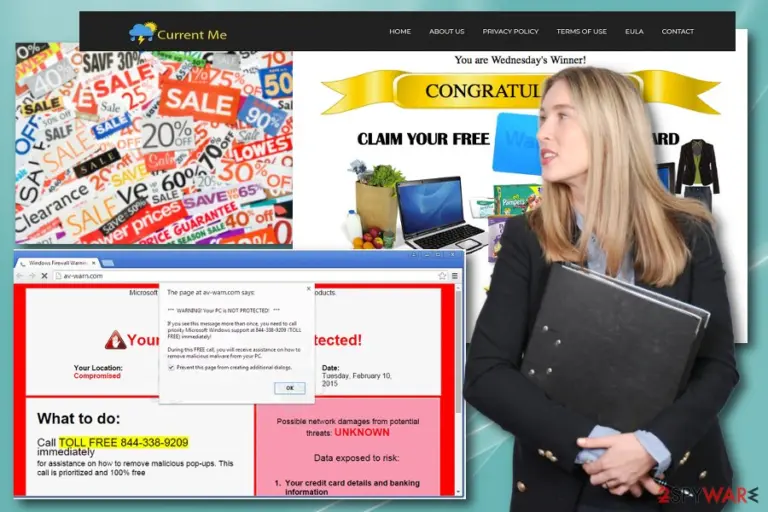
The motive is quite clear – to gain monetary benefit from traffic generated to sponsors’ websites. To achieve that, developers of Current Me often deliver numerous ads, banners, offers, deals, coupons and other pop-ups directly into users browsers (any browser can be affected, like Google Chrome, Internet Explorer, MS Edge, Mozilla Firefox, etc.).
Quite often, the displayed content invades websites which typically do not array any advertisements (like Amazon, Wikipedia, and similar well-known sites). Thus, some users might think that adverts are legitimate and provided by website originators. However, the culprit is adware. Current Me virus removal should be performed to avoid these pop-ups.
By far the most dangerous adware feature of Current Me virus is its redirecting tendencies. Users might end up on malware-ridden or phishing websites. Malware can damage your computer and its system files, making them unusable. Phishing websites might lead to severe consequences like stolen bank account information or identity theft. Hence, this activity is extremely perilous.
Also, Current Me adware program often gathers a variety of non-personally identifiable information,[3] such as:
IP address,
ISP;
geo-location;
search queries;
websites visited;
clicks on ads, etc.
The research concluded that this information is notably valuable for marketing purposes. It can be used to promote sponsors’ products and services, convincing users they are the best on the market.
Rather than providing “improved search results” and “enhanced browsing experience,” this dubious application will make users’ browsing sessions miserable as adware often installs additional components (like add-ons, toolbars, fake optimization tools, etc.) without victims’ consent.
Thus, we suggest you remove Current Me from your computer at once. FortectIntego is a fantastic tool which can help you with PUP elimination with ease. Otherwise, you can follow manual deletion instructions which can be found below this article.
Learn to install software correctly to avoid unwanted programs
Many computer users often fail to understand how unwanted programs get onto their PCs. The answer is quite simple: bundled software. This technique is entirely legal and used all over the world. Regardless, it does not seem to be fair. Nevertheless, users should learn to protect themselves from unwanted guests on their machines and avoid adverse consequences.
First of all, we suggest carefully picking the source of software and its updates. Sometimes, third-party websites might hide malware, spyware and other PUPs within their installation managers. Therefore, always choose an official source. You can also read up on unknown programs or websites on the internet (forums, blogs, articles, etc.).
When installing free software obtained from the internet, we urge you to pick Advanced/Custom installation mode. Inexperienced users often select recommended settings – they are trying to save time. However, in most cases, you can only withdraw all the offered unwanted programs in Advanced mode.
Additionally, we do not recommend clicking on suspicions advertisements and visiting websites of dubious content (such as gambling, adult, online dating sites and similar).
Uninstall Current Me adware and avoid getting tricked by PUP developers
Presence of adware should never be ignored. As we already mentioned, it can lead to various computer infections and stolen sensitive information. Luckily, Current Me removal is quite easy to execute.
All users who are not that familiar with computers and their processes should merely rely on a robust anti-virus application which can eliminate PUPs, adware, spyware, and malware efficiently. Just pick one of the security tools mentioned below, download it, update to the most recent version and perform a full computer scan.
For those who want to remove Current Me virus without employing additional software – we can offer a step-by-step guide written by our experts. Please be aware that this method should be executed carefully and in the correct order.
Uninstall from Windows
Uninstall from Windows 10/8:
Type Control Panel into the Windows search box and open the result.
Under Programs, select Uninstall a program.
Uninstall from Windows 7/XP:
Click on Windows Start > Control Panel (Windows XP users should click on Add/Remove Programs).
In Control Panel, select Programs > Uninstall a program.
Remove the unwanted program:
In the Programs and Features window, look for any recently installed suspicious entries, select them, and click Uninstall.
If User Account Control appears, click Yes to confirm, then complete the removal.
Delete from macOS
Remove the unwanted application:
From the menu bar, select Go > Applications.
In the Applications folder, look for any suspicious entries, then drag them to Trash (or right-click and pick Move to Trash).
Delete leftover files and folders:
Select Go > Go to Folder.
Enter /Library/Application Support and remove any suspicious folders related to the unwanted program.
Repeat the same check in the /Library/LaunchAgents and /Library/LaunchDaemons folders, deleting any suspicious entries.
Finally, empty the Trash to permanently remove the leftovers.
Reset Internet Explorer
Remove dangerous add-ons:
Open Internet Explorer, click on the Gear icon (IE menu) on the top-right corner of the browser
Pick Manage Add-ons.
You will see a Manage Add-ons window. Here, look for suspicious plugins. Click on these entries and select Disable.
Change your homepage if it was altered:
Open IE and click on the Gear icon.
Select Internet Options.
In the General tab, delete the Home page address and replace it by your preferred one (for example, Google.com).
Click Apply and then select OK.
Delete temporary files:
Press on the Gear icon and select Internet Options.
Under Browsing history, click Delete...
Select relevant fields and press Delete.
Reset Internet Explorer:
Click on Gear icon > Internet options and select Advanced tab.
Select Reset.
In the new window, check Delete personal settings and select Reset.
Remove from Microsoft Edge
Delete unwanted extensions from MS Edge:
Select Menu (three horizontal dots at the top-right of the browser window) and pick Extensions.
From the list, pick the extension and click on the Gear icon.
Click Remove.
Clear cookies and other browser data:
Click on the Menu (three horizontal dots at the top-right of the browser window) and select Settings > Privacy, search, and services..
Under Clear browsing data, pick Choose what to clear.
Select Cookies and other site data and Cached images and files. (apart from passwords, although you might want to include Media licenses as well, if applicable) and click on Clear.
Restore new tab and homepage settings:
Click the menu icon and choose Settings.
Then find On startup section.
Click Remove next to any suspicious startup page.
Reset MS Edge if the above steps did not work:
Press on Ctrl + Shift + Esc to open Task Manager.
Click on More details arrow at the bottom of the window.
Select Details tab.
Now scroll down and locate every entry with Microsoft Edge name in it. Right-click on each of them and select End Task to stop MS Edge from running.
Instructions for Chromium-based Edge
Delete extensions from MS Edge (Chromium):
Open Edge and click select Settings > Extensions.
Delete unwanted extensions by clicking Remove.
Clear cache and site data:
Click on Menu and go to Settings.
Select Privacy, search and services.
Under Clear browsing data, pick Choose what to clear.
Under Time range, pick All time.
Select Clear now.
Reset Chromium-based MS Edge:
Click on Menu and select Settings.
On the left side, pick Reset settings.
Select Restore settings to their default values.
Confirm with Reset.
This will disable extensions and reset startup pages but will not delete bookmarks, saved passwords, or browsing history.
Remove from Mozilla Firefox (FF)
Remove dangerous extensions:
Open Mozilla Firefox browser and click on the Menu (three horizontal lines at the top-right of the window).
Select Add-ons.
In here, select the unwanted extension and click Remove.
Reset the homepage:
Click three horizontal lines at the top right corner to open the menu.
Choose Settings.
Under Home, set your preferred homepage and new tab settings.
Clear cookies and site data:
Click Menu and pick Settings.
Go to Privacy & Security section.
Scroll down to locate Cookies and Site Data.
Click on Clear Data...
Select Cookies and Site Data and Temporary cached files and pages, then click Clear.
Reset Mozilla Firefox
If clearing the browser as explained above did not help, reset Mozilla Firefox:
Open Mozilla Firefox browser and click the Menu.
Go to Help and then choose Troubleshooting Information.
Under Give Firefox a tune up section, click on Refresh Firefox...
Once the pop-up shows up, confirm the action by pressing on Refresh Firefox.
Remove from Google Chrome
Delete malicious extensions from Google Chrome:
Open Google Chrome, click on the Menu (three vertical dots at the top-right corner) and select More tools > Extensions.
In the newly opened window, you will see all the installed extensions. Uninstall all suspicious extensions related to the unwanted program by clicking Remove.
Clear cache and web data from Chrome:
Click on Menu and pick Settings.
Under Privacy and security, select Clear browsing data.
Select Browsing history, Cookies and other site data, as well as Cached images and files.
Click Clear data.
Change your homepage:
Click menu and choose Settings.
Look for a suspicious site in the On startup section.
Click on Open a specific or set of pages and click on three dots to find the Remove option.
Reset Google Chrome:
If the previous methods did not help you, reset Google Chrome to eliminate all the unwanted components:
Click on Menu and select Settings.
In the Settings, scroll down and click Advanced.
Scroll down and locate Reset and clean up section.
Now click Restore settings to their original defaults.
Confirm with Reset settings.
Delete from Safari
Remove dangerous extensions:
Open Safari, click Safari in the menu at the top-left of the screen, and select Preferences.
Go to the Extensions tab, look for any suspicious entries, and click Uninstall to remove them.
Clear history and website data:
Click Safari in the menu and pick Clear History.
Set Clear to all history and confirm with Clear History.
Reset Safari:
Click Safari in the menu and select Preferences > Advanced.
Enable Show Develop menu in menu bar.
From the menu bar, click Develop and select Empty Caches.






















































Be the first to comment